Saint Fructuosus of Braga

Nobility given away for the ascetic life
Fructuosus was born in the early seventh century into a Visigothic noble family — his father, according to his near-contemporary biography, the Vita Fructuosi, was a military commander (dux) with substantial landholdings in the region of what is now northern Spain and Portugal. That background made Fructuosus's later choices genuinely notable: rather than stepping into the comfortable position his birth guaranteed him, he chose an ascetic religious life from a young age, and after his father's death he began distributing his considerable inheritance to the poor and, increasingly, to the monastic communities he started founding across the region.
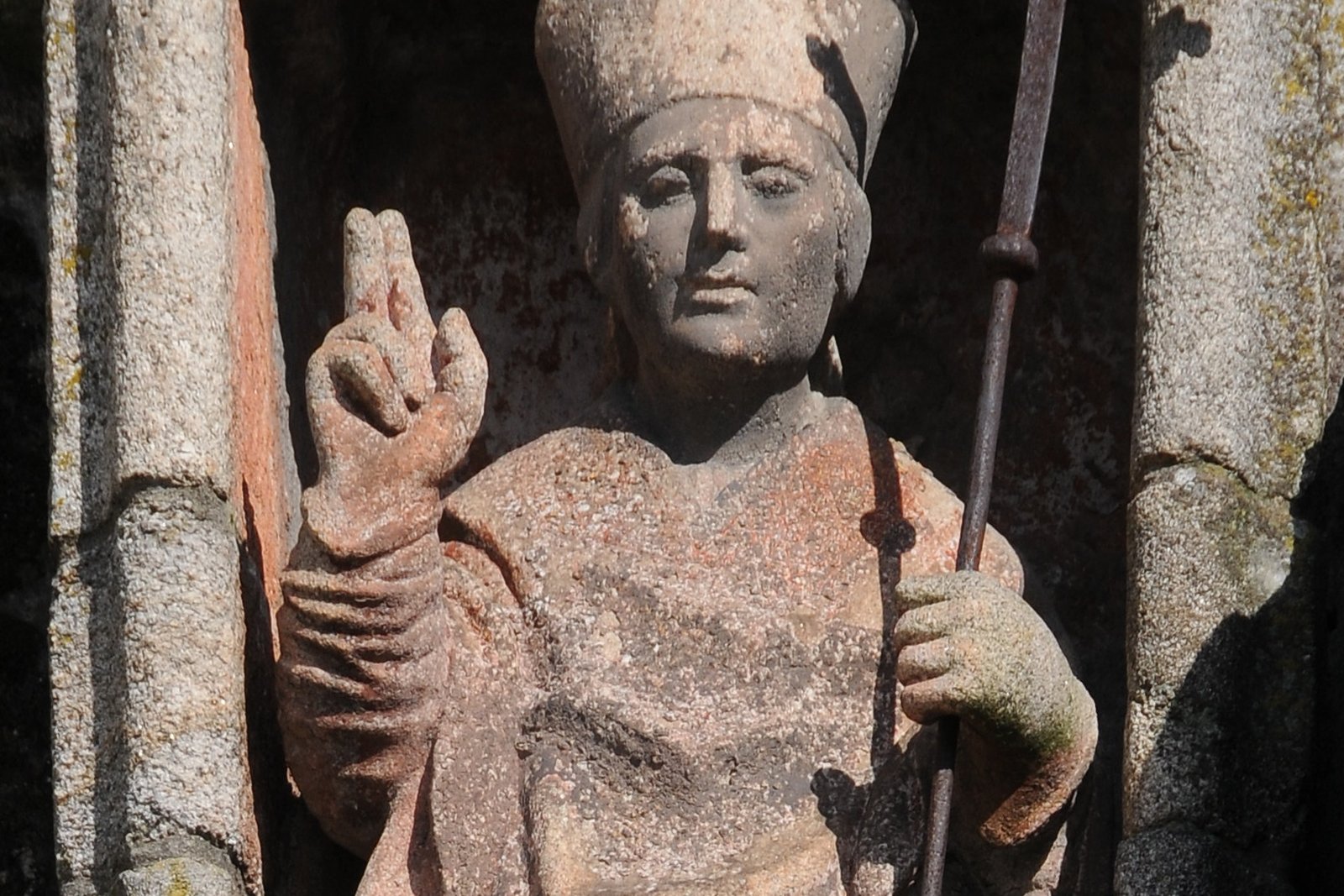
Statue of Saint Fructuosus of Braga, Braga, Portugal — used under CC BY-SA 3.0, photograph by Joseolgon.
His first major foundation was the monastery of Compludo, established with resources from his own inheritance, and it set a pattern that continued for the rest of his life: Fructuosus kept founding new monasteries, for both men and women, across the northwestern Iberian Peninsula, drawing recruits from a wide range of backgrounds and building what became one of the more extensive networks of monastic communities anywhere in Visigothic Spain.
Fleeing his own popularity
One of the more unusual, well-documented details in Fructuosus's biography is his repeated retreat from his own success. The Vita Fructuosi describes him founding a monastery, attracting more recruits than he had anticipated or particularly wanted — his own preference ran toward smaller, more contemplative communities rather than large, growing institutions — and then moving on to found a new house in an even more remote or difficult location, seeking the kind of isolation that would let him return to a simpler monastic life before the pattern repeated itself again. It's a detail that reads almost as a running joke in the source material, but it also reflects something genuinely characteristic of Fructuosus: a preference for personal austerity that persisted even as his broader institutional influence kept expanding around him whether he wanted it to or not.
This pattern eventually took him to some of the more remote parts of northwestern Iberia, including sites in what would become Galicia, where his foundations helped establish monasticism as a lasting feature of the regional religious landscape well beyond his own lifetime.
Rules that shaped Iberian monastic life
Fructuosus's most lasting institutional legacy is textual rather than architectural: he is credited with writing at least two monastic rules, the longer Regula Monachorum and the shorter Regula Communis, governing communal life in his foundations in real practical detail — covering prayer schedules, the handling of property, discipline, and the relationships between different monastic communities operating under a shared network. These rules are significant historical sources today precisely because they're so specific and practical, giving historians a genuinely detailed picture of how early medieval Iberian monastic life actually functioned day to day, in a period for which comparably detailed sources are relatively rare. The Regula Communis in particular addressed a distinctive feature of some Iberian monasticism of the period: whole families, including married couples, sometimes entering monastic life together, a practice the rule attempted to regulate rather than simply forbid outright.
Fructuosus's rules circulated alongside other influential monastic legislation of the period and were later incorporated, alongside other Iberian monastic rules, into broader compilations that helped preserve them for later medieval readers even after Visigothic Spain itself fell to the Umayyad conquest in the early eighth century.
A network spanning two later kingdoms
The monastic network Fructuosus built stretched across territory that would, centuries later, be divided between Spain and Portugal, and his foundations in Galicia and the region around Braga formed one of the most substantial and organized clusters of religious houses anywhere in Visigothic Iberia. This geographic spread meant Fructuosus's influence reached communities in genuinely remote, rural areas that more centrally located reformers rarely touched directly, giving his monastic movement a real presence in exactly the kind of frontier territory where sustained Christian institutional life was hardest to establish and maintain. Later medieval Portuguese and Galician religious tradition continued to credit Fructuosus specifically as a founding figure of regional monastic identity, a reputation that outlasted the Visigothic kingdom itself by many centuries.
From monk to archbishop
Despite his consistent preference for withdrawal and simplicity, Fructuosus was eventually drawn into formal Church leadership: he became bishop of Dumium and later archbishop of Braga, in what is now northern Portugal, positions that placed him at the center of Visigothic ecclesiastical governance in the region during the final years of his life. He held these roles alongside his ongoing monastic commitments rather than abandoning one for the other, continuing to support and oversee his network of monastic foundations even as a bishop.
Fructuosus died in 665. His feast is kept on April 16. He remains especially venerated in northern Portugal and Galicia, the regions most shaped by his decades of monastic foundation, and his written rules continue to be studied by historians as one of the clearest surviving windows into the practical realities of religious life in Visigothic Spain — a body of work that outlasted the kingdom itself by many centuries.
Trivia
Who was Saint Fructuosus of Braga?
Why did Fructuosus give away his inheritance?
What did Fructuosus write?
Why did Fructuosus keep moving to more remote locations?
When is Saint Fructuosus's feast day?
You May Also Like
Related Reading