Saint Gregory Thaumaturgus

A promising student redirected toward theology
Gregory was born around 213 in Neocaesarea, in the Roman province of Pontus in northern Asia Minor (in what is now north-central Turkey), into a prosperous pagan family, and was originally trained for a career in law, with rhetoric and legal studies forming the core of his early education — a conventional path for a young man of his social standing in the Roman world of the period. His path shifted decisively when he traveled to Caesarea in Palestine, reportedly initially for other reasons, and came into contact with Origen, already established as one of the most significant and prolific Christian theologians of the early Church, running an influential school there.
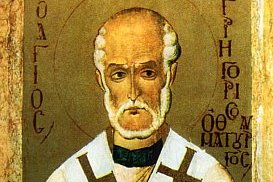
Unknown iconographer, icon of Saint Gregory Thaumaturgus, 14th century — public domain.
Gregory studied under Origen for several years, and the experience reshaped his intended career entirely — he abandoned his legal studies in favor of theological and philosophical formation under one of the era's most demanding teachers. Before leaving Caesarea, Gregory composed an oration of thanks to Origen, praising both the content and the method of his teacher's instruction; that oration survives today and remains one of the most valuable firsthand sources historians have for understanding how Origen actually taught, offering a genuinely detailed picture of his pedagogical approach from the perspective of a grateful and clearly gifted former student.
A bishop for a mostly pagan city
Gregory returned to his native Neocaesarea and was consecrated bishop there around 240, taking charge of a city and surrounding region that was, by essentially all accounts, still overwhelmingly pagan at the time of his appointment — tradition holds that only seventeen Christians could be counted in the entire city when Gregory began his episcopate. Whatever the precise accuracy of that specific number, independent early sources consistently describe Neocaesarea and its surrounding region undergoing a genuinely dramatic transformation toward Christianity during the roughly three decades of Gregory's episcopal ministry there.
The primary account of how this transformation happened comes from Gregory of Nyssa, writing a biography of his namesake roughly a century after Gregory Thaumaturgus's own death, drawing on both local tradition and, likely, some earlier written sources no longer independently available. That biography credits Gregory with a substantial body of reported miracles — healings, and other dramatic interventions attributed to his ministry — vivid and specific enough, and referenced by other independent early Christian writers as well, that the tradition of Gregory's miraculous reputation is treated by historians as considerably more than later invention, even while individual episodes, recorded a century after the fact, resist precise historical verification in the way a contemporary eyewitness account might allow.
The wonder-worker's nickname
It's this substantial and early body of miracle tradition that earned Gregory his lasting title, Thaumaturgus — a Greek term meaning wonder-worker or miracle-worker — distinguishing him among the many early Christian figures who shared the increasingly common name Gregory. The nickname reflects a genuine and unusually strong ancient reputation rather than a later medieval embellishment; Gregory of Nyssa's biography, written within living historical memory of people who might still have had access to reliable local tradition about Gregory Thaumaturgus's actual ministry, is a considerably earlier and more historically grounded source than the kind of centuries-later hagiography that produced miracle traditions for many other early saints.
Gregory of Nyssa's account also credits Gregory Thaumaturgus with practical pastoral innovation, including introducing new liturgical practices intended to help ease the transition of pagan converts into Christian worship — a detail that, whatever its precise historical accuracy, reflects the broader, more sober historical reality that Gregory's episcopate did see a genuine, significant, and lasting shift in the religious composition of Neocaesarea and its surrounding region during the third century, a period when Christianity in most of the Roman world was still a minority faith facing real social and legal pressure.
A near-total reversal, and a lasting feast
By tradition, when Gregory died around 270, the religious composition of Neocaesarea had reversed almost completely from what it had been at the start of his episcopate — the same tradition that counted seventeen Christians at his arrival holding that only seventeen pagans remained by the time of his death. Whatever precision one grants that specific figure, the underlying claim of a genuinely dramatic, sustained Christian growth across Gregory's three decades as bishop is well supported by the consistency of independent early sources describing the transformation.
His feast is kept on November 17. Gregory remains highly venerated, particularly in the Eastern Christian tradition, and is invoked in some devotional traditions specifically as a patron for desperate or seemingly impossible situations — a fitting patronage for a bishop remembered, across some of the earliest and most historically grounded miracle traditions to survive from the ancient Church, for turning an overwhelmingly pagan frontier city into an overwhelmingly Christian one within a single working lifetime.
Trivia
Who was Saint Gregory Thaumaturgus?
What does the nickname 'Thaumaturgus' mean?
What was Gregory's connection to Origen?
How thoroughly is the story of Neocaesarea's conversion documented?
When is Saint Gregory Thaumaturgus's feast day?
You May Also Like
Related Reading