Saint Guthlac of Crowland

Nine years as a warrior
Guthlac was born in 674 into a noble Mercian family, at a time when the Anglo-Saxon kingdoms of Britain were still frequently at war with one another and with the native Britons along their western borders. As a young man, he took up the life expected of someone of his class and circumstances: he led a warband, raiding across contested borderlands for roughly nine years, a period his near-contemporary biographer Felix describes in some detail as genuine, sustained warfare rather than youthful posturing.
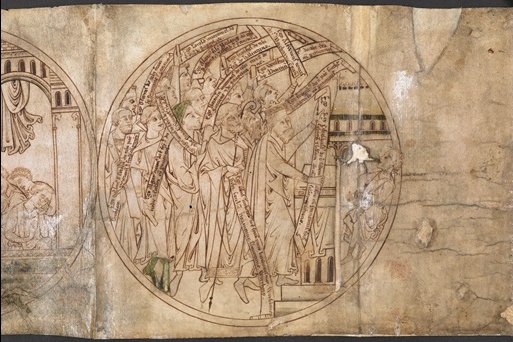
The Guthlac Roll, roundel depicting Saint Guthlac, c. 1210, illuminated parchment — public domain.
What makes Guthlac's story unusual, and what his biography treats as the pivotal turn of his life, is what happened after those nine years. According to Felix, writing within a couple of decades of Guthlac's death and likely drawing on testimony from people who had known him, Guthlac underwent a real change of conviction — reflecting, the account says, on the deaths of earlier kings and warriors he had known or heard of, and concluding that a life spent raiding could not be the purpose he was meant for. He gave up his warband and entered religious life at the monastery of Repton, submitting to monastic discipline after a decade spent as a fighting man — a transition Felix presents as difficult and genuine rather than an easy or obvious step.
Choosing a haunted marsh
Monastic life at Repton wasn't, in the end, where Guthlac's story settled. After a period there, he sought a more solitary path, and chose to withdraw into the Lincolnshire Fens — a genuinely difficult, waterlogged wilderness landscape that most Anglo-Saxon settlement of the period actively avoided, consisting of marsh, reed beds, and scattered low islands barely above the waterline. He settled specifically on a burial mound at a place called Crowland, a site local tradition already held to be inhabited by malevolent spirits, which Felix presents not as an incidental detail but as central to what Guthlac's hermitage actually involved.
Felix's account of Guthlac's years at Crowland reads less like a record of peaceful contemplative withdrawal and more like an ongoing campaign — demonic attacks described in vivid, almost military terms, assaults Guthlac endured and, according to the biography, eventually overcame through sustained prayer and discipline rather than any single decisive victory. It's a striking rhetorical choice on Felix's part, recasting the warrior Guthlac had been as a different kind of fighter, still engaged in real conflict but now against spiritual rather than earthly enemies — a framing device common enough in early medieval hagiography, but handled with unusual narrative vividness in Guthlac's specific case.
A near-contemporary account, unusually detailed
Felix's Life of Saint Guthlac is one of the more valuable surviving pieces of early Anglo-Saxon hagiography precisely because of how close it sits to its subject's actual lifetime — written within a generation or two of Guthlac's death in 714, drawing, by its own account, on testimony from people who had known him directly, including his sister Pega, herself later venerated as a saint. This relative closeness gives historians more confidence in at least the broad outline of Guthlac's biography than is available for many comparable early medieval hermit-saints, even while the specific demonic encounters remain, by their nature, outside what historical method can independently verify.
The text also had real literary influence beyond its immediate religious purpose — it was later adapted into Old English poetry, and Guthlac's story became one of the more widely known hermit narratives circulating in Anglo-Saxon England, contributing to a broader tradition of solitary sanctity that would continue to shape English religious life for centuries.
A sister's testimony behind the record
One detail worth drawing out specifically is Felix's stated reliance on testimony from Guthlac's sister, Pega, who is recorded as having lived nearby in her own separate hermitage and later became venerated as a saint in her own right. Her firsthand recollection, filtered through Felix's own literary and theological framing, gives the Life a genuinely personal source underneath its more formal hagiographic structure — a family member's memory of a brother's chosen isolation, rather than only the more distanced, secondhand accounts typical of saints' lives compiled from general community tradition long after the fact. That detail is part of why historians treat Felix's account, whatever its supernatural content, as resting on an unusually direct chain of testimony for the period.
An abbey grown from a hermitage
After Guthlac's death in 714, his hermitage site at Crowland became a place of pilgrimage, and eventually the location of Crowland Abbey, a substantial medieval Benedictine monastery built directly on the ground where he had lived alone decades earlier. The abbey grew into an important regional religious and economic center in the following centuries, its history recorded in remarkable visual detail in the Guthlac Roll, an illuminated parchment created around 1210 depicting scenes from Guthlac's life in a sequence of roundels — one of the more visually striking pieces of English medieval art connected to any Anglo-Saxon saint, and a key source for how his story was remembered and retold generations after Felix's original account.
Guthlac's feast is kept on April 11. Substantial ruins of Crowland Abbey's later medieval buildings still stand in Lincolnshire today, a direct physical link to the site a former warrior chose, more than thirteen hundred years ago, as the place to spend the rest of his life fighting battles no one else could see.
Trivia
Who was Saint Guthlac of Crowland?
Why did Guthlac give up his life as a warrior?
What kind of place was Crowland when Guthlac settled there?
What is the Guthlac Roll?
When is Saint Guthlac's feast day?
You May Also Like
Related Reading