Saint Guy of Anderlecht

A childhood defined by giving things away
Guy was born around 950 in the Brabant region, in what is now Belgium, to parents remembered chiefly for their own piety rather than for any wealth or status they passed on to their son. From a young age, according to the accounts collected in his later cult, Guy showed an instinct that went well beyond ordinary childhood generosity — he reportedly gave away food, clothing, and whatever small possessions came his way to anyone poorer than himself, and spent much of his free time visiting the sick and elderly of his town rather than pursuing anything resembling his own advancement. This pattern, more than any single dramatic episode, is what defines the surviving portrait of Guy as a young man: someone for whom poverty wasn't a circumstance to escape but very nearly a discipline he'd chosen for himself before anyone formally asked him to.
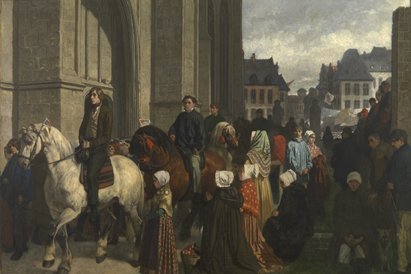
Charles de Groux, "De bedevaart van Sint-Guido te Anderlecht" (The Pilgrimage of Saint Guido at Anderlecht), 1856 — public domain.
That disposition eventually led him to a position as sacristan — the layperson responsible for the practical care of a church's sacred vessels, vestments, and building — at the church of Laeken, near Brussels. It was a modest, unglamorous role, involving none of the status or income of the clergy he served, and by every account it suited Guy perfectly: steady, useful work that let him remain close to the life of the church without requiring him to seek out anything more.
A single, regretted attempt at self-improvement
The one real deviation from Guy's pattern of chosen poverty came when a merchant approached him with an investment opportunity — a trading venture that, if successful, promised to multiply Guy's small savings considerably. Guy agreed, and tradition treats this decision not as a reasonable, modest financial choice but as a genuine lapse, a moment where the pull of ordinary self-interest briefly overcame the deliberate simplicity he'd otherwise maintained his whole life. Whether or not Guy himself framed it in such severe terms at the time, later accounts of his life certainly do, treating the episode as instructive: even a fundamentally holy man could be tempted, briefly, by the promise of security.
The lesson, in the story as it's come down, arrived swiftly and completely. The ship carrying the merchant's goods was lost — historical accounts differ on the exact circumstances, but the result was the same either way — and Guy's investment disappeared along with it. He is said to have taken the loss not with anger but with something closer to relief, as confirmation that the life he'd already been living, dependent on nothing beyond what each day actually required, had been the right one all along.
Seven years on pilgrimage, ending in Jerusalem
Having lost both his savings and, in short order, his position as sacristan, Guy set out on an extended pilgrimage that would occupy roughly the last seven years of his life, traveling from shrine to shrine across a route that eventually carried him all the way to Jerusalem — an extraordinarily demanding journey for a man of modest means and, by this point, advancing age, undertaken on foot for most of its length. Medieval pilgrimage of this scale was neither safe nor comfortable under the best circumstances, and Guy's version of it, sustained on essentially nothing, reflected the same total dependence on providence that had characterized his entire adult life.
By around 1012, exhausted and seriously ill, Guy made his way back toward Anderlecht, near where he had spent his working life, and died shortly after arriving at the town's public hospital — a facility, typical of the period, intended for travelers and the destitute rather than a place of any particular comfort. He died, in other words, exactly as poor as he had lived, with nothing accumulated and nothing to leave behind beyond the reputation his neighbors already held for him.
A grave that started drawing horses
What happened after Guy's death is where his story takes an unexpected turn. His grave near Anderlecht quickly became a local site of pilgrimage as reports of miracles attributed to his intercession began to circulate, and among the details that stuck in local memory was an account of a horse stopping unbidden at his grave — a small, strange episode that nonetheless became the seed of a devotional association between Guy and working animals that would persist for the better part of a thousand years. Whatever actually happened, the connection took hold strongly enough that Guy became recognized as a patron of farmers, laborers, stable hands, and specifically of horses and other work animals — an unusually concrete and practical patronage, tied directly to the agricultural economy of the region that had produced him.
That patronage found its most visible expression in an annual pilgrimage that grew up around his shrine: cab drivers and farmers from across Brabant would lead their horses to Anderlecht each year to be blessed, a tradition substantial enough to survive for centuries before the disruption of the First World War in 1914 brought the organized procession to an end. The collegiate church of Saints Peter and Guido in Anderlecht, where his relics are kept, remains a pilgrimage destination today, and his feast, kept on September 12, is still observed with particular attention in the town most closely tied to his memory.
A patron shaped by what he refused to hold onto
Guy's cult offers an unusually clean illustration of a pattern common across medieval sainthood but rarely stated this plainly: sanctity recognized not through visible achievement, dramatic martyrdom, or institutional legacy, but through a lifelong, consistent refusal to accumulate anything for himself, sustained even through a genuine and understandable temptation to do otherwise. He built no monastery, wrote no surviving text, and held no position of any real authority — and it's precisely that absence of worldly accomplishment that later generations of ordinary laborers and farmers, people whose own lives similarly depended on forces well beyond their control, apparently found worth honoring at his grave for the better part of a millennium.
Trivia
Who was Saint Guy of Anderlecht?
Why did Guy lose his savings?
Why is Saint Guy considered a patron of farmers and horses?
What was the Anderlecht horse pilgrimage?
When is Saint Guy of Anderlecht's feast day?
You May Also Like

Related Reading