Saint Roch — The Pilgrim Who Healed the Plague-Stricken

From inheritance to the open road
According to tradition, Roch was born around 1295 in Montpellier, then a prosperous city in the south of France, the son of the region's governor. He lost both parents while still young and, rather than settle into the comfortable life his birth guaranteed him, gave away his inheritance to the poor and set out on foot as a pilgrim toward Rome — trading a noble household for a pilgrim's cloak and staff.
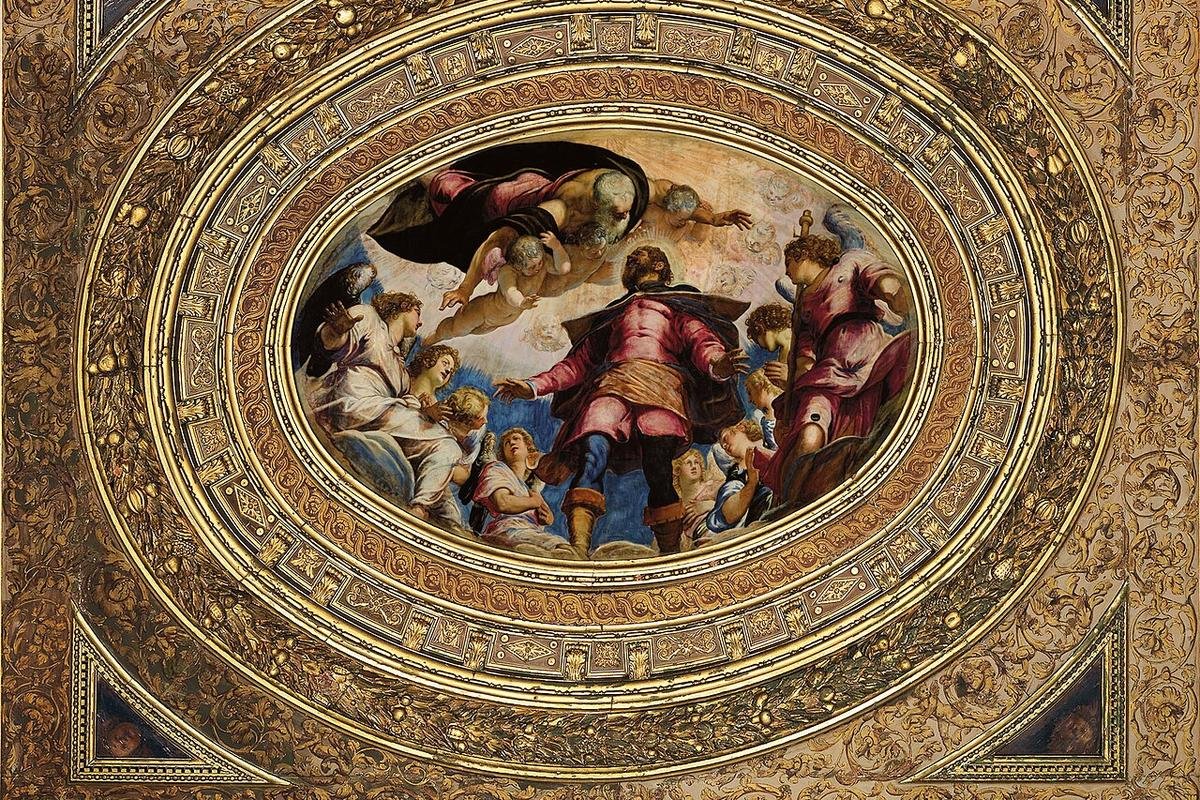
Jacopo Tintoretto, "Glorification of Saint Roch," 1564, Church of San Rocco, Venice — public domain.
It's worth naming, honestly, how much of Roch's story survives only through later legend rather than contemporary documentation. No writings from Roch's own lifetime describe him in detail, and the earliest accounts of his life were compiled well after his death. What follows should be understood as devotional tradition — deeply held, widely venerated for centuries, but not the same category of certainty as an event recorded by an eyewitness.
A pilgrim who stayed to nurse the dying
Tradition holds that as Roch traveled through Italy, he encountered towns devastated by plague — quite possibly connected to the Black Death that swept across Europe starting in 1347, though the exact chronology is debated among historians of his legend. Rather than pass through and continue his pilgrimage, he stayed, tending to the sick in hospital wards that healthier travelers avoided entirely. Accounts describe him healing some of the afflicted simply by praying over them and marking them with the sign of the cross — the kind of detail that belongs squarely to pious legend rather than verified history, but one that shaped how his devotion developed for centuries afterward.
The dog that saved him
Eventually, the disease Roch had spent years treating in others caught up with him. Rather than risk infecting the community around him, he is said to have withdrawn alone into a forest to die. It's here that the most famous detail of his legend takes shape: a nobleman's hunting dog discovered him, brought him bread each day, and licked the plague sore on his leg — nursing him, against all odds, back to health. The nobleman who owned the dog, so the story goes, eventually followed it into the forest, found Roch, and became his devoted companion and follower afterward.
That single image — a dying pilgrim saved by a dog's daily faithfulness — became the defining scene of Roch's iconography. Nearly every painting or statue of Saint Roch shows him as a pilgrim in traveling clothes, one hand lifting his robe to reveal a wound on his thigh, a dog at his feet, often with bread in its mouth. The wound isn't decorative detail; it's the visual proof that Roch suffered the very disease he devoted his life to treating in others, rather than ministering to the sick from behind any kind of safe distance.
Mistaken for a spy, dying unrecognized
Roch's story doesn't end with his recovery in the forest. Tradition holds that once healed, he continued on toward his home region, but by then years had passed and he had changed enough — worn down by travel, disease, and poverty — that when he arrived back near Montpellier, local authorities took him for a spy and threw him into prison rather than recognizing him as the governor's own son. According to the legend, he never identified himself or asked for special treatment, choosing instead to endure five years of unjust imprisonment in silence, and died in that cell still unrecognized. Only after his death, the story goes, was a birthmark in the shape of a cross found on his chest, along with documents confirming who he truly was — the same nobleman who had spent his fortune walking penniless among plague victims, dying anonymously in a prison built to hold criminals. It's a detail later legend leaned on heavily, reinforcing the same theme that runs through the whole of Roch's story: a man of high birth who repeatedly chose to be counted among the poorest and most suspect people around him rather than reclaim any privilege his birth had given him.
Venice's devotion, and a body without a settled resting place
Roch's cult found an especially enthusiastic home in Venice, a city that knew plague intimately across its long maritime history. In 1485, Venetian merchants claimed to have brought Roch's relics to the city, and the confraternity built around his cult, the Scuola Grande di San Rocco, went on to commission one of the great decorative projects of Venetian painting — an entire building's ceilings and walls filled with scenes from Roch's life and from Scripture, largely the work of Tintoretto, whose depiction of Roch's own glorification illustrates this article. Several other European cities have made competing claims to hold genuine relics of Roch over the centuries, a common pattern for medieval saints whose remains were prized enough that multiple communities each insisted on possessing the authentic body — a reminder that even a saint's physical resting place can carry its own tangled, disputed history, quite apart from the question of his sanctity itself.
A patron born directly out of his own story
Because his entire legend circles around contagion, suffering, and recovery, Roch became one of the most widely invoked saints against plague across late medieval and early modern Europe — a devotion that spread rapidly as epidemic disease remained a recurring terror for centuries. Towns commissioned his image and dedicated churches to him specifically hoping for protection during outbreaks; his intercession was sought the way a community today might seek any available defense against a disease with no reliable cure.
His patronages have grown naturally from there: alongside plague and epidemic disease, he's invoked for the sick generally, for surgeons who treat the afflicted, and — thanks to the dog whose loyalty saved his life — for dogs and their owners. His feast day, August 16, remains a major celebration in parts of Italy and in Italian-American and French-American Catholic communities, often marked with processions carrying his statue through the streets his devotion was meant to protect.
Trivia
Who was Saint Roch and when did he live?
Why is Saint Roch shown with a dog?
Why does Saint Roch point to a sore on his leg in most images?
What is Saint Roch the patron saint of?
When is Saint Roch's feast day?
You May Also Like

Related Reading