Saint Illtud

A soldier's conversion, by tradition
Illtud's early life is known almost entirely through a Life written well after his death, which means the specific biographical details — his birth around 450, a family background sometimes connected to Brittany, and, most strikingly, a claimed early career as a soldier — should be read as later tradition rather than documented contemporary fact. According to that tradition, Illtud served for a time as a warrior, possibly attached to the court of a British king, before undergoing a decisive conversion experience that led him to abandon military life for monastic discipline. It's a conversion narrative with obvious echoes of similar stories told about other early Christian figures, which is part of why historians treat the specific soldier detail cautiously — but the broader claim that Illtud came to monastic life as an adult, from outside it, rather than being raised within it from childhood, is treated as plausible.
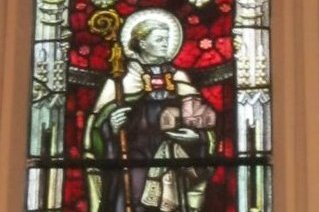
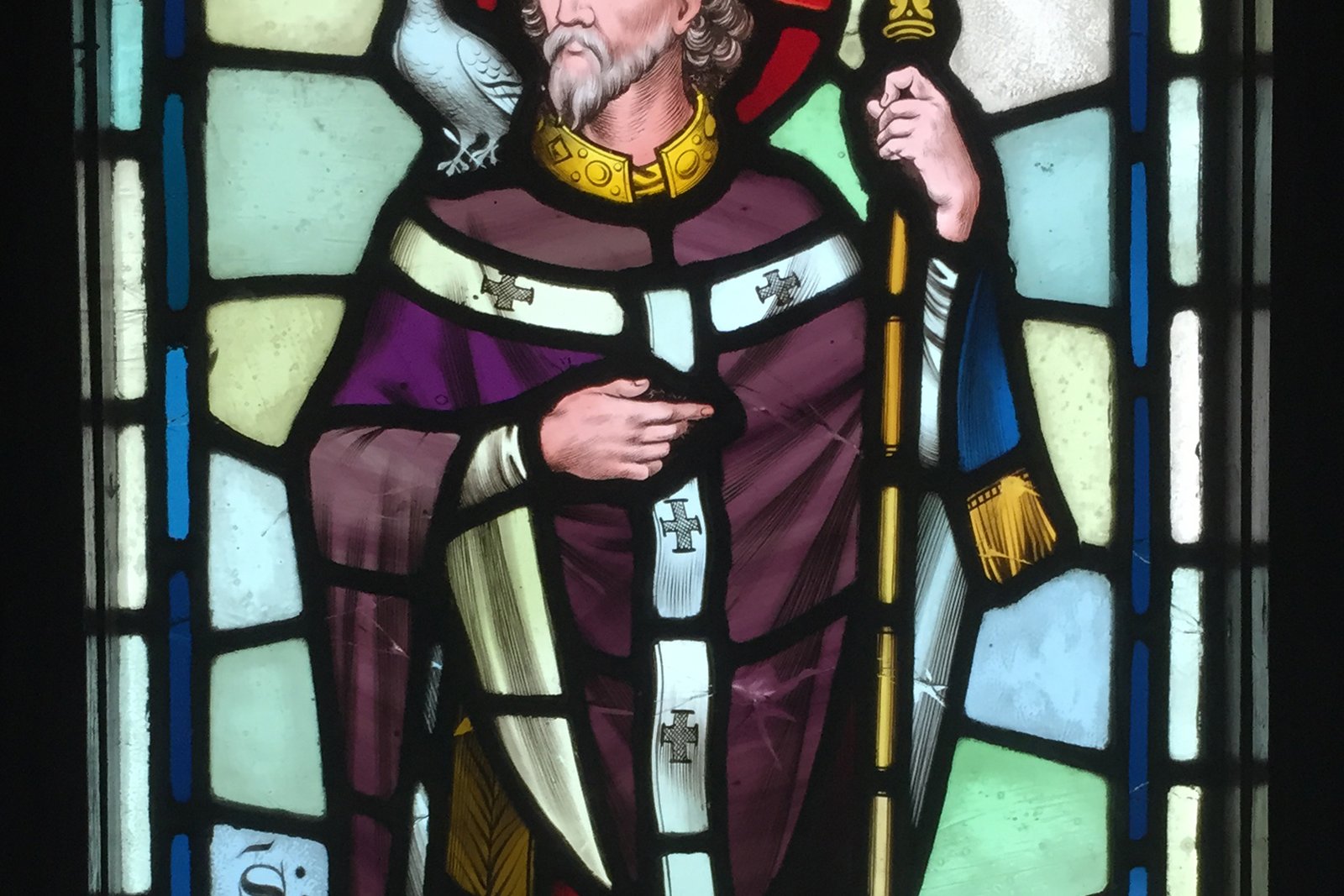
Stained glass depiction of Saint Illtud, Holy Trinity Church, Abergavenny — used under CC BY-SA 3.0, photograph by Gwenddwr.
Whatever the precise path that led him there, Illtud settled in the Vale of Glamorgan in South Wales and founded a monastery at a site that became known as Llanilltud Fawr — "Illtud's great church" — the settlement now called Llantwit Major. It grew, over the following years, into far more than a single monastic house.
A school that trained a generation
What made Illtud's foundation genuinely significant, and what secured his lasting reputation, was its function as a center of education reaching well beyond basic monastic formation. Post-Roman Britain, by the later fifth century, had lost most of the formal educational infrastructure that Roman administration had supported, and centers capable of offering serious instruction — in Scripture and theology, certainly, but also more broadly in reading, writing, and classical learning — were becoming genuinely scarce. Illtud's school at Llantwit Major is remembered as one of the places that kept this broader tradition of learning alive, training students who went on to shape Christian life across Wales, Cornwall, Ireland, and Brittany.
The best-documented of these students is Saint Samson of Dol, whose own relatively early and reliable Life confirms his training under Illtud before Samson went on to found the influential bishopric of Dol in Brittany — a connection that gives Illtud's teaching reputation more solid grounding than most similar claims from this period, since it comes via a source closer to events rather than purely later tradition. Other traditions associate additional early Welsh saints with Illtud's school, including, in some accounts, David of Wales himself, though that particular connection rests on later material and is treated with more caution by historians than the Samson connection.
Legendary elements worth naming clearly
As with most early Welsh saints, later layers of legend accumulated around Illtud that go well beyond what can be treated as documented history. Various miracle stories attach to him in the later Life — including tales of miraculous provision during famine and encounters with kings that resolve in Illtud's favor through divine intervention — that follow familiar patterns of medieval hagiography rather than offering independently verifiable historical detail. None of this is unusual for a saint of this period and region; it simply means that what can be said with real confidence about Illtud is comparatively modest: that he founded an important monastic school in South Wales, that the school had a genuine and lasting reputation for learning, and that at least one of its students, Samson, went on to a well-documented and historically significant career of his own.
A school within a wider network of Celtic learning
Llantwit Major didn't operate in isolation — it existed within a broader web of early Welsh, Irish, and Breton monastic schools that maintained contact with one another, exchanging students, texts, and monastic practices across the Irish Sea and the English Channel during a period when secular political authority across the former Roman provinces of Britain and Gaul was fragmented and unstable. Illtud's school is generally counted among the more significant nodes in this network, alongside other early centers of Celtic Christian learning, precisely because of the number and later prominence of students it's credited with training. That regional network of monastic schools, of which Illtud's foundation was one important part, helped keep a shared Christian intellectual culture alive across a genuinely fractured political landscape in the centuries following the end of Roman administration in Britain.
A name that outlasted the man
Illtud died around 535, according to the traditional dating, though as with much of his biography this date rests more on later reckoning than firm contemporary record. His feast is kept on November 6. The town of Llantwit Major, which grew up around his original foundation, still carries his name in its Welsh form today, a rare case of an early medieval monastic founder's memory being preserved directly in ongoing place-name usage rather than surviving only in ecclesiastical calendars and church dedications. Among the network of early Welsh monastic founders whose schools shaped Christian learning across the wider Celtic world, Illtud's specific and lasting contribution was less about his own recorded deeds than about the students he trained and sent onward — a teacher's legacy, measured in the careers of the people he taught rather than primarily in his own.
Trivia
Who was Saint Illtud?
What was Illtud's monastic school at Llantwit Major known for?
Which saints are said to have studied under Illtud?
Was Illtud really a soldier before becoming a monk?
When is Saint Illtud's feast day?
You May Also Like
Related Reading