Saint David of Wales

A thinly documented founder
David was born, according to tradition, around the year 500 in what is now Pembrokeshire in southwest Wales, a period and region for which reliable contemporary written sources are extremely scarce. Almost everything commonly said about his life — his royal ancestry, the specific circumstances of his birth, his education, his travels — comes from a Life of Saint David written by a cleric named Rhygyfarch roughly five hundred years after David's actual death, a gap that makes careful historians treat most of the specific narrative details as pious tradition rather than documented biography. What can be said with more confidence is that David was a real historical figure, a bishop and monastic founder whose community and cult were already well established in Wales by the time later medieval sources began recording fuller accounts of his life.
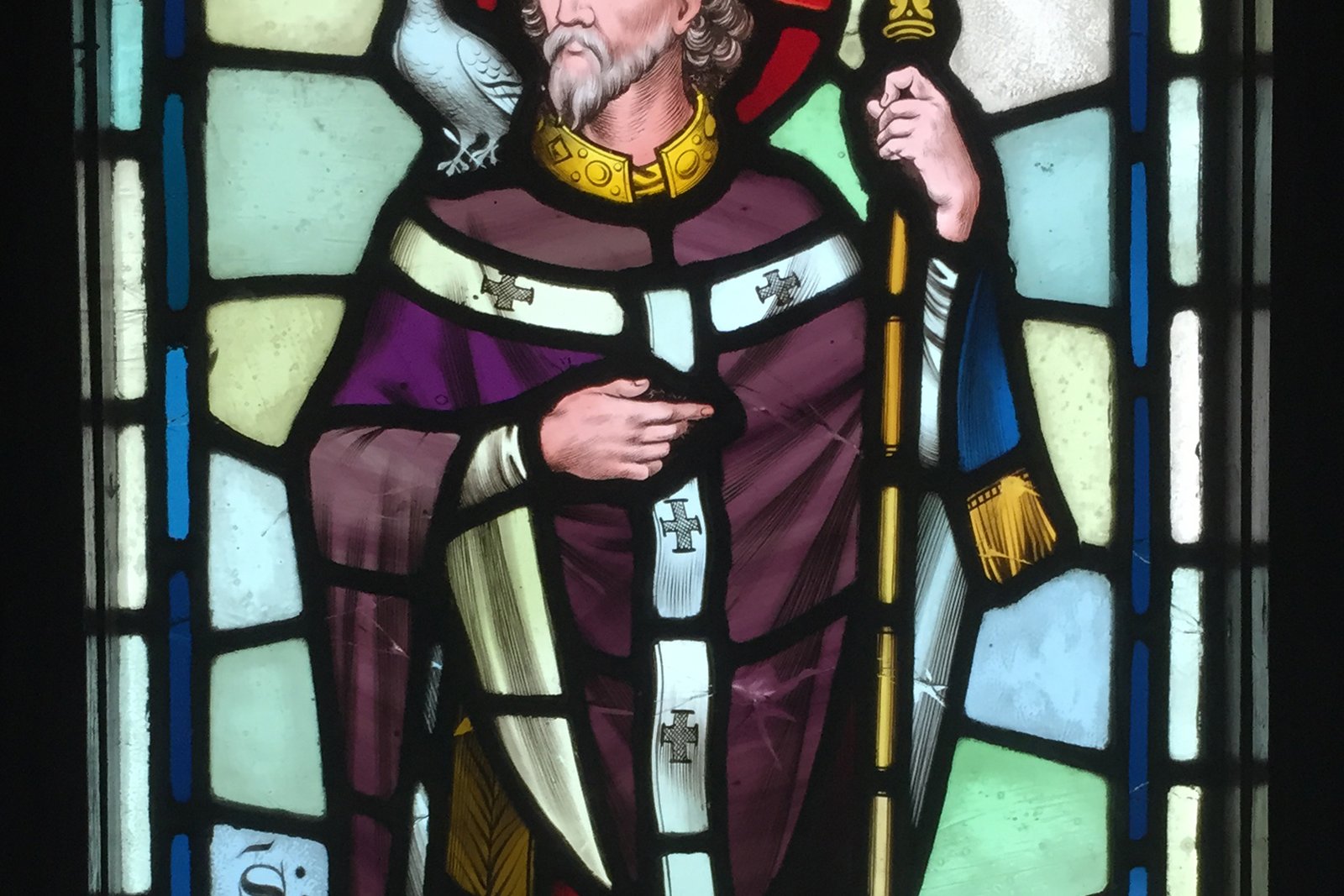
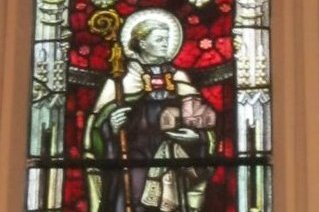
Stained glass panel of Saint David, Castell Coch, Wales — used under CC BY-SA 4.0.
David founded a monastery at the far southwestern tip of Wales, at the site that is now the small city of St Davids — Britain's smallest city, built up entirely around the cathedral that stands on the site of David's original foundation. The location wasn't a comfortable choice; it sits on an exposed, windswept coastal spot, consistent with the broader pattern of early Celtic monastic founders often choosing physically demanding sites as part of the ascetic discipline they built into their communities.
An unusually strict monastic rule
Where the sources are more consistent, even across later retellings, is on the character of David's monastic discipline, which tradition remembers as exceptionally strict. His monks reportedly pulled their own ploughs rather than using draft animals, subsisted on bread, vegetables, salt, and water rather than meat or beer, and spent extended periods each day in prayer, reading, and manual labor rather than idle time. David himself is said to have drunk only water — the likely origin of his traditional epithet, "Dewi Ddyfrwr," David the Waterman — a detail striking enough, and consistent enough across independent strands of the later tradition, that most scholars treat the broad picture of an unusually austere community as reflecting something genuinely remembered about David's foundation, even if individual anecdotes built around it are embellished.
This asceticism placed David within a wider current of early British and Irish monasticism that tended toward more physically demanding discipline than continental European monasticism of the same period — a pattern also visible in the traditions surrounding contemporaries like Saint Illtud, under whom some traditions place David's early education, though the specific claim of that teacher-student relationship rests on later sources rather than firm contemporary evidence.
The hill that rose beneath him
The single most famous episode attached to David's legend is his appearance at a church synod at Llanddewi Brefi, called to address the Pelagian heresy — a teaching, associated with the British theologian Pelagius, that downplayed the necessity of divine grace for salvation, which the Church had already formally condemned but which apparently still required active preaching against in Wales. According to the later tradition, the crowd gathered to hear David was too large for him to be seen or heard properly, so the ground beneath his feet rose up into a small hill, letting everyone present see and hear him clearly, with a white dove — since become one of David's traditional emblems — settling on his shoulder as he spoke.
It's worth being plain about this story's status: it appears only in Rhygyfarch's Life, written centuries after the events it describes, and virtually no historian treats the literal miracle as documented fact. What the story does reflect, reliably enough, is that David had a real and lasting reputation as an effective, persuasive preacher against Pelagianism specifically — the doctrinal content of the legend, if not its miraculous staging, likely does reflect something genuine about David's actual theological priorities and preaching career.
"Do the little things"
David's death, traditionally dated to March 1, is remembered through what may be the most quoted line attributed to any Welsh saint: his final words to his monks, urging them to "be joyful, and keep your faith and your creed, and do the little things that you have seen me do and heard about." The phrase survives in Welsh as gwnewch y pethau bychain — "do the little things" — and has taken on a life well beyond its original monastic context, quoted today as a kind of informal Welsh national motto of quiet, sustained faithfulness in ordinary daily tasks rather than dramatic gestures.
David was never formally canonized in the modern sense — his veneration predates the centralized canonization process — but he was recognized as Wales's patron saint by the medieval Church, and Pope Callixtus II reportedly declared in the twelfth century that two pilgrimages to St Davids were equivalent to one to Rome, a mark of how significant the shrine had become. His feast, March 1, remains Wales's national day, celebrated today with daffodils and leeks, traditional Welsh symbols, and public celebration of Welsh identity that extends well beyond the saint's own specifically religious legacy — itself a fitting outcome for a monk whose most famous words were about the value of small, faithfully repeated things.
Trivia
Who was Saint David of Wales?
What was David's monastery like?
What is the legend of the hill at Llanddewi Brefi?
What were Saint David's last words?
When is Saint David's feast day?
You May Also Like
Related Reading