Saint Samson of Dol

Trained in one of Wales's great monastic schools
Samson was born around 486 in South Wales, into a family with, according to his biography, connections on both sides to figures of some regional standing. As a boy he was sent to study at Llantwit Major, the monastic school run by Saint Illtud, one of the most important centers of Christian learning in early Wales, where a cluster of students who would themselves go on to become significant figures in the Celtic Christian world were trained together — a genuine hub of early British monastic education rather than an isolated hermitage. Under Illtud, Samson would have received training not only in monastic discipline and Scripture but in the broader classical learning that Illtud's school was known for maintaining, unusually, even as direct Roman administrative structures in Britain had already collapsed.
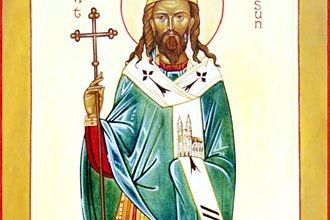
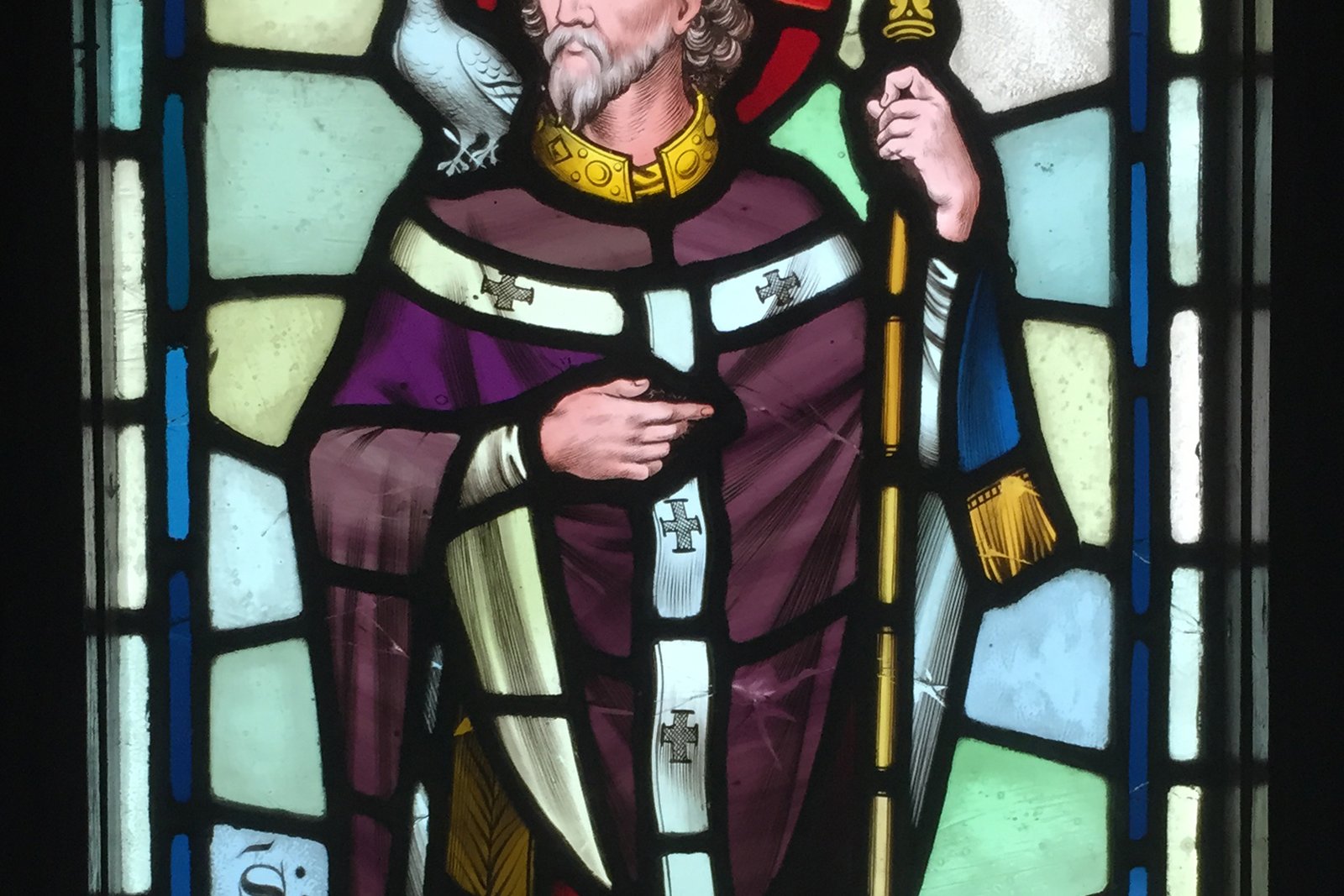
Engraving of Saint Samson of Dol, traditional devotional image — used under CC BY-SA 3.0.
After his time under Illtud, Samson was ordained deacon and then priest, and for a period lived as a hermit on Caldey Island, off the Pembrokeshire coast — a small, isolated retreat that several early Welsh monastic figures used for periods of more solitary discipline before or between other roles. He was eventually consecrated a bishop, though not tied to a fixed territorial see in the way later medieval bishops typically were — consistent with the more fluid, monastery-centered pattern of episcopal authority common in early Celtic Christianity.
An unusually early, unusually reliable Life
What sets Samson apart from most of his contemporaries in the historical record is the quality and relative age of the source describing his life. The Vita Sancti Samsonis, the earliest surviving biography of Samson, was very likely written within about a century of his death — a genuinely short gap by the standards of early medieval hagiography, where lives of comparable figures were frequently written three, four, or more centuries after their subjects died, once oral tradition had already reshaped the material considerably. That relative proximity doesn't make the Vita a modern, source-critical biography — it still includes the miracle stories and theological framing typical of the genre — but historians generally treat its core outline of Samson's career, and many of its specific incidental details, as considerably more trustworthy than what survives for most early Welsh and Breton saints.
This relative reliability is part of why Samson is often used by historians as something close to an anchor point for understanding the broader, much less documented movement of British Christians and clergy across the Channel to Brittany during this period — a genuine historical migration, driven partly by Anglo-Saxon expansion into Britain, that reshaped the religious landscape of both regions but left few other sources as detailed as Samson's Life.
Founding Dol in a new Christian frontier
Samson's move to Brittany placed him at the center of a genuinely significant historical process: the settlement and Christianization of the Armorican peninsula by British migrants, many of them fleeing the advancing Anglo-Saxon kingdoms in Britain, who brought their own Christian traditions and, in some cases, their own clergy with them. In this new frontier, Samson founded a monastery and bishopric at Dol, on the northern Breton coast, which grew into one of the most important early medieval sees in the region — significant enough that Dol's bishops later made repeated, ultimately unsuccessful claims to metropolitan status independent of the archbishopric of Tours, a dispute that ran for centuries after Samson's own lifetime and reflects how substantial a foundation he had actually built.
Samson is counted among the traditional Seven Founder Saints of Brittany, a group of missionary bishops credited with establishing Christianity's institutional structure across the region during this migration period — Brittany's rough equivalent to the founding-father figures venerated in other regions evangelized during the same broad wave of early medieval missionary activity. Samson's specific role at Dol made him, within that group, one of the more concretely documented figures rather than a name attached mainly to later legend.
A bishop without a fixed diocese, by the standards of his time
One detail that highlights how differently episcopal authority worked in this period compared to later medieval practice is that Samson's consecration as bishop did not immediately tie him to a single fixed territorial see in the way a later medieval or modern bishop would be. Early Celtic and sub-Roman British Christianity generally organized episcopal authority around monastic communities and their abbots rather than around cities and formal diocesan boundaries, a structural difference that makes comparing Samson's early career too directly to later Continental models somewhat misleading. His eventual settling at Dol, and the more conventional territorial bishopric that grew up there over subsequent generations, reflects a gradual shift toward more standard Continental patterns of Church organization taking hold in Brittany during and after his own lifetime.
A feast still kept on both sides of the Channel
Samson died around 565, having spent the final decades of his life building an institution in Brittany that would long outlast him. His feast is kept on July 28, observed both in parts of Wales, where his early training took place, and especially in Brittany, where Dol remained an important ecclesiastical center for centuries and where his cult has always been strongest. Among the early medieval saints who carried British Christianity across the Channel into what became one of the most enduringly Christian regions of France, Samson remains one of the clearest and best-attested examples the surviving record actually supports.
Trivia
Who was Saint Samson of Dol?
Why is Samson's biography considered unusually reliable?
Where did Samson train as a monk?
What did Samson do in Brittany?
When is Saint Samson's feast day?
You May Also Like
Related Reading