Saint Kinga of Poland

A Hungarian princess sent north
Kinga was born in 1224 into the Árpád dynasty, the ruling house of Hungary, one of several royal daughters in a family with extensive marriage connections across Central Europe — her aunt was Elizabeth of Hungary, later canonized in her own right, and her sister Margaret would also eventually be recognized as a saint. At around age five, Kinga was betrothed to Bolesław, a young Polish duke, as part of the political alliances typical of the period, and she moved to the Polish court to be raised alongside him well before their marriage took place in 1239, when she was about fifteen.
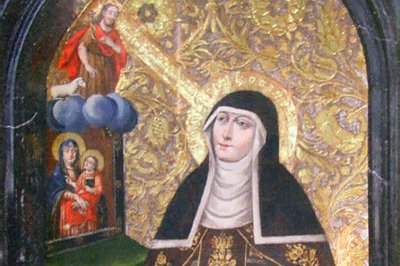
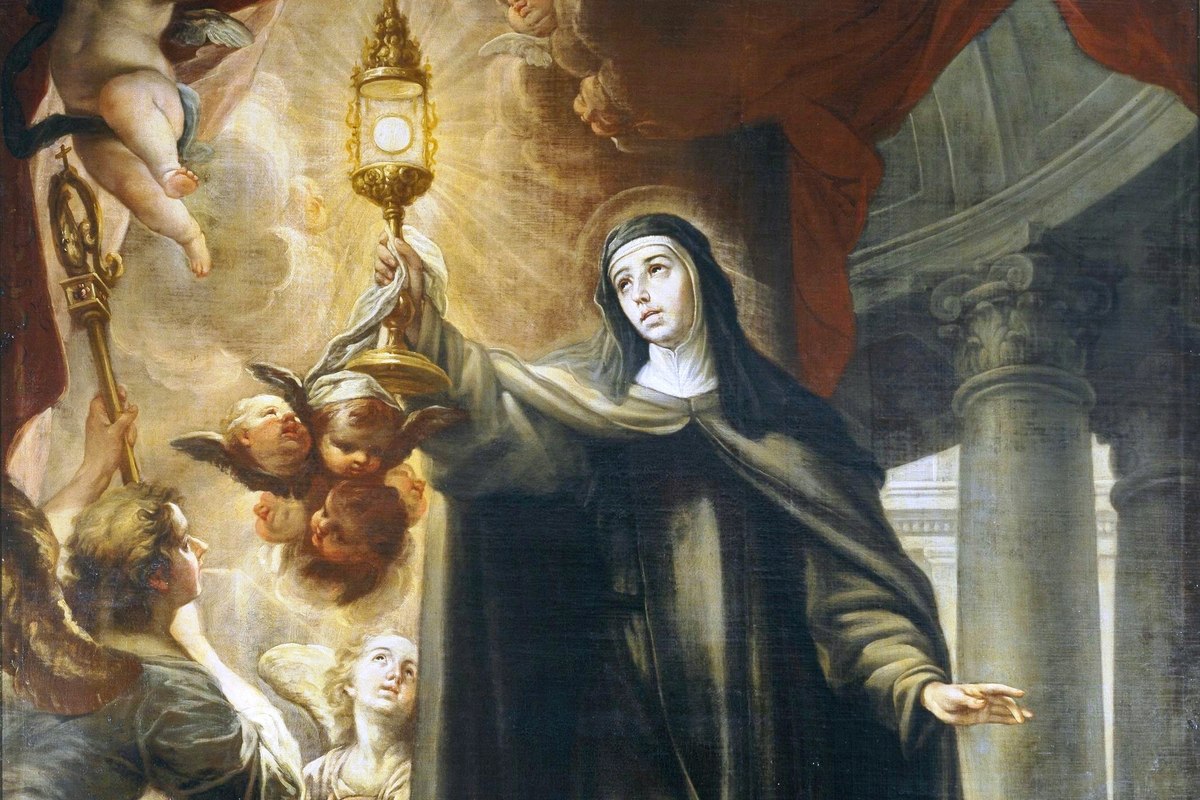
Devotional portrait of Saint Kinga of Poland, public domain reproduction.
Poland in this period was a fractured collection of duchies rather than a unified kingdom, and Bolesław eventually became Duke of Kraków and Sandomierz, ruling one of the more significant of these principalities. The marriage placed Kinga at the center of Polish political life for the following four decades, through a period that included the trauma of Mongol invasions in the 1240s, which devastated large parts of Poland and forced Kinga and Bolesław to flee to safety in Hungary at least once before returning to rebuild.
A marriage without children, by choice
One of the most striking, well-attested facts about Kinga's life is that she and Bolesław took a mutual vow of perpetual chastity within their marriage — a real arrangement documented for a small number of royal and noble couples in the medieval period, usually connected to strong personal devotion on both sides rather than any external pressure. Bolesław's own historical epithet, "the Chaste," reflects this same choice, and medieval sources treat the arrangement as consensual and lasting rather than a source of tension between them. The couple had no children as a direct result, which meant that when Bolesław died in 1279, the question of succession in Kraków passed to other branches of the Piast dynasty rather than to any heir of their own — a genuinely unusual outcome for a medieval ruling marriage, and one that speaks to how seriously both partners held to their vow.
During Bolesław's reign, Kinga was active well beyond the ceremonial role often assigned to medieval duchesses. She's credited with organizing relief efforts during famines and after the Mongol invasions, and with founding hospitals and religious houses using her own resources, including wealth she had brought with her from Hungary as part of her dowry — resources she increasingly directed toward charitable and religious purposes rather than court display as her life went on.
The legend of the salt mine
The story most associated with Kinga in popular memory today is the legend of Wieliczka: that before leaving Hungary for her marriage, Kinga threw her engagement ring down a salt mine shaft, asking God to give the gift of salt to her new homeland, and that the ring later surfaced embedded in a block of rock salt at Wieliczka, near Kraków, revealing the site of what would become one of medieval Europe's most economically important salt mines. It's a vivid, memorable story, and it's also, in its specific details, a legend rather than documented history — the earliest written versions of it appear centuries after Kinga's death, well into the development of her popular cult.
What is historically documented is that salt extraction at Wieliczka intensified significantly during the period of Kinga's marriage to Bolesław, and that Kinga herself is credited in more sober regional histories with bringing skilled Hungarian miners to help develop Polish salt production — a genuine economic contribution that likely gave rise to the more elaborate ring legend over time, rather than the legend describing an actual miraculous discovery. Wieliczka remains a working symbol of that connection today: deep within the mine, miners over the centuries carved an entire chapel dedicated to Saint Kinga out of rock salt, including salt chandeliers and relief carvings, still one of the mine's most visited features and a fittingly literal monument to a legend built on a real industry.
Convent, canonization, and a lasting Polish cult
After Bolesław's death in 1279, Kinga distributed her remaining property to the poor and to the Poor Clare convent she had already founded at Stary Sącz, then entered the convent herself and was elected its abbess — choosing, as her aunt Elizabeth of Hungary had also done after widowhood, a religious community over a return to political life. She led the convent until her own death in 1292, and it remained an important center of Franciscan women's religious life in Poland for centuries afterward.
Kinga's cause for canonization moved slowly by later standards; she was beatified in 1690 and not canonized until 1999, when Pope John Paul II — himself from the region of Poland where her cult remained strongest — presided over the ceremony. Her feast is kept on July 24. She remains a significant figure in Polish religious and cultural identity, particularly around Kraków and Stary Sącz, and at Wieliczka, where her name and legend are now inseparable from one of Poland's most visited historical sites.
Trivia
Who was Saint Kinga of Poland?
Did Kinga and her husband have children?
What is the legend connecting Kinga to Poland's salt mines?
What did Kinga do after her husband's death?
When is Saint Kinga's feast day, and where is she especially venerated?
You May Also Like

Related Reading