Saint Nino of Georgia

A refugee from persecution, not a commissioned missionary
Nino's origins, as passed down in Georgian tradition, place her in Cappadocia in the latter part of the 3rd century, the daughter of a Roman military commander named Zabulon and a mother, Sosana, said to have been a sister of the Patriarch of Jerusalem. She was raised, by these accounts, in Jerusalem itself under the guidance of an older woman who instilled in her a devotion to the Seamless Robe of Christ — the garment the Gospels describe soldiers casting lots for at the crucifixion — and a conviction that it had ended up somewhere in the Caucasus, carried there after the crucifixion. That detail matters more than it might first appear: it gave Nino's eventual mission to Iberia a specific, almost personal motive, rather than a generic mandate to spread the faith wherever she happened to end up.
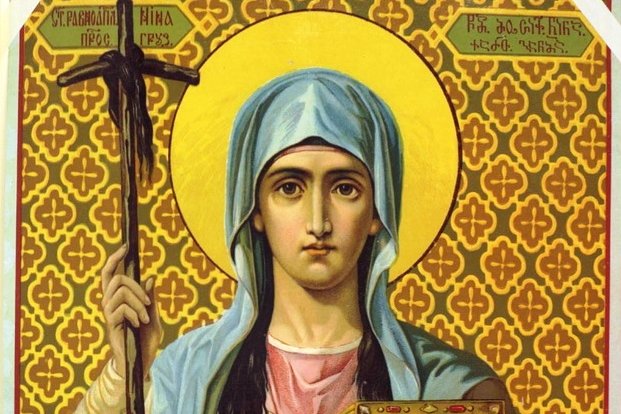
E. I. Fesenko, chromolithograph of Saint Nino, Odessa, 1894 — public domain.
The wider context is the Roman Empire's periodic persecution of Christians, which by tradition scattered Nino's family and pushed her toward the edges of the known Christian world. However she actually arrived at the decision, by the early 4th century she had made her way north into the kingdom of Iberia — a mountainous, still-pagan territory that occupied much of what's now eastern Georgia — arriving, according to the tradition preserved by the Georgian Church and by later Byzantine historians like Rufinus, with essentially nothing but her faith and the small vine cross she is said to have made and bound with her own hair before setting out.
A queen's illness, and a foothold at the royal court
Nino's mission did not begin with preaching to crowds. Tradition holds that she settled first among Jewish communities already living in Mtskheta, the Iberian capital, and became known locally for her piety and for healing the sick through prayer. Her decisive opening came through Queen Nana, wife of King Mirian III, who was suffering from a serious illness that court physicians could not treat. Nino prayed over her, and the queen recovered — an episode that, whatever its exact medical reality, gave Nino direct access to the royal household and put her faith in front of the one audience capable of changing the kingdom's official religion.
Mirian himself remained unconvinced and reportedly grew hostile as Nino's influence with the queen deepened, at one point considering having her killed. The turning point, as Georgian tradition tells it, came during a hunting expedition, when the king was suddenly plunged into total darkness in broad daylight. Mirian prayed first to his own gods, to no effect, and then — recalling his wife's recovery — called out to "the God whom Nino preaches," promising to build a church and convert if his sight returned. It did, immediately, and Mirian kept his word: he was baptized, along with much of his court, and Iberia became one of the earliest kingdoms anywhere to adopt Christianity as its official religion, a step Georgian tradition dates to around 327 — decades before the Roman Empire itself formally tolerated the faith under Constantine.
Building the first church
With royal backing secured, Nino's remaining years were spent establishing the institutional Christianity that would outlast her — chief among these efforts, the church at Mtskheta later rebuilt in stone as Svetitskhoveli Cathedral, still standing today as one of Georgia's most significant religious sites and, by tradition, the resting place of Christ's Seamless Robe that had originally drawn Nino's attention to the region as a young woman in Jerusalem. She's also credited with evangelizing beyond the capital, traveling into more remote mountain districts of Georgia to spread the faith among communities the royal conversion alone wouldn't have reached.
Nino spent her final years living an ascetic life in a small settlement in the mountains of Kakheti rather than remaining at the royal court her efforts had transformed — a choice consistent with the account of someone whose driving motivation was devotion rather than influence. She died around 338 or 340, and was buried at her own request in the humble location she'd chosen rather than in the grand new church at Mtskheta, though a monastery — Bodbe — later grew up around her tomb and remains an active pilgrimage site today.
A cross that became a national symbol
The Grapevine Cross of St. Nino — its arms bent slightly downward, unlike the even proportions of a standard cross — survived as a physical relic and is preserved today in Tbilisi's Sioni Cathedral, where it remains one of Georgian Christianity's most venerated objects. Its distinctive shape has since become a broadly recognized emblem of Georgian identity itself, appearing on church architecture, iconography, and even in contemporary Georgian design, an unusually direct link between a fourth-century missionary's own handiwork and the visual language of a modern nation.
Nino's title, "Equal to the Apostles," places her among a small group of saints across Christian history — Constantine, Helena, Mary Magdalene, Patrick — recognized for missionary work judged comparable in scope to that of Christ's original apostles. For a woman remembered as having arrived in a foreign, hostile kingdom with nothing but conviction and a homemade cross, and leaving behind a nation's enduring religious identity, the comparison is hard to argue with.
Trivia
Who was Saint Nino of Georgia?
What is the significance of Saint Nino's grapevine cross?
How did King Mirian III of Iberia come to convert?
What church is associated with Saint Nino's mission?
When is Saint Nino's feast day?
You May Also Like
Related Reading