Saint Odo of Cluny

A musician's education, put to religious use
Odo was born around 878 near Le Mans, in western France, into a family connected to the regional nobility, and received an unusually strong education for his time — training as a canon that included substantial grounding in music and classical literature alongside more standard religious instruction. He reportedly spent time in his youth in a position connected to a noble or courtly household before a personal turn toward more committed religious life led him first to become a canon at Tours and then, more decisively, to study under the respected scholar Remigius of Auxerre, deepening the classical and theological education that would later shape his own teaching and writing as abbot.
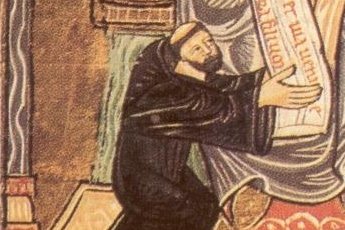
Unknown illuminator, manuscript miniature of Saint Odo of Cluny, 13th century — public domain.
Odo eventually entered monastic life at Baume, a Benedictine house already known for observing a stricter form of the Rule of Saint Benedict than many contemporary monasteries, absorbing there the reforming instincts that would define the rest of his career. From Baume, he moved to Cluny, a monastery in Burgundy founded only a few years earlier, in 910, by Duke William I of Aquitaine, under an unusual charter that placed the new house directly under papal protection rather than under the authority of any local bishop or noble — a structural independence that would prove important for what Odo eventually built there.
Taking charge of a young monastery
Odo became abbot of Cluny around 927, succeeding its first abbot, Berno, at a monastery still less than two decades old but already distinguished by its papal exemption and its commitment to strict Benedictine observance. Under Odo's leadership, Cluny's reputation for disciplined, carefully regulated monastic life grew quickly, and other religious communities — some struggling with declining discipline, others actively seeking reform — began looking to Cluny as a model and, increasingly, as a direct source of reforming leadership.
What distinguished the movement Odo built from simple imitation was a genuine structural innovation: rather than each newly reformed monastery remaining entirely independent once it adopted Cluniac observance, houses that came under Cluny's reforming influence were placed under varying degrees of ongoing accountability to Cluny itself — a network model, still relatively loose in Odo's own lifetime compared to what it would become over the following two centuries, but a real departure from the fully autonomous governance that had characterized most Benedictine houses up to that point.
A reformer who traveled to do the work himself
Odo didn't simply issue instructions from Cluny and wait for other monasteries to adopt them; he traveled extensively himself to oversee reform directly, including significant journeys into Italy at the invitation of the papacy and members of the Roman nobility, who saw in Cluniac reform a genuine solution to the disorder and declining discipline affecting many Italian monasteries of the period. He personally reformed or helped found a number of houses during these travels, extending Cluny's practical influence well beyond Burgundy within his own working lifetime rather than leaving that expansion entirely to successors.
Odo was also a genuine scholar and writer in his own right, consistent with his early education — he composed music, wrote saints' lives including a well-known biography of the layman Gerald of Aurillac, and produced moral and theological writing that circulated well beyond Cluny itself. This combination of practical reforming energy and genuine intellectual and artistic accomplishment gave Odo's leadership a breadth that went beyond pure administrative reform, reflecting the same well-rounded education that had shaped him before he ever entered monastic life.
A reformer's understanding of monastic and lay holiness
Odo's biography of Gerald of Aurillac is worth pausing on specifically, because it reflects something distinctive about Odo's own broader vision of holiness: rather than confining sanctity to monks and clergy, Odo presented Gerald, a genuinely powerful and wealthy lay nobleman, as capable of real, exemplary sanctity while remaining fully engaged in secular responsibilities and warfare — provided those responsibilities were carried out with real justice and personal restraint. This willingness to take lay holiness seriously as a genuine category, not merely a lesser imitation of monastic perfection, is part of what made Odo's broader reforming vision resonate as effectively as it did with the noble patrons whose support Cluny's expansion ultimately depended on.
A movement that outgrew its founder
Odo died in 942, having led Cluny for roughly fifteen years and, in that time, transformed it from one relatively young Burgundian monastery into the recognized center of the most significant monastic reform movement of the tenth century — a movement that would continue to grow dramatically under his successors, eventually encompassing hundreds of monasteries across France, Italy, Spain, and England by the height of Cluniac influence in the eleventh and twelfth centuries. That later, much larger network was built directly on the reforming model and reputation Odo had established during his own comparatively brief but foundational tenure as abbot.
His feast is kept on November 18. Among the figures who shaped medieval Western monasticism's recurring cycle of decline and reform, Odo's specific and lasting contribution was demonstrating that reform could be exported deliberately and systematically, through a real network of accountable houses, rather than remaining confined to whatever discipline a single community could maintain entirely on its own — an insight that Cluny's later medieval successors would build into one of the most extensive religious networks in Western Christian history.
Trivia
Who was Saint Odo of Cluny?
What was Odo's background before becoming a monk?
What made the Cluniac reform movement significant?
How far did Cluny's influence spread during Odo's lifetime?
When is Saint Odo's feast day?
You May Also Like
Related Reading