Saint Aelred of Rievaulx

A court career set aside
Aelred was born in 1110, likely at Hexham in Northumbria, into a family with a tradition of clerical service — his father and grandfather had both held positions connected to the church at Hexham. As a young man, Aelred spent time at the court of King David I of Scotland, where he held a position, possibly as steward or in a similarly responsible household role, that placed him within reach of a genuinely substantial secular career, close to real political power in a kingdom actively consolidating its institutions during David's long and significant reign.

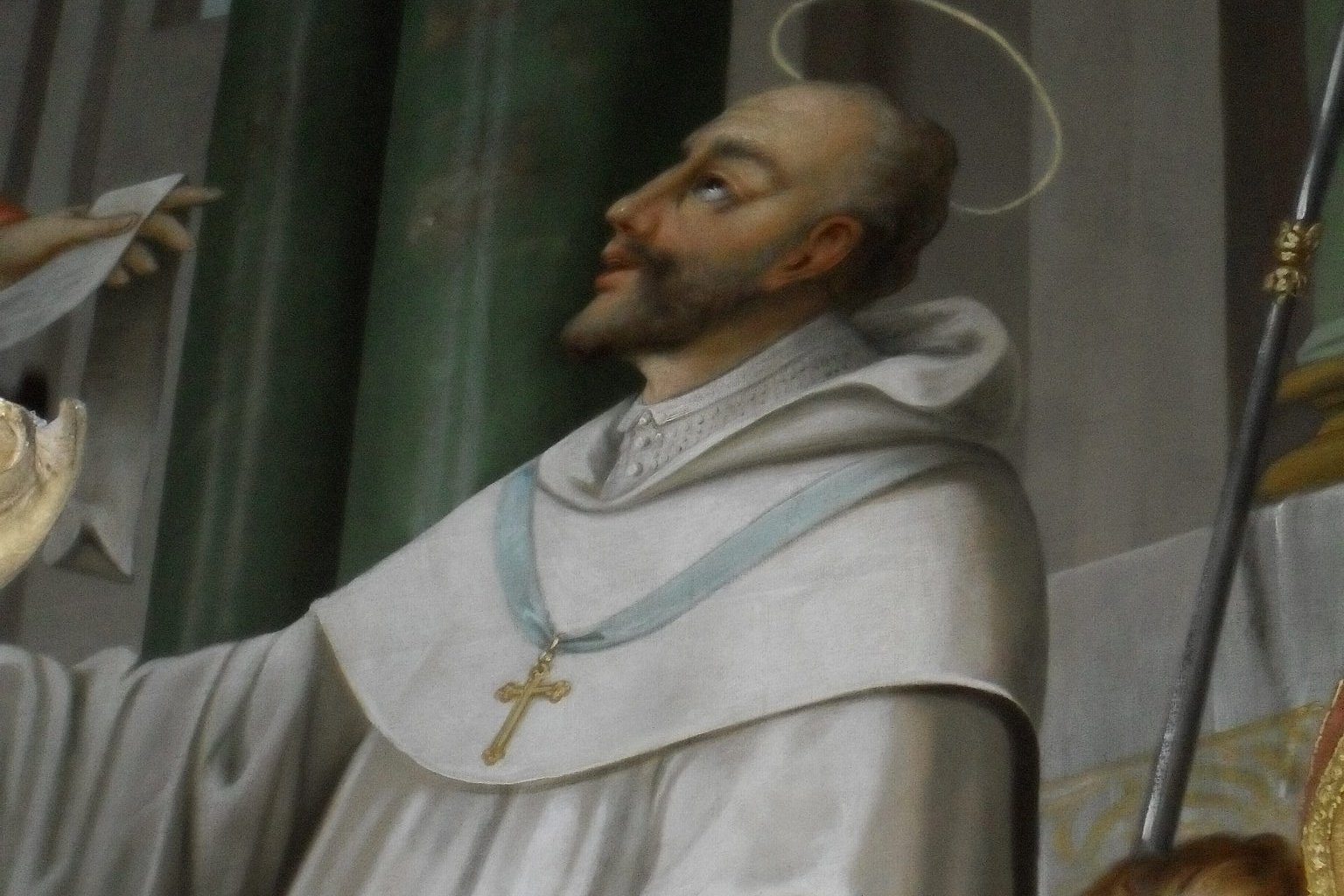
Illuminator of the De Speculo Caritatis manuscript, portrait miniature of Saint Aelred of Rievaulx, c. 1140 — public domain.
Around 1134, Aelred set that path aside and entered Rievaulx Abbey in Yorkshire, then only a few years old, one of the earliest Cistercian foundations in England, established as part of the same wave of reform-minded monastic expansion that had grown out of Saint Stephen Harding's work at Cîteaux and Bernard of Clairvaux's subsequent leadership at Clairvaux. What drew Aelred to Rievaulx specifically isn't fully documented, but the choice fits a broader pattern: the new Cistercian houses of this period drew a number of well-connected, capable young men away from secular careers, attracted by the order's stricter, more demanding observance and its explicit rejection of the comfortable accommodations that had crept into older Benedictine houses.
Rising quickly within the order
Aelred's abilities were recognized within the Rievaulx community fairly quickly. He was sent to Rome on business connected to the abbey within a few years of his entry, and by 1143 had become abbot of a newly founded daughter house, Revesby in Lincolnshire — itself a mark of real trust, since founding a new Cistercian community from an established house required exactly the kind of administrative competence and spiritual authority that a young monk without an established reputation would not normally be handed.
In 1147, Aelred returned to Rievaulx itself as abbot, a position he held until his death two decades later. Under his leadership, the community grew substantially, reportedly housing several hundred monks and lay brothers at its height, making it one of the largest and most significant Cistercian houses anywhere in England. Contemporary and near-contemporary accounts consistently describe Aelred's style of governance as notably gentle, marked by real personal attentiveness to individual monks rather than a purely disciplinary approach to leadership — a reputation that aligns closely with the sympathetic, psychologically attentive quality of his later writing.
A monk who took friendship seriously
Aelred's most distinctive and lasting contribution is his spiritual writing, and above all his treatise De Spiritali Amicitia, On Spiritual Friendship, composed as a dialogue partly modeled on Cicero's classical treatise on the same theme. In it, Aelred makes an argument that was, for a monastic writer of his period, genuinely notable in its warmth: that close personal friendship between individuals, properly ordered and directed toward shared spiritual growth, isn't a distraction from the love of God that monastic life was meant to cultivate, but can actually be one of the ways people learn to practice that love concretely, in a relationship with another specific, known person rather than only in the abstract.
This wasn't a casual or peripheral theme in Aelred's thought — he returned to questions of human affection, attachment, and spiritual companionship repeatedly across his writing, treating them with a psychological seriousness and personal warmth that stands out against the more austere, sometimes suspicious treatment of particular friendships found in some other monastic writing of the period, which worried that close individual attachments between monks could undermine the broader unity and discipline of a religious community. Aelred's more sympathetic approach has made his work a subject of renewed scholarly attention in recent decades, read now by audiences well beyond specifically Cistercian or even specifically religious readers.
He also wrote historical works, including a life of Edward the Confessor and accounts connected to English royal history, reflecting the same court-adjacent education and interests that had shaped his early years before he entered religious life.
Writing beyond the treatise on friendship
Aelred's literary output extended well beyond De Spiritali Amicitia alone. He wrote The Mirror of Charity, a longer work of spiritual instruction addressed to his fellow monks that explores the relationship between rightly ordered love and monastic discipline more broadly, and a treatise specifically for his own sister, offering guidance for women living as recluses or anchoresses — a genre of spiritual direction addressed to solitary religious women that was reasonably common in the period but that Aelred approached with the same close personal attentiveness visible throughout his other writing. Taken together, this body of work gives Aelred a claim to being one of the more genuinely humane and psychologically perceptive monastic writers of the twelfth century, someone consistently interested in how real individual people, not abstract spiritual types, actually experienced the demands of religious life.
A gentle abbot's lasting influence
Aelred died in 1167, having led Rievaulx for two decades as one of the most respected Cistercian abbots of his generation. His feast is kept on January 12. He was never formally canonized through the modern papal process, but he has been venerated for centuries within the Cistercian order and in connection with Rievaulx specifically, and the ruins of the abbey he led — extensive and evocative, among the finest surviving Cistercian ruins in England — remain a significant historical site in North Yorkshire today. Among medieval monastic writers, Aelred's specific and lasting distinction is the sympathy with which he treated one of the most ordinary human experiences, close friendship, as something worth taking seriously within a spiritual life rather than setting firmly aside.
Trivia
Who was Saint Aelred of Rievaulx?
Why did Aelred leave the Scottish royal court?
What is Aelred's treatise on friendship about?
What was Rievaulx Abbey like under Aelred's leadership?
When is Saint Aelred's feast day?
You May Also Like

Related Reading