Saint Servatius, Bishop and Ice Saint of Old Europe

A bishop from the edge of the empire
Servatius served as bishop of Tongeren (in Latin, Atuatuca Tungrorum), a Roman settlement in what is now Belgian Limburg, sometime in the mid-fourth century, dying in 384 AD. This places him among the earliest documented bishops of the Low Countries — a region still being actively Christianized at the time, sitting near the empire's northern frontier, where Roman civil order was already showing the strain that would, within a century, give way to Frankish rule. Very little is known with certainty about his early life; what survives comes primarily through later hagiography and the record of his participation in major Church councils, which places him more securely in documented fourth-century Church history than many bishops of the period.
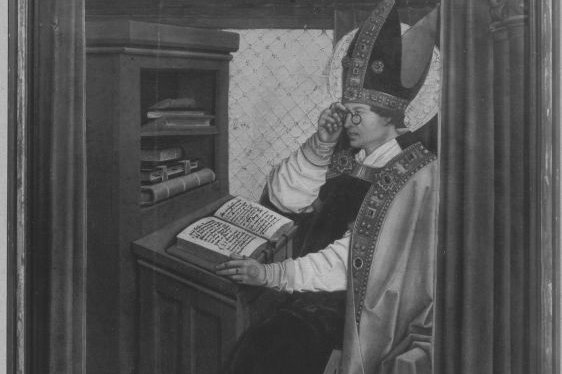
Bernhard Strigel, "Saint Servatius" (panel from the Mindelheim Sippenaltar), c. 1505-06, Bavarian State Painting Collections — public domain (Wikimedia Commons).
Standing firm at Sardica and Rimini
The fourth century was consumed by a theological crisis that shaped the entire structure of the early Church: Arianism, the teaching associated with the priest Arius that held Christ the Son to be a created being, subordinate to and not co-eternal with God the Father — a direct challenge to the doctrine that the Council of Nicaea had affirmed in 325, that the Son is "of one substance" (homoousios, in the Greek of the Nicene Creed) with the Father. This wasn't an abstract academic dispute; it split bishops, cities, and even emperors for decades, with Arian-leaning and pro-Nicene factions each controlling major sees at different points.
Servatius attended the Council of Sardica in 343, one of several fourth-century councils convened to try to resolve the controversy, where he stood among bishops defending the Nicene position. Sixteen years later, he was present at the Council of Rimini in 359 — a council notorious in Church history for the pressure Emperor Constantius II exerted on the assembled bishops, many of whom, worn down by imperial pressure and lengthy negotiations, eventually signed a deliberately ambiguous creed that Arian sympathizers could interpret in their own favor. Saint Jerome later summarized the outcome bitterly, writing that "the whole world groaned and marveled to find itself Arian" — a line describing the council's broader failure, not a statement about Servatius specifically. Tradition holds that Servatius was among the minority who resisted signing and held firm to Nicene orthodoxy throughout the council, though the specific details of his personal resistance come down through later tradition rather than a contemporary eyewitness record naming him individually.
A relocation to Maastricht
Later tradition credits Servatius with beginning the process of moving his episcopal seat from Tongeren to the nearby town of Maastricht (in Latin, Traiectum ad Mosam, meaning "crossing of the Meuse"), a strategically situated river crossing that would grow into a major medieval city. Whether Servatius formally relocated the see during his lifetime or whether this development happened more gradually after his death, with tradition later crediting him with initiating it, is not entirely settled among historians. What is firmly established is where he was buried: in Maastricht, not Tongeren, a fact that anchored the city's identification with him for the rest of Church history.
Over his grave, a basilica was eventually constructed — the Basilica of Saint Servatius, one of the oldest churches in the Netherlands, with portions of the current building dating back roughly a thousand years, though the site itself has been continuously venerated since Servatius's own burial in the late fourth century. The basilica's treasury still holds a reliquary bust of the saint and other objects associated with his cult, and Maastricht continues to mark his feast with the Saint Servatius Procession, a tradition with roots stretching back centuries.
Why farmers still watch the calendar around his feast day
Servatius's most widely recognized association today, outside the Netherlands and Belgium specifically, has nothing directly to do with his theology or his episcopate. In German, Austrian, and other Central European folk traditions, his feast day of May 13 falls within a cluster of days — alongside Saint Mamertus (May 11), Saint Pancras (May 12), and Saint Boniface of Tarsus (May 14), sometimes with Saint Sophia (May 15) included as well — collectively known as the "Ice Saints" (Eisheiligen in German). Popular agricultural tradition held that a final, late cold snap capable of damaging young, frost-sensitive crops was likely to occur around these days in mid-May, and farmers historically waited until after this window passed before planting seedlings like beans, cucumbers, or tender flowers outdoors.
It's worth being clear about what kind of tradition this is: it has nothing to do with anything in Servatius's actual life or ministry, and everything to do with an old, empirically observed pattern in European spring weather that happened to get attached, by the accident of the liturgical calendar, to a cluster of saints' feast days falling in the same short stretch of May. Some modern meteorological analysis has found a modest statistical basis for a late-May cold pattern in parts of Central Europe, though shifting climate patterns have made the old rule considerably less reliable than it once was. Regardless, the phrase "after the Ice Saints" remains part of everyday gardening folklore across German-speaking Europe today, and Servatius's name is inseparable from it.
A bishop remembered two different ways
Servatius's story splits cleanly into two layers that rarely get told together: the documented fourth-century bishop who stood with the pro-Nicene party through two of the era's most consequential and contentious councils, at real personal and professional risk, and the folk figure whose feast day became a fixed point on the European agricultural calendar for reasons that have nothing to do with theology at all. Both layers are genuinely part of how he's remembered, and neither cancels out the other — a bishop can be venerated simultaneously for defending Christ's full divinity against imperial pressure and for lending his name, many centuries later and for entirely unrelated reasons, to a farmer's rule of thumb about when it's finally safe to plant the tomatoes.
Trivia
Who was Saint Servatius?
What did Servatius do at the Council of Sardica and the Council of Rimini?
Why is Saint Servatius called an 'Ice Saint'?
Where is Saint Servatius buried, and why does it matter?
What is Saint Servatius the patron saint of?
You May Also Like
Related Reading