Saint John the Apostle

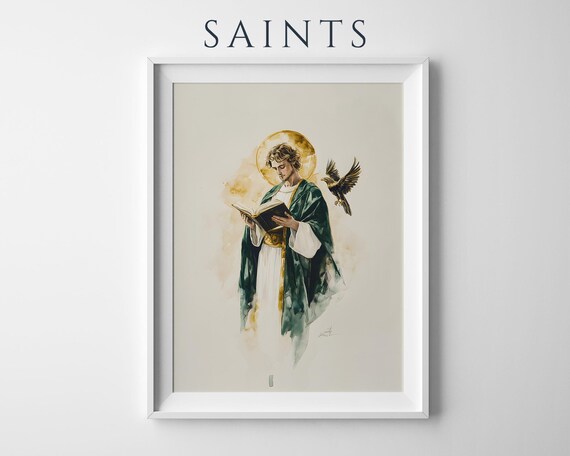
The disciple Jesus loved
Among the twelve, John occupies a distinct place in his own Gospel, where he's repeatedly referred to, without naming himself directly, as the disciple "whom Jesus loved." That disciple reclines next to Jesus at the Last Supper, is the only apostle present at the crucifixion itself, and is among the first to reach the empty tomb after Mary Magdalene's report — present, again and again, at exactly the moments the other apostles are absent or scattered.
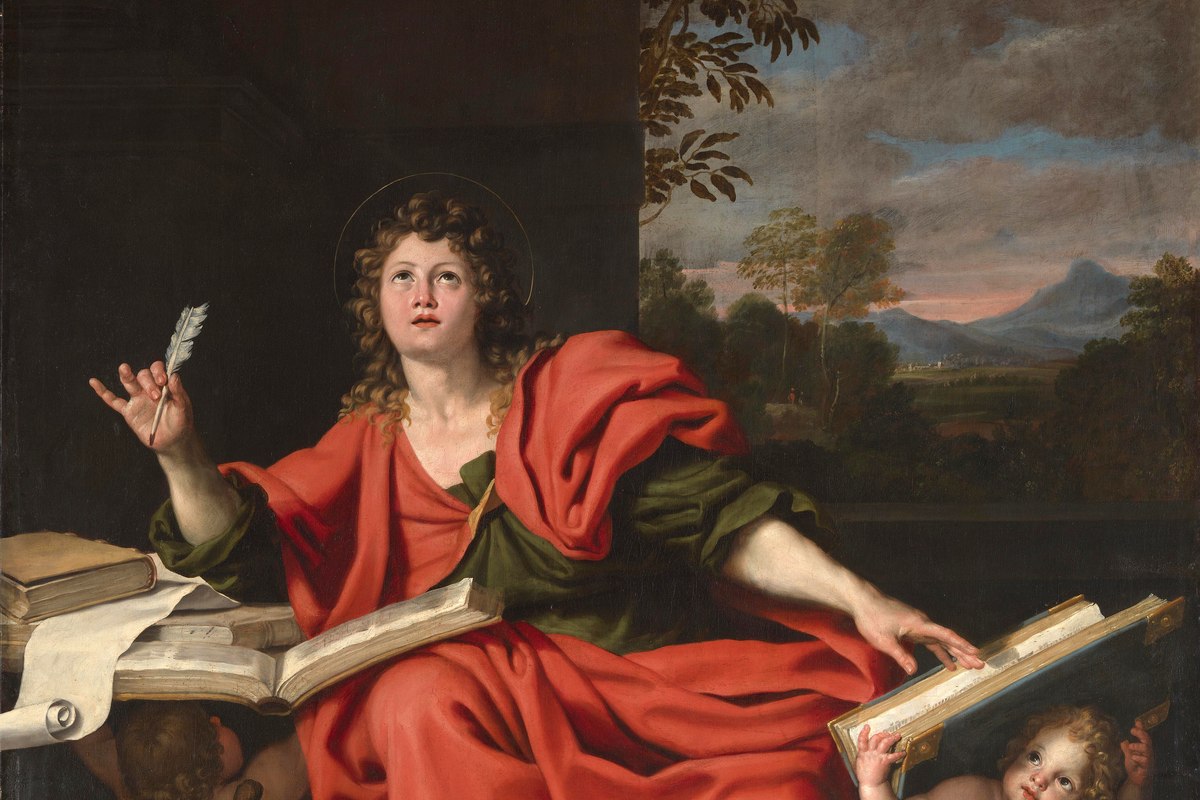
Domenichino, "Saint John the Evangelist," c. 1624-1629 — public domain.
John was a fisherman by trade, working the Sea of Galilee alongside his brother James and their father, Zebedee, when Jesus called them both away from their nets. Along with Peter, the brothers formed part of an inner circle Jesus drew close on several key occasions — present alone with him at the raising of Jairus's daughter, at the Transfiguration on Mount Tabor, and in the garden of Gethsemane before his arrest. Mark's Gospel records that Jesus nicknamed James and John "Boanerges," meaning "sons of thunder" (Mark 3:17, RSV-CE) — a name most scholars connect to an episode in Luke's Gospel where the brothers, indignant that a Samaritan village had refused to welcome Jesus, asked whether they should call down fire from heaven to destroy it. It's a striking detail, since it suggests the "beloved disciple" remembered for tenderness in his own Gospel began his discipleship with a temper considerably less gentle than his later reputation would suggest.
A responsibility handed over while dying
That closeness reaches its most personal moment at the cross itself. Rather than addressing his followers as a group, Jesus singles out two people standing together: "When Jesus saw his mother and the disciple there whom he loved, he said to his mother, “Woman, behold, your son.” Then he said to the disciple, “Behold, your mother.” And from that hour the disciple took her into his home." (John 19:26-27, RSV-CE). It's a strikingly domestic instruction to give in the middle of an execution — not a final teaching for the crowd, but a son's arrangement for his mother's care, entrusted to the one apostle who hadn't run.
This connection between John and Mary has long shaped Catholic devotional life, most visibly in the widespread tradition that John personally cared for her at Ephesus in the years following the crucifixion, a belief the Church has never formally defined as dogma but has treated with respect for centuries — the House of the Virgin Mary near Ephesus, still visited by pilgrims today, draws directly on this same tradition. John's authorship is also traditionally attached to three New Testament letters bearing his name, in addition to his Gospel, all of which return repeatedly to the theme of love as the defining mark of genuine discipleship — a thematic consistency scholars have long noted runs through everything traditionally attributed to him, whether or not the same individual physically wrote every word.
Exiled for a testimony, not a crime
Decades later, tradition places John in exile on the island of Patmos during the reign of the Roman emperor Domitian, sent there, according to his own account in Revelation, "for the word of God and the testimony of Jesus" — banished not for any civil offense but simply for continuing to preach. It was there, isolated from the churches he had once led in person, that he reported receiving the sweeping vision recorded in the Book of Revelation.
Patmos is a small, rocky island in the Aegean Sea, and Roman authorities regularly used similarly remote islands as places of exile for political and religious dissidents, since geography alone made escape or continued organizing nearly impossible. Tradition holds that John received his visions in a cave on the island, still known today as the Cave of the Apocalypse and maintained as a place of pilgrimage. The Book of Revelation that resulted is markedly different in style from John's Gospel and letters — dense with symbolic imagery, numbered visions, and apocalyptic warning — which has led some scholars to debate whether it was written by the same John who wrote the Gospel or by another early Christian leader of the same name. The Church has traditionally identified them as one and the same, a position that remains widely, though not universally, held.
The apostle who lived to grow old
What sets John apart most starkly from the other eleven is simply how his life ended. Tradition holds he was the only apostle not to die a martyr's death, living out his final years at Ephesus, reportedly caring for Mary until her own death, before dying of old age himself — the last living link, by the time he died, to a circle of companions who had nearly all been executed for the same faith he had spent decades continuing to teach.
That doesn't mean tradition remembers him as untested. An early legend, recorded by the Church historian Tertullian, holds that Roman authorities in the city attempted to execute John by immersing him in a vat of boiling oil before his exile to Patmos, and that he emerged from it unharmed — an episode still commemorated in the Roman liturgical calendar as the feast of "Saint John at the Latin Gate" on May 6, distinct from his main feast day of December 27, which falls within the Christmas octave alongside the Holy Innocents. Because of that legend, and because Revelation describes him being given a cup to drink that didn't harm him, John became associated in Christian art and devotion with a chalice, sometimes shown with a small serpent emerging from it — imagery that made him, over time, the patron saint of writers, theologians, and, by later extension, printers and booksellers, all professions tied to the written testimony he left behind.
Trivia
Why is John called 'the beloved disciple'?
What did Jesus ask of John while dying on the cross?
Why was John exiled to the island of Patmos?
Was John really the only apostle not to be martyred?
Related Reading