Saint John Neumann

Too many priests, and a passage to America
John Neumann grew up in Bohemia, part of the Austrian Empire, and completed his seminary studies with every intention of being ordained a priest in his home diocese of Budweis. He arrived at ordination time to find the door closed — the diocese, unusually, had more seminary graduates than it had parish assignments to give them, and new ordinations had been suspended. Rather than wait indefinitely, Neumann made the decision to sail for the United States in 1836, arriving in New York with almost nothing beyond the clothes he carried, hoping an American bishop might have use for a priest that Bohemia didn't.
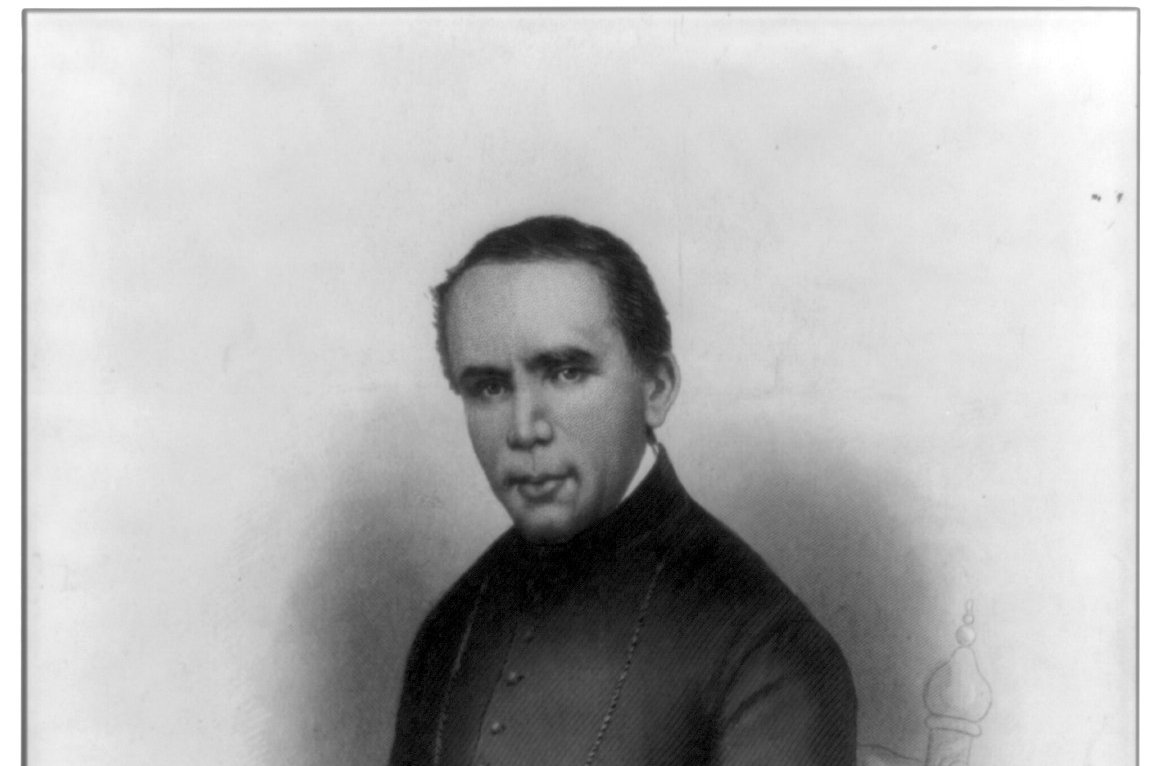
Samuel Hollyer, engraving, 1892 — public domain (Library of Congress).
Ordained within weeks, missionary within months
The gamble worked. The Bishop of New York ordained Neumann shortly after his arrival, and he was assigned as a missionary priest to a scattered, largely German-speaking Catholic immigrant population across western New York state — exactly the kind of underserved, geographically difficult assignment few established priests wanted. Neumann threw himself into it, traveling long distances on foot between isolated communities to say Mass, hear confessions, and minister to Catholics who otherwise had almost no regular access to a priest.
Joining the Redemptorists
In 1840, Neumann entered the Congregation of the Most Holy Redeemer — the Redemptorists — becoming the first person to profess vows in that congregation on American soil. The Redemptorists were themselves a missionary order focused on serving the poor and marginalized, a natural fit for a priest who had already spent years working among immigrant communities with few resources. He continued serving largely German-speaking Catholic parishes through the 1840s, eventually becoming well known within the American Church for his pastoral energy and administrative capability. Neumann's own linguistic gift was considerable — by most accounts he had working knowledge of close to a dozen languages by the time he was consecrated bishop, an asset in a diocese where Catholic immigrants arrived speaking German, Irish-accented English, French, Italian, and a handful of other languages, none of them interchangeable in the confessional.
By the late 1840s he had risen within the Redemptorists to serve as superior of the American branch of the congregation, overseeing its expanding network of parishes and religious houses across the country — administrative responsibility that, in hindsight, looks like direct preparation for the diocesan-scale organizing he would take on only a few years later as bishop.
A small man with a reputation for austerity
Neumann was physically unimposing — short, plain in manner, and by most contemporary descriptions almost painfully humble for a man who would go on to run one of the country's largest dioceses. He kept a personally austere lifestyle even after his consecration as bishop, a habit formed during his years of hand-to-mouth missionary work in rural New York and one he never really abandoned once he had a bishop's income and household at his disposal. Some Philadelphia clergy of the period, used to more socially polished bishops, reportedly found his plain manner and lack of interest in the trappings of the office a little disconcerting at first — an impression that faded quickly once the scale of his organizational work became apparent.
Building a school system from almost nothing
In 1852, Neumann was appointed Bishop of Philadelphia, at the time one of the largest and fastest-growing Catholic dioceses in the country. He is best remembered for organizing what's widely credited as the first diocesan-wide Catholic parochial school system in the United States, expanding parish schools in the diocese from roughly two to close to one hundred during his time as bishop — a scale of growth that mirrors, in a different diocese, the school-building work Elizabeth Ann Seton had begun decades earlier in Maryland. He also introduced the Forty Hours Devotion, a period of continuous eucharistic adoration, on a diocesan-wide basis, a practice that spread well beyond Philadelphia in the years that followed.
Canonization and legacy
John Neumann died suddenly in Philadelphia in January 1860, collapsing on a city street at only forty-eight years old, worn down by the pace of a decade spent building a diocese from the ground up. Pope Paul VI canonized him in 1977, making him the first American male to be canonized a saint by the Catholic Church — a milestone that came more than a century after his death, following the careful, multi-stage process the Church requires for sainthood, including the formal recognition of miracles attributed to his intercession. His feast day is celebrated on January 5, and his remains are enshrined at the National Shrine of Saint John Neumann in Philadelphia, in the same city where his school-building legacy is still felt in the diocese's educational institutions today. Alongside Saint Katharine Drexel, another Philadelphia-connected saint remembered for her work in Catholic education generations later, Neumann helped establish the city as a genuine center of the American Church's commitment to schooling its immigrant and working-class faithful — a legacy neither saint set out to build alone, but one the diocese has carried forward for well over a century.
Trivia
Why couldn't John Neumann be ordained a priest in his native Bohemia?
What did Neumann do when he arrived in New York in 1836?
What organization did John Neumann join, and why is that significant?
What did Neumann build as Bishop of Philadelphia?
When was John Neumann canonized?
You May Also Like
Related Reading