The Destroying Angel of the First Passover

The last and most terrible of the plagues
By the time Exodus reaches its twelfth chapter, nine plagues have already struck Egypt — water turned to blood, frogs, locusts, darkness — and Pharaoh has still refused to release the enslaved Israelites. What follows is described in Scripture as the decisive blow, severe enough to finally break Pharaoh's resistance: the death of every firstborn son across the land, from the royal household to the poorest prisoner's family, in a single night.
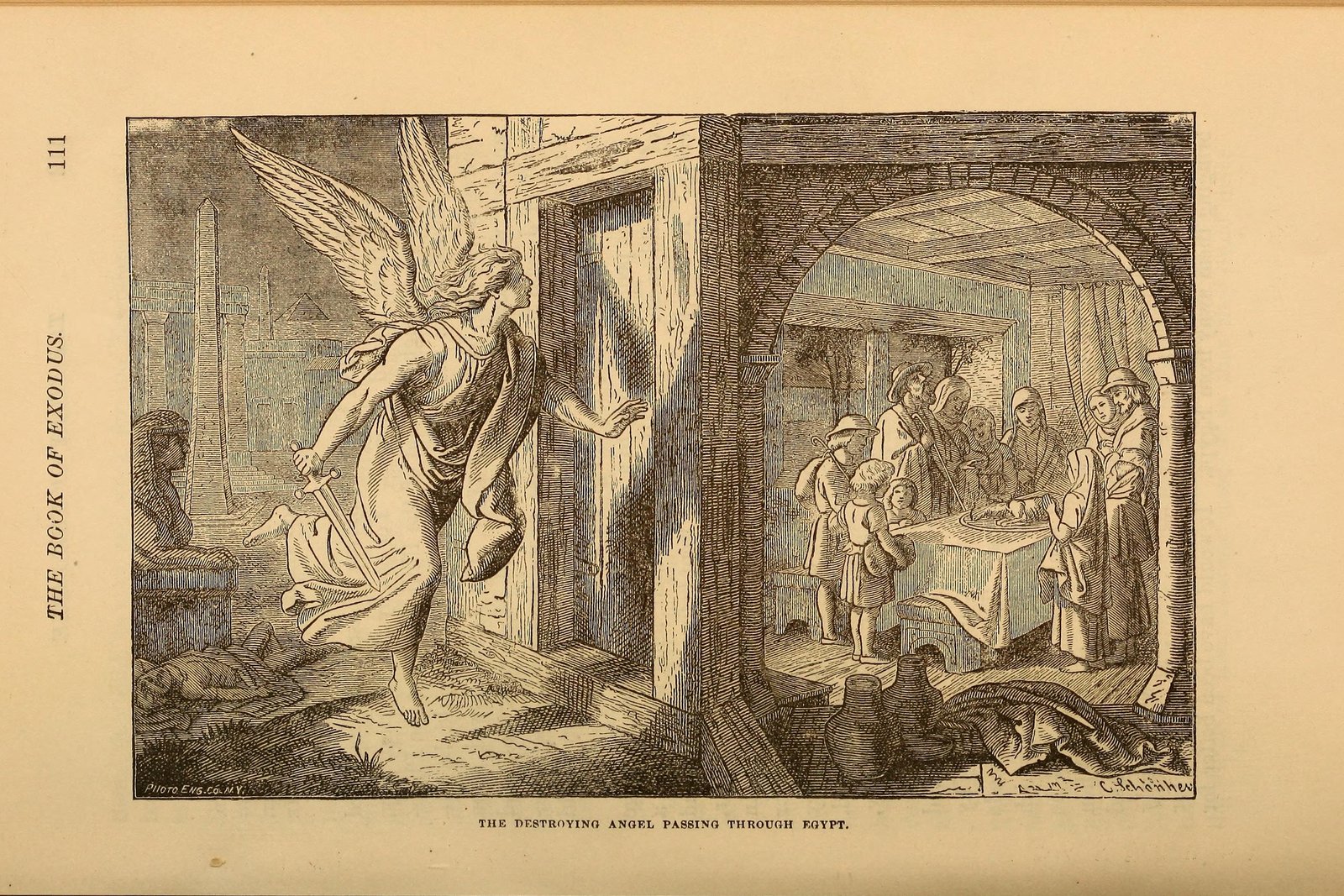
"The Destroying Angel Passing Through Egypt," illustration from Charles Foster's Bible Pictures and What They Teach Us, 1881, Library of Congress — public domain.
Before it happens, God gives Moses detailed instructions for how Israelite households can be spared. Each family is to slaughter a lamb, roast it whole, eat it in readiness for departure, and apply its blood to the lintel and doorposts of their home. The instruction comes with an explicit reason attached: "For when the Lord goes by to strike down the Egyptians, seeing the blood on the lintel and the two doorposts, the Lord will pass over that door and not let the destroyer come into your houses to strike you down" (Exodus 12:23, NABRE).
Who — or what — is "the destroyer"?
The Hebrew text at this point introduces a figure Exodus names only "the destroyer" (in Hebrew, ha-mashchit), without further identification. The passage's language shifts in a way worth noticing: verse 23 speaks of the Lord passing over the door and not letting "the destroyer" enter, appearing to distinguish between God's own action and a separate destroying agent operating under divine command — while verse 29, describing the event itself, states plainly that "the Lord struck down every firstborn," attributing the act directly to God without mentioning any intermediary at all.
Scripture doesn't resolve this apparent tension explicitly, and interpreters across Jewish and Christian tradition have read it in different ways. Some understand "the destroyer" as an angel carrying out God's decree, in keeping with the broader biblical pattern of the "angel of the Lord" acting as an extension of God's own presence and will. Others read the shifting language as simply reflecting Hebrew narrative style, in which an act attributed to God can also be described through the agency that carries it out, without implying two genuinely separate actors. What the text does make unmistakably clear, regardless of how the destroyer's precise nature is understood, is the totality and severity of the judgment: "there was not a house without its dead" (Exodus 12:30, NABRE).
A sign that had to be visible, not merely believed
What stands out in the instructions Moses relays isn't a call for the Israelites' inward faith alone, but for a specific, visible act: blood physically applied to a doorframe. Exodus 12:22 instructs the elders to "take a bunch of hyssop, and dipping it in the blood that is in the basin, apply some of this blood to the lintel and the two doorposts. And none of you shall go outdoors until morning" (NABRE) — a plain, physical marker, not a private conviction, that determined which households the destroyer would pass by.
This detail has long shaped how the passage is read theologically: protection here comes through obedience made visible and concrete, not through ancestry, status, or even faith held silently. An Israelite household that failed to mark its door, the text implies, would have received no exemption on the basis of identity alone — the blood itself was the sign that mattered.
The origin of a feast still kept today
The instructions in Exodus 12 don't end with the night of the destroyer's passing; they establish an ongoing memorial. God tells Moses that this night is to be commemorated permanently: "This day will be a day of remembrance for you, which your future generations will celebrate with pilgrimage to the Lord; you will celebrate it as a statute forever." (Exodus 12:14, NABRE, paraphrased in context). That instruction became the origin of Passover (Pesach), one of the most significant and enduringly observed feasts in Jewish religious life, still marked with a ritual meal — the Seder — that deliberately recalls many of the same elements described in this original account.
A shadow of the cross, in Christian reading
Christian tradition, from the New Testament onward, has read the Passover narrative as more than a single historical rescue — as a foreshadowing of a greater deliverance still to come. John's Gospel identifies Jesus directly as "the Lamb of God, who takes away the sin of the world" (John 1:29), language that deliberately echoes the Passover lamb whose blood spared Israelite households from the destroyer. Saint Paul makes the connection even more explicit, writing to the Corinthians, "For our paschal lamb, Christ, has been sacrificed" (1 Corinthians 5:7, NABRE).
This typological reading — seeing the Passover lamb's blood as pointing forward to Christ's own sacrifice — sits at the heart of how the Catholic Church has long understood the Last Supper, which Jesus himself celebrated as a Passover meal with his disciples the night before his crucifixion, and by extension the Eucharist that flows from it. The night of the destroyer, severe as it is, becomes in this reading not simply a story about judgment escaped, but the first sketch of a far larger pattern of deliverance the Church holds was still to unfold.
Trivia
What does Exodus say happened on the night of the first Passover?
Who or what is 'the destroyer' mentioned in Exodus 12?
Why did blood on the doorframe protect Israelite households?
Is the destroyer of Exodus the same figure as the angel of death in later Jewish tradition?
How does the Passover story connect to Christian understanding of Christ?
Related Reading