Naboth's Vineyard

A king who wants what's next door
The First Book of Kings sets up this story with almost domestic simplicity: "Naboth the Jezreelite had a vineyard in Jezreel next to the palace of Ahab, king of Samaria" (1 Kings 21:1). Ahab, ruling over the northern kingdom of Israel, wants that land for a vegetable garden and makes what sounds, on its face, like a reasonable offer: "Give me your vineyard to be my vegetable garden, since it is close by, next to my house. I will give you a better vineyard in exchange, or, if you prefer, I will give you its value in money" (1 Kings 21:2). No threats, no coercion — a straightforward property transaction, initiated by the king but framed as an exchange rather than a seizure.
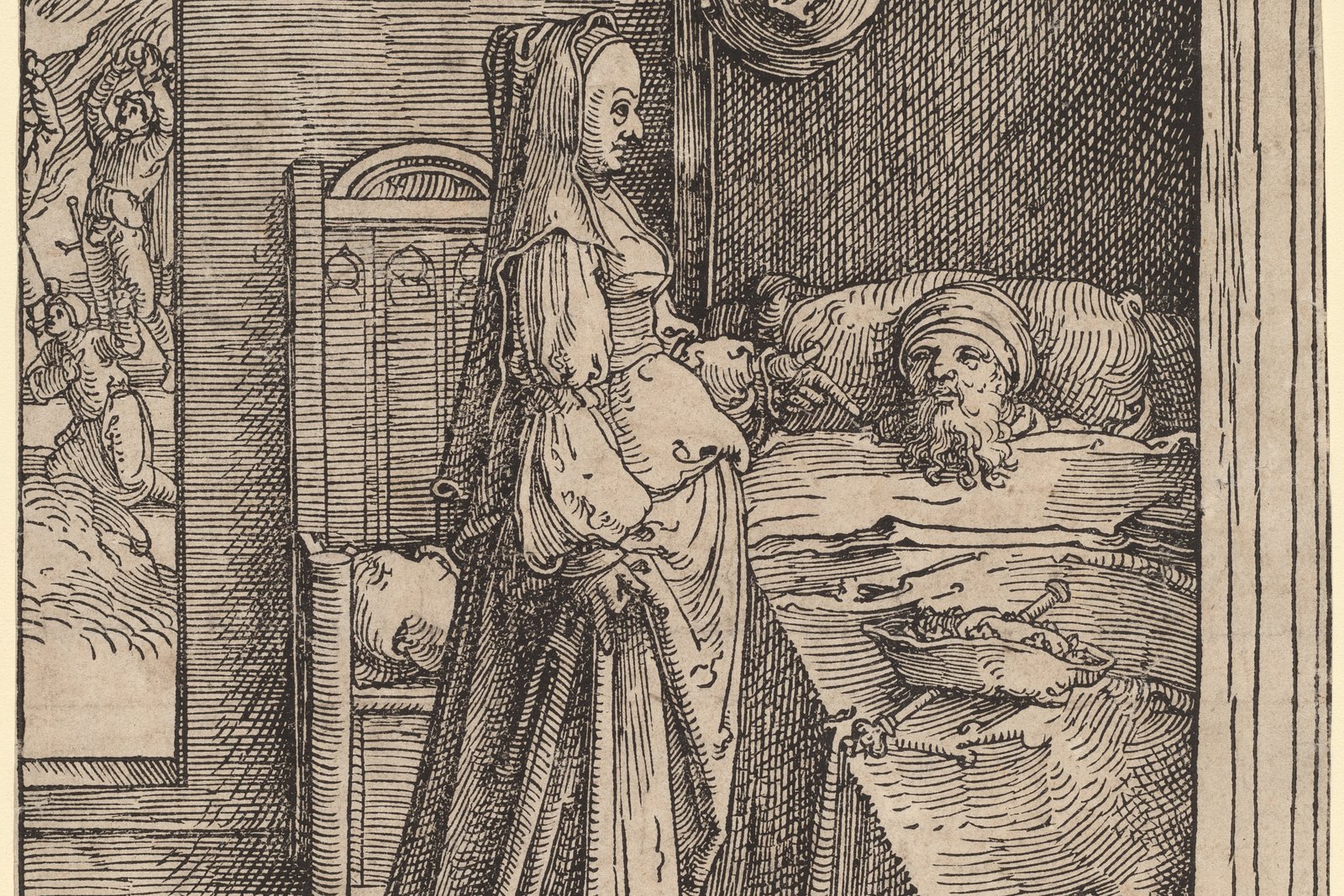
Lucas van Leyden, "Jezebel Promising Naboth's Vineyard to King Ahab," 1516-19, National Gallery of Art, Washington. Public domain (CC0).
"The Lord forbid that I should give you my ancestral heritage"
Naboth's refusal is immediate and rooted in something deeper than sentiment: "The Lord forbid that I should give you my ancestral heritage" (1 Kings 21:3). Under the Law given at Sinai, land inherited within a tribe was meant to remain within that family line across generations — a system meant to prevent the kind of permanent concentration of land and power that would leave some families landless forever (see Leviticus 25:23-28 on the redemption of ancestral land). For Naboth, selling to the king wasn't simply giving up a piece of property; it was breaking faith with an inheritance he understood himself as a steward of, not an owner free to dispose of it however he wished.
A king who sulks like a child
Ahab's reaction to being told no is strikingly petty for a reigning monarch: "Ahab went home disturbed and angry at the answer Naboth the Jezreelite had given him... Lying down on his bed, he turned away and would not eat" (1 Kings 21:4). It's an image the text seems to present with a touch of dry irony — a king who commands armies and governs a nation, reduced to sulking in bed over a vegetable garden he can't have, refusing food like a child denied a toy.
Jezebel takes over
Queen Jezebel, Ahab's wife — a Phoenician princess whose introduction of Baal worship into Israel had already made her one of the most notorious figures in the historical books of the Old Testament — has no patience for her husband's helplessness. "Do you not now exercise royal power over Israel? Get up, eat, and be cheerful. I will obtain the vineyard of Naboth the Jezreelite for you" (1 Kings 21:7). What follows is a coldly efficient plot: "she wrote letters in Ahab's name and, having sealed them with his seal, sent them to the elders and to the nobles who lived in the same city with Naboth" (1 Kings 21:8), instructing them to proclaim a public fast, seat Naboth prominently as though he were being honored, then bring in "two scoundrels" to falsely accuse him of cursing both God and the king (1 Kings 21:9-10) — a charge carrying the death penalty under Israelite law (see Leviticus 24:15-16).
A false trial, and an execution
The city's own leaders carry it out exactly as instructed: "His fellow citizens... did as Jezebel had ordered in the letters she sent them... the scoundrels accused him in the presence of the people, 'Naboth has cursed God and king.' And they led him out of the city and stoned him to death" (1 Kings 21:11-13). It's one of the starkest depictions in the Old Testament of institutional injustice — not a single villain acting alone, but a whole civic structure, elders and nobles and public assembly, cooperating in the judicial murder of an innocent man because a letter arrived bearing the king's seal.
The king walks into the vineyard, and finds a prophet waiting
Jezebel reports back to Ahab with brutal efficiency: "Go, take possession of the vineyard of Naboth the Jezreelite which he refused to sell you, because Naboth is not alive, but dead" (1 Kings 21:15). Ahab doesn't hesitate or ask how Naboth died — he simply goes to claim what he wanted. What he finds there changes everything: "the word of the Lord came to Elijah the Tishbite: Go down to meet Ahab, king of Israel... He will be in the vineyard of Naboth, where he has gone to take possession" (1 Kings 21:17-18). Elijah, the same prophet who had confronted Ahab before over the worship of Baal (see our article on Elijah and the priests of Baal), delivers a judgment that lands like a verdict: "Thus says the Lord: After murdering, do you also take possession? ... In the place where the dogs licked up the blood of Naboth, the dogs shall lick up your blood, too" (1 Kings 21:19).
A king's genuine, if incomplete, repentance
What happens next complicates the story's moral arithmetic. Ahab doesn't dismiss Elijah's prophecy or have him executed for the accusation — he responds with visible, apparently sincere grief: "When Ahab heard these words, he tore his garments, put on sackcloth, and fasted... He went about subdued" (1 Kings 21:27). God's response to Elijah acknowledges this directly: "Have you seen that Ahab has humbled himself before me? Since he has humbled himself before me, I will not bring the evil in his time; I will bring the evil upon his house in his son's time" (1 Kings 21:29). The judgment isn't cancelled, but it's delayed — a rare Old Testament instance of a clearly guilty king receiving mercy in response to visible repentance, even as the deeper consequences remain in motion for the next generation.
A story about power and its limits
Naboth's vineyard has served for centuries as one of Scripture's clearest illustrations of the difference between what power can do and what it's entitled to do. Ahab as king had no legal right under Israelite law to simply seize an unwilling subject's inherited land — the story only works because Jezebel has to manufacture a false legal process to get around that limit, rather than simply overriding it by decree. For readers of the historical books, it stands alongside stories like the rise of the kings of Israel as a case study in how quickly royal power, left unchecked by prophetic confrontation, could curdle into exactly the abuses Israel's own law had been designed to prevent.
Lucas van Leyden's engraving of the deal
The image accompanying this article, an early 16th-century engraving by the Dutch printmaker Lucas van Leyden, captures the moment before the worst of the story unfolds — Jezebel presenting Ahab with the news or the deed to the vineyard, the king's posture already suggesting the passive, almost childlike helplessness the biblical text describes. Van Leyden was known for exactly this kind of narrative precision in his prints, choosing the quieter, transactional moment of the story over its violence, and trusting viewers already familiar with the text to supply the moral weight of what came just before and after it.
Trivia
Why did King Ahab want Naboth's vineyard?
Why did Naboth refuse to sell it?
How did Queen Jezebel get the vineyard for Ahab?
What did the prophet Elijah say to Ahab after Naboth's death?
Did Ahab face any consequences for what happened to Naboth?
Related Reading