Elijah: Fire on Carmel and a Whisper at Horeb

A Kingdom Gone After Baal
By the time Elijah steps onto the biblical stage, the northern kingdom of Israel is ruled by Ahab, whose wife Jezebel has imported the worship of Baal, a Canaanite storm and fertility god, and is actively hunting down the Lord's own prophets. A three-year drought, announced by Elijah himself as a sign of God's judgment, has left the land starving. Even Ahab's own palace administrator, Obadiah, secretly hides a hundred prophets in caves to keep them alive (1 Kings 18:4). This is the world Elijah moves through: not a quiet spiritual backwater, but a kingdom where loyalty to the God of Israel could get a person killed.
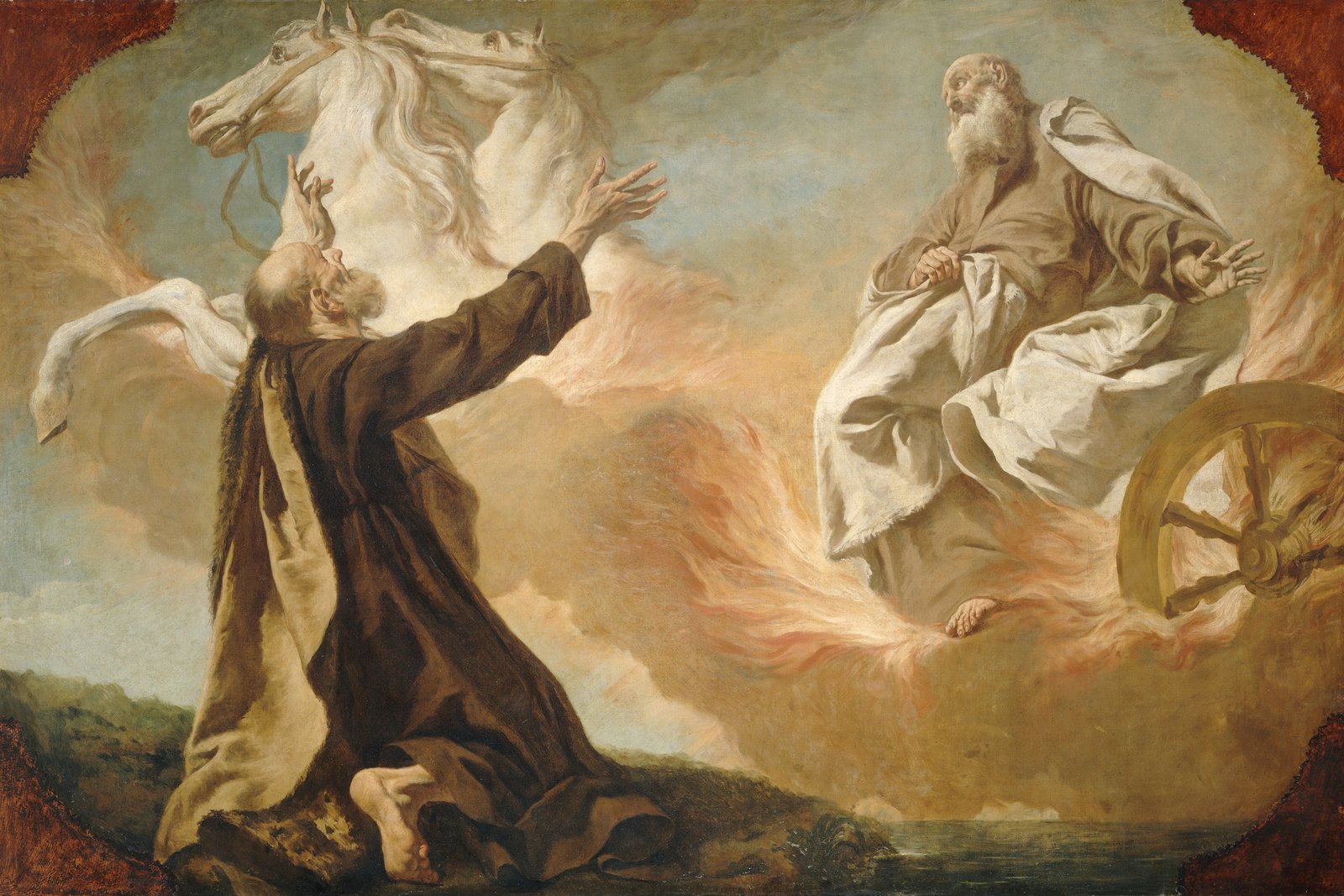
Giuseppe Angeli, "Elijah Taken Up in a Chariot of Fire," c. 1740-1755, National Gallery of Art — public domain (CC0).
The Contest on Mount Carmel
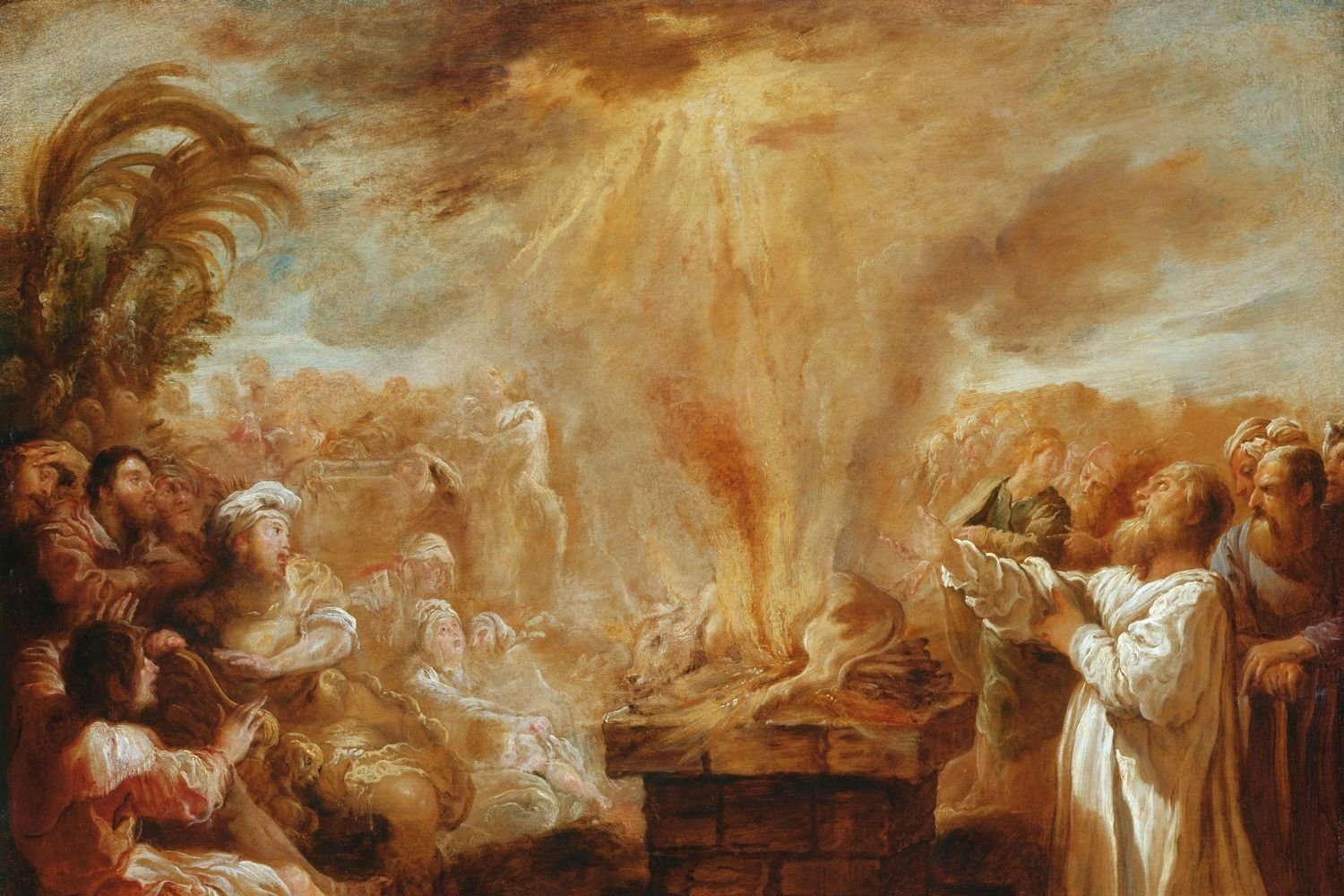
Elijah forces the issue into the open. He summons Ahab, the people of Israel, and 450 prophets of Baal to Mount Carmel for a public test. "How long will you straddle the issue? If the Lord is God, follow him; if Baal, follow him" (NABRE, 1 Kings 18:21). Two bulls are prepared for sacrifice, one for each side, but no fire is lit. Whichever god answers by fire is God.
The prophets of Baal go first, calling on their god from morning until noon, then afternoon, cutting themselves with swords in ritual desperation. "There was no sound, no one answering, no one listening" (NABRE, 1 Kings 18:29). Elijah, watching, taunts them: "Call louder, for he is a god; he may be busy doing his business, or may be on a journey. Perhaps he is asleep and must be awakened" (NABRE, 1 Kings 18:27).
Then Elijah rebuilds a ruined altar of the Lord, digs a trench around it, and — rather than making the miracle easier — has the offering drenched in water three separate times, until the trench itself is full. He prays a single short prayer, and "the Lord's fire came down and devoured the burnt offering, wood, stones, and dust, and lapped up the water in the trench" (NABRE, 1 Kings 18:38). The people fall on their faces: "The Lord is God! The Lord is God!" (NABRE, 1 Kings 18:39).
Flight, Fear, and a Voice in the Silence
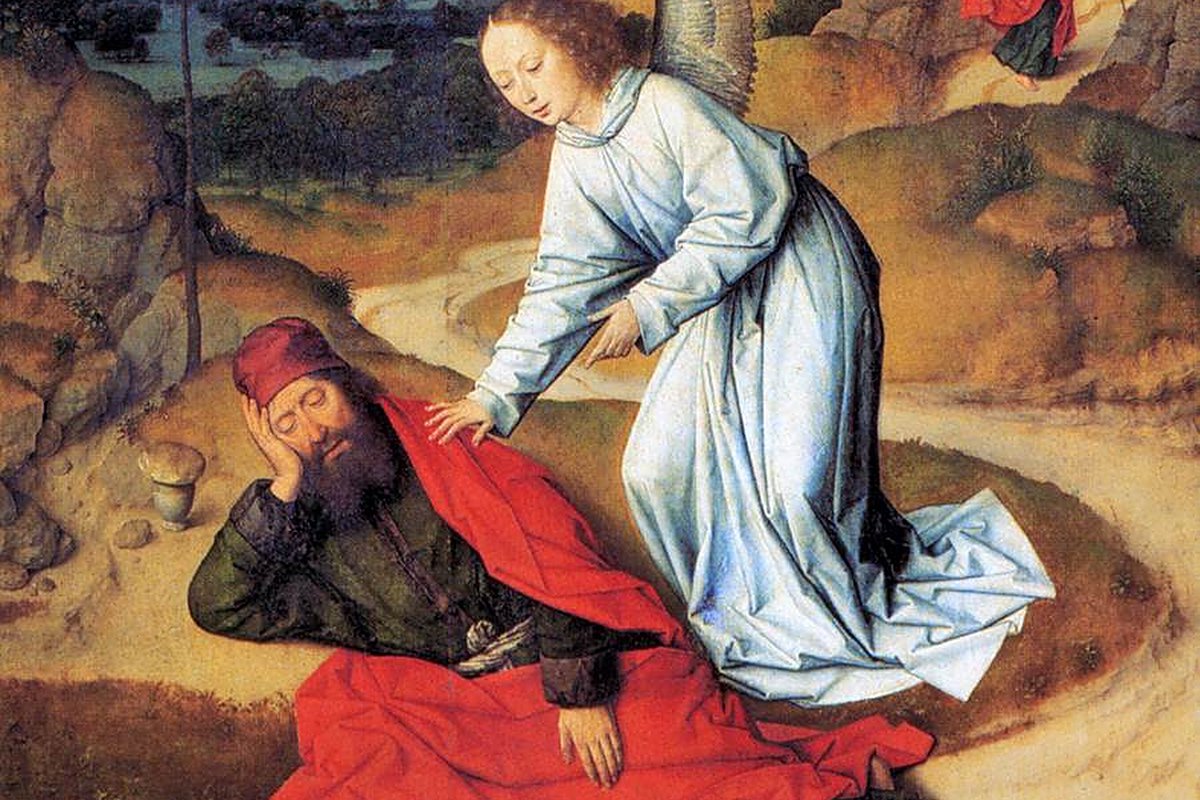
The triumph does not last. Jezebel, furious at the slaughter of Baal's prophets that follows the contest, vows to kill Elijah within a day. Astonishingly, the man who has just called down fire from heaven "was afraid and fled for his life" (NABRE, 1 Kings 19:3), collapsing under a broom tree in the wilderness and praying for death: "Enough, Lord! Take my life, for I am no better than my ancestors" (NABRE, 1 Kings 19:4). It is one of the Bible's most honest portraits of burnout — a man who has just done something extraordinary, and is now completely spent.
An angel feeds him twice, and on that strength he walks forty days to Horeb, the mountain of God — the same mountain where Moses received the Law. There, in a cave, God asks him, "Why are you here, Elijah?" and tells him to stand and wait. A violent wind tears the mountains apart, but "the Lord was not in the wind"; an earthquake follows, but "the Lord was not in the earthquake"; then fire, and again, the Lord is not in the fire. Finally comes what the NABRE renders as "a light silent sound" (NABRE, 1 Kings 19:12) — the phrase often translated elsewhere as a "still small voice." It is in that quiet, not in any of the spectacular forces, that God speaks to him.
The encounter does not erase Elijah's despair with a lecture; God simply gives him a new commission — anoint new kings, and anoint Elisha as his own successor — and a piece of information Elijah badly needed: he is not, in fact, the last faithful person left in Israel. "I will spare seven thousand in Israel—every knee that has not bent to Baal" (NABRE, 1 Kings 19:18).
The Chariot of Fire
Elijah's story does not end in a grave. Walking with Elisha near the Jordan River, aware that his time is ending, Elijah asks what he can do for his successor before he goes. Elisha asks for "a double portion of your spirit" (NABRE, 2 Kings 2:9) — the inheritance right of a firstborn son, asking to carry Elijah's prophetic mission forward at full strength. Then, "as they walked on still conversing, a fiery chariot and fiery horses came between the two of them, and Elijah went up to heaven in a whirlwind" (NABRE, 2 Kings 2:11).
Because Elijah is taken up rather than buried, Jewish tradition came to expect his return before the coming of the Messiah, a hope reflected in Malachi's closing prophecy. In the Gospels, this expectation surfaces directly: crowds wonder if John the Baptist is Elijah returned, and Elijah himself appears with Moses at Jesus's Transfiguration, standing for the Prophets as Moses stands for the Law, both bearing witness to Christ.
Trivia
Who was the prophet Elijah?
What happened at Mount Carmel?
What is the 'still small voice' of Elijah?
How did Elijah die?
Why is Elijah important in Christian tradition?
You May Also Like
Related Reading