The Annunciation

A greeting that unsettles before it explains anything
Luke sets the scene with almost no ceremony: "the angel Gabriel was sent from God to a town of Galilee called Nazareth, to a virgin betrothed to a man named Joseph" (Luke 1:26-27, NABRE). Nazareth was not a significant place — a small, easily overlooked town in a region without much prestige. Gabriel's opening line to Mary isn't a name or an explanation, but a title: "Hail, favored one! The Lord is with you" (Luke 1:28, NABRE). Luke records her reaction with precision — not terror at an angelic visitor, but confusion at the greeting itself: she "was greatly troubled at what was said and pondered what sort of greeting this might be" (Luke 1:29, NABRE). She's working out the meaning of the words before she's even afraid of the messenger.
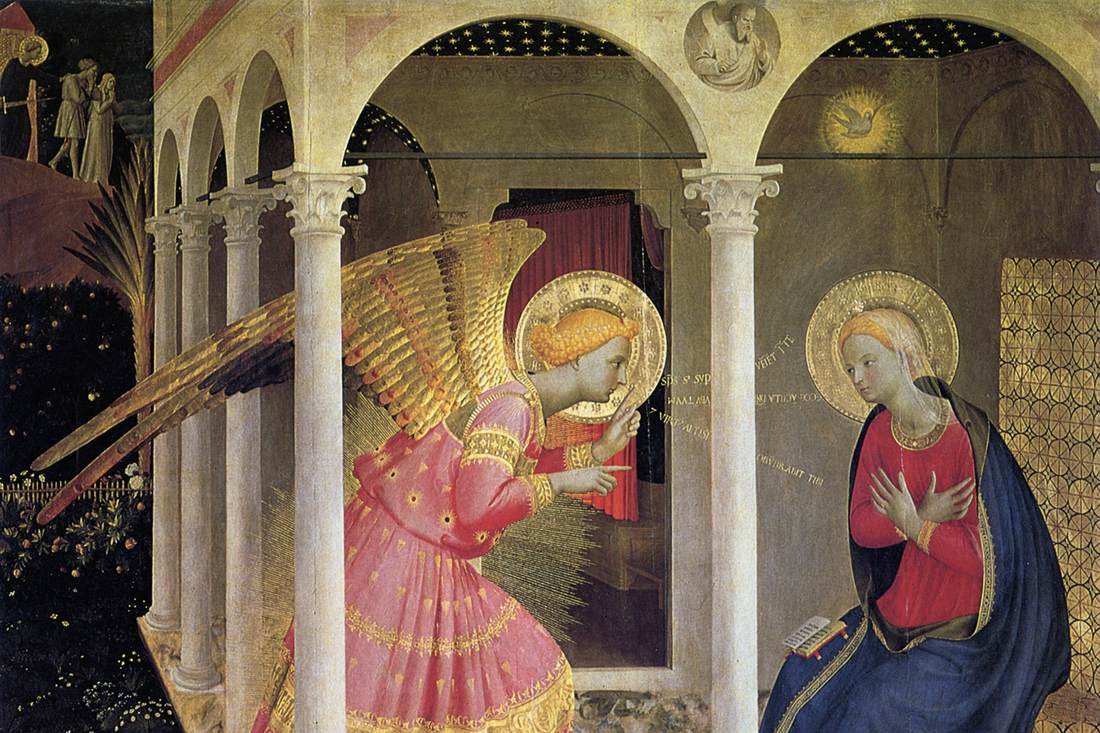
Fra Angelico, "The Annunciation," c. 1433-34, Museo Diocesano, Cortona. Public domain.
Gabriel himself isn't a stranger to Luke's narrative by this point. The same angel had already appeared, six months earlier, to the priest Zechariah in the Temple in Jerusalem, announcing the birth of John the Baptist to Zechariah and his wife Elizabeth, both of them long past the age of having children. Luke deliberately pairs the two annunciations — one delivered in the Temple's inner sanctuary to an elderly priest, the other in an obscure village home to a teenage girl — inviting a reader to notice the contrast in setting even as the same messenger carries an even greater announcement to someone with far less social standing than a priest.
A message, not yet a request
Gabriel's actual announcement follows a pattern familiar from Old Testament angelic visits: reassurance, then the news itself. "Do not be afraid, Mary, for you have found favor with God," he tells her, before laying out what's coming — a son, to be named Jesus, "great" and called "Son of the Most High," who will reign over the house of Jacob "forever," a kingdom "there will be no end" of (Luke 1:30-33, NABRE). It's worth noticing that at this point in the exchange, nothing has been asked of Mary yet. Gabriel is describing what will happen, in the same declarative voice used throughout Luke's infancy narrative.
The language Gabriel uses — a son who will reign "over the house of Jacob" on a throne inherited from his ancestor David — deliberately echoes the language of Old Testament promises made to Israel's kings centuries earlier, particularly the covenant God made with David through the prophet Nathan. Any listener steeped in Jewish Scripture, as Luke's earliest readers were, would have recognized immediately that Gabriel wasn't describing an ordinary birth: he was describing the long-awaited fulfillment of Israel's royal and messianic hope, arriving through the most unexpected possible channel.
The one question Mary actually raises
Mary's response isn't doubt about whether God can do what's promised — it's a direct, practical question about the mechanics of it: "How can this be, since I have no relations with a man?" (Luke 1:34, NABRE). It's a strikingly grounded question to ask in the middle of an angelic visitation, and Gabriel treats it as a real one, worth a real answer. He tells her the child will be conceived "by the holy Spirit," not through any human father, and offers a sign to back up the impossible claim: her relative Elizabeth, long past the age of childbearing, is already six months pregnant. Gabriel closes with a line that echoes through the whole Gospel afterward: "nothing will be impossible for God" (Luke 1:35-37, NABRE).
The Fiat: consent, not compulsion
What Mary says next is short, and it's the hinge on which Catholic tradition has always understood the entire scene to turn: "Behold, I am the handmaid of the Lord. May it be done to me according to your word" (Luke 1:38, NABRE). Catholic theology has long emphasized that this consent was freely given, not coerced — a real yes from a person capable of saying no. Tradition calls it the Fiat, from the Latin of the Vulgate translation ("fiat mihi," let it be done to me), and it's treated as the moment the Incarnation — God taking on human flesh — actually begins, not merely as the moment it's announced.
The Fiat has shaped Catholic devotional life well beyond this single scene in Luke. The Angelus, a prayer traditionally recited three times a day in many Catholic communities, walks through the Annunciation narrative in miniature, repeating Mary's words of consent as its centerpiece — a daily devotional habit built directly around this one moment of assent. It's also the reason Mary is so often described in Catholic theology as the "New Eve": where the biblical account of the Fall in Genesis shows humanity's first woman answering God's word with disobedience, Mary's answer at Nazareth is read as its reversal, an obedience that undoes, rather than repeats, that earlier refusal.
Distinguishing Scripture from later devotion
The Annunciation itself is a Gospel account, and the Church's teaching on the virginal conception it describes is affirmed as Catholic doctrine in the Catechism. But much of the visual imagery associated with the scene — lilies symbolizing purity, a specific room or garden setting, the exact posture of Mary at prayer — comes from centuries of later artistic and devotional tradition, not from the biblical text itself, which gives almost no physical description of the encounter at all. The feast of the Annunciation is celebrated on March 25, nine months before Christmas, a placement that has shaped the Christian calendar since at least the early medieval period.
It's worth being precise about a doctrine that's easily confused with this feast: the Annunciation is not the same event as the Immaculate Conception, even though the two are sometimes mixed up. The Immaculate Conception refers to Mary's own conception in her mother's womb, free from original sin, and is celebrated separately on December 8; the Annunciation, by contrast, is the moment roughly nine months before Christmas when Mary conceived Jesus. Keeping the two distinct matters for understanding what the Church actually teaches about each event, rather than treating them as interchangeable references to "something miraculous involving Mary." Readers interested in the birth this angelic visit set in motion may also want to read about the Nativity of Jesus.
Trivia
What did the angel Gabriel actually say when he first greeted Mary?
What specifically did Gabriel ask Mary to do?
How did Mary object, and how did Gabriel answer her?
What were Mary's exact words of consent?
Is the Annunciation a formally defined Catholic dogma or a Gospel event described plainly in Scripture?
You May Also Like
Related Reading