The Visitation: When Two Unborn Prophecies Met

A Journey Made in Haste
Luke's Gospel moves quickly from the Annunciation — the angel Gabriel's announcement to Mary that she will conceive the Son of God — straight into motion. "During those days Mary set out and traveled to the hill country in haste to a town of Judah, where she entered the house of Zechariah and greeted Elizabeth" (NABRE, Luke 1:39-40). The urgency in that phrase, "in haste," is easy to skim past, but it says something about how Mary responded to the news she'd just received: not with withdrawal, but with immediate, practical movement toward someone she loved.
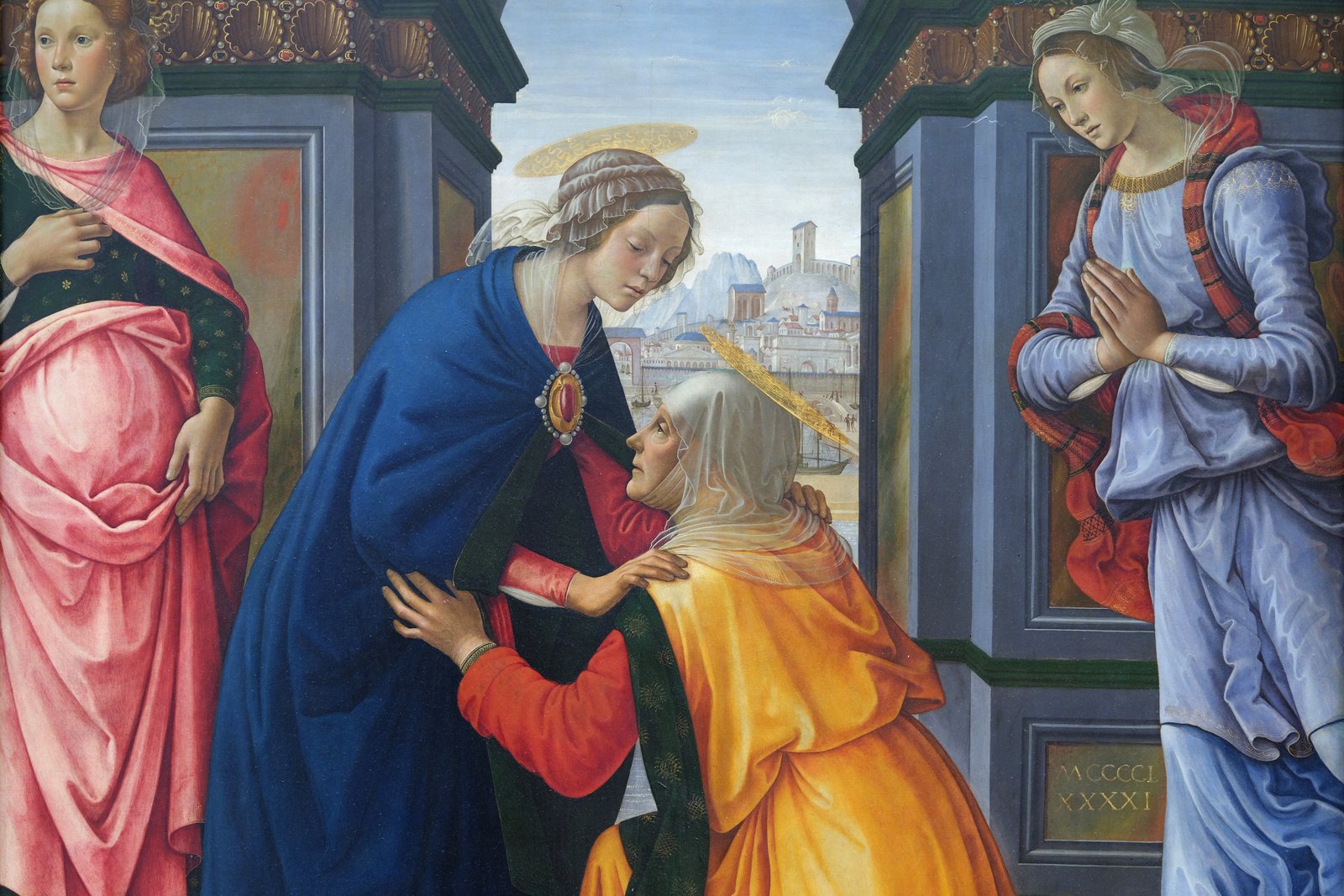
Domenico Ghirlandaio, "The Visitation," 1491, Louvre — public domain.
Elizabeth was Mary's relative — Luke calls her a "kinswoman" — and, according to the angel's own words to Mary, was then six months into a pregnancy long thought impossible; she and her husband Zechariah, a temple priest, were both elderly and had been childless. The child Elizabeth carried would become John the Baptist. This was the news, in fact, that Gabriel had offered Mary as a sign that "nothing will be impossible for God" (Luke 1:37).
A Leap Before a Word Was Explained
What happens the moment Mary arrives is one of the most striking small details in the infancy narratives. Before any conversation, before Mary has said anything about what happened to her in Nazareth, something happens spontaneously: "When Elizabeth heard Mary's greeting, the infant leaped in her womb, and Elizabeth, filled with the holy Spirit, cried out in a loud voice" (NABRE, Luke 1:41-42). The unborn John, later remembered by Christian tradition as the one who would "prepare the way" for Jesus, seems to recognize the presence of Christ before anyone has spoken a word of explanation.
Elizabeth's greeting is itself prophetic: "Most blessed are you among women, and blessed is the fruit of your womb. And how does this happen to me, that the mother of my Lord should come to me?" (NABRE, Luke 1:42-43). Elizabeth calls Mary's unborn child "my Lord" — an extraordinary declaration for the Gospel to place this early, from the mouth of an ordinary elderly woman rather than an angel. She closes with a line the Church has long read as a model of trusting faith: "Blessed are you who believed that what was spoken to you by the Lord would be fulfilled" (NABRE, Luke 1:45).
Mary's Answer: The Magnificat
Mary's response to Elizabeth's greeting is not modest silence but song. Her hymn, known from its opening Latin word as the Magnificat, opens: "My soul proclaims the greatness of the Lord; my spirit rejoices in God my savior. For he has looked upon his handmaid's lowliness; behold, from now on will all ages call me blessed" (NABRE, Luke 1:46-48).
The prayer that follows draws heavily on the Old Testament — its structure and many of its phrases echo Hannah's prayer of thanksgiving after the birth of Samuel (1 Samuel 2:1-10), suggesting Mary, like Hannah, was a woman deeply formed by Israel's own prayer tradition rather than someone reciting spontaneous, unprecedented words. But the Magnificat's content goes further than personal gratitude; it becomes a sweeping statement about how God acts in the world: "He has shown might with his arm, dispersed the arrogant of mind and heart. He has thrown down the rulers from their thrones but lifted up the lowly. The hungry he has filled with good things; the rich he has sent away empty" (NABRE, Luke 1:51-53). It is a hymn about reversal — about a God who consistently favors the humble over the powerful — spoken by a poor, unmarried teenager from an unremarkable town.
The Magnificat closes by anchoring this reversal in Israel's own covenant history: "He has helped Israel his servant, remembering his mercy, according to his promise to our fathers, to Abraham and to his descendants forever" (NABRE, Luke 1:54-55). The Church has prayed this hymn daily for centuries as part of Evening Prayer, making Mary's words at this one household visit among the most frequently repeated prayers in Christian history.
Three Months, Then Home
Luke tells us simply, "Mary remained with her about three months and then returned to her home" (NABRE, Luke 1:56) — likely staying through the birth of John the Baptist before returning to Nazareth. The chapter continues immediately into the account of John's birth and Zechariah's own prophetic canticle, the Benedictus, forming a matched pair with Mary's Magnificat: two households, two unexpected pregnancies, and two hymns of praise breaking out within the same short span of Luke's narrative.
The Visitation sits at a hinge point in the Gospel story, joining the two conception narratives — John's and Jesus's — into a single scene of recognition, joy, and prophecy, before either child has been born. For the fuller context of Mary's own story in these early chapters, see our article on The Betrothal of Mary and Joseph.
Trivia
What is the Visitation in the Bible?
Why did Mary visit Elizabeth?
What did Elizabeth say when Mary arrived?
What is the Magnificat?
How long did Mary stay with Elizabeth?
You May Also Like
Related Reading