The Nativity of Jesus


A census that moved a pregnant woman ninety miles
Luke frames the birth of Jesus inside a very ordinary piece of Roman bureaucracy: a decree from Caesar Augustus requiring "the whole world" under his rule to be enrolled, with each person registering in their ancestral town rather than wherever they currently lived (Luke 2:1-3, NABRE). Because Joseph belonged to the line of David, that meant traveling from Nazareth in Galilee down to Bethlehem in Judea — a journey of roughly ninety miles by the most direct route, undertaken with Mary "who was with child" (Luke 2:4-5, NABRE). Bethlehem itself carried deep significance beyond simply being Joseph's ancestral town: centuries earlier, the prophet Micah had named it as the origin of a future ruler for Israel, which is part of why later Christian reflection saw the setting of Jesus's birth as no accident of bureaucracy but a fulfillment of that older expectation.
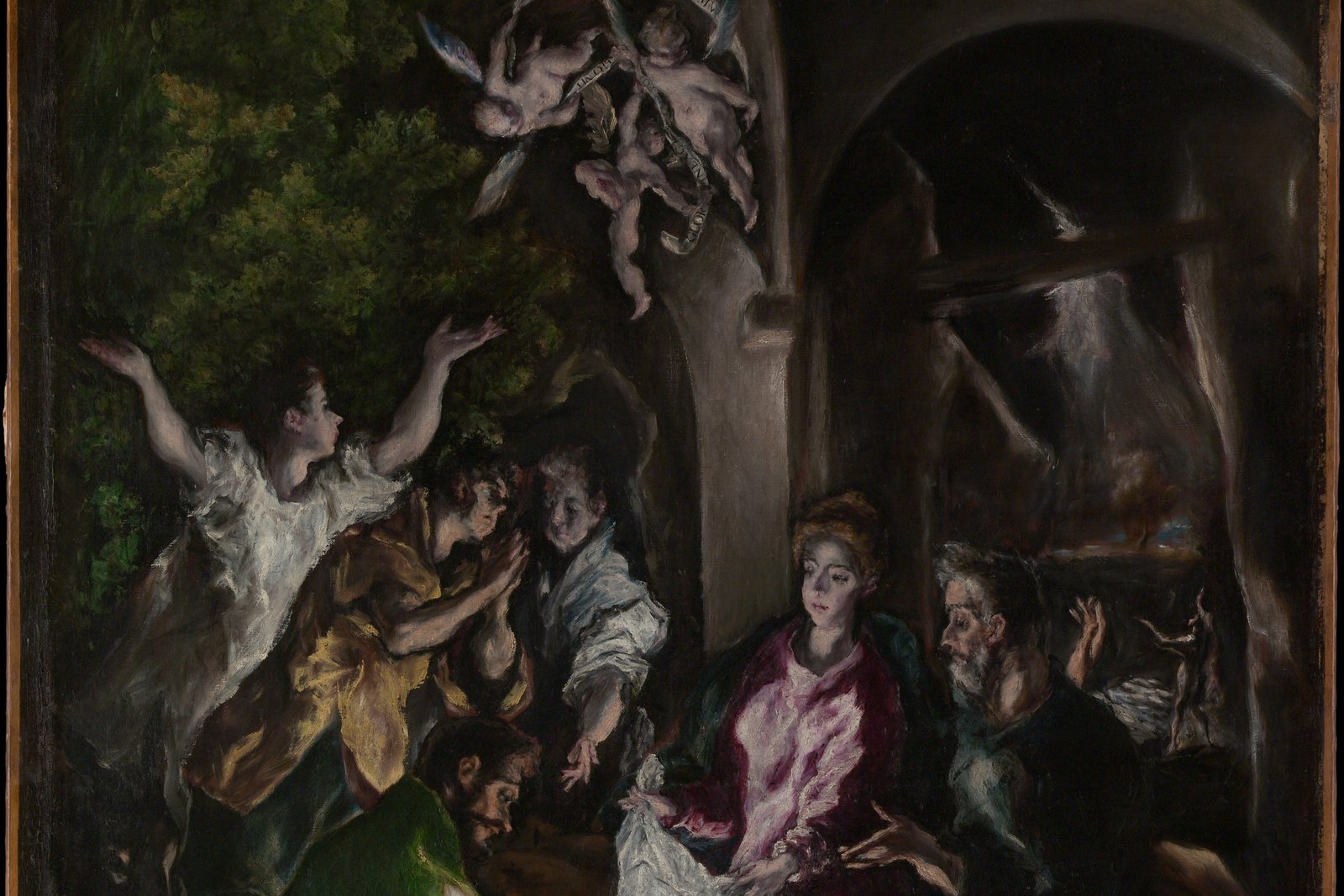
El Greco, "The Adoration of the Shepherds," c. 1605-10, The Metropolitan Museum of Art. Public domain.
Luke doesn't describe the trip itself. He moves straight from the decree to their arrival, letting the scale of the obligation — an imperial-wide census pulling a pregnant woman across the country — sit in the background rather than the foreground. Historians have long debated the precise historical census Luke has in mind, since Roman records of a single empire-wide enrollment matching his description exactly have not survived, but the broader practice of periodic regional census-taking under Roman rule, requiring travel to one's home district, is well documented for the period regardless of the exact date.
No room, and no drama made of it
The birth itself is recorded in a single understated sentence: "she gave birth to her firstborn son. She wrapped him in swaddling clothes and laid him in a manger, because there was no room for them in the inn" (Luke 2:7, NABRE). It's worth noting how little the Gospel text actually says here — no stable is explicitly named, no animals are mentioned, no cave, no innkeeper turning them away at the door. Those familiar details come from centuries of later devotional tradition and artistic imagination, built outward from the one concrete fact Luke does give: a manger, an animal feeding trough, used as a crib because there was nowhere else. One early and very old tradition, going back at least to the second century, places the birth specifically in a cave used for animal shelter on the edge of Bethlehem — a tradition old enough that the Basilica of the Nativity was built directly over that site, and it remains one of the oldest continuously used Christian churches in the world.
News delivered to men working the night shift
What Luke does linger on is who receives the announcement of this birth, and it isn't anyone with rank. "Shepherds in that region" are "living in the fields and keeping the night watch over their flock" when "the angel of the Lord appeared to them" (Luke 2:8-9, NABRE). Shepherding in first-century Judea was low-status work, often looked down on. The angel's message to them is direct and specific: "today in the city of David a savior has been born for you who is Messiah and Lord," and gives them a sign built entirely out of the same poverty that marked the birth itself — "you will find an infant wrapped in swaddling clothes and lying in a manger" (Luke 2:11-12, NABRE).
A multitude of voices, then an empty field
The angel isn't alone for long. Luke describes "a multitude of the heavenly host" joining in, praising God with words that have echoed through Christian liturgy ever since: "Glory to God in the highest and on earth peace to those on whom his favor rests" (Luke 2:13-14, NABRE). Then, just as abruptly, they're gone, and the shepherds are left standing in an ordinary field making an ordinary decision — to go see for themselves. They find things exactly as described: "Mary and Joseph, and the infant lying in the manger" (Luke 2:16, NABRE).
Two very different responses to the same night
Luke draws a quiet but deliberate contrast in how people respond to what's happened. The shepherds go out and tell everyone, and "all who heard it were amazed" (Luke 2:18, NABRE) — a public, immediate reaction. Mary's response is set apart from that entirely: she "kept all these things, reflecting on them in her heart" (Luke 2:19, NABRE). It's one of the few windows Luke gives into Mary's interior life directly, and it frames her not as a passive figure in the story but as someone actively processing events whose full meaning she can't yet see.
A story that keeps being retold in new settings
Few scenes from the Gospels have been depicted in art as often, or in as many different cultural settings, as this one. Painters across centuries and continents have placed the manger scene within their own local landscapes and architecture, dressing Mary, Joseph, and the shepherds in the clothing of their own era rather than first-century Judea — a visual instinct that captures something true about how Christians have always understood the Nativity: not as a story locked into one particular time and place, but as an event whose meaning belongs to every culture that receives it. The custom of building a physical Nativity scene, with figures of the Holy Family, the shepherds, and eventually the Magi arranged around a manger, is traditionally traced to Saint Francis of Assisi, who staged a living Nativity scene in a cave near Greccio, Italy, in 1223 specifically to help ordinary people, many of them unable to read, connect with the humility of Christ's birth in a direct, physical way. That tradition has shaped Christmas devotion ever since, alongside the wider account of the Holy Family and their life together in the years that followed Bethlehem.
Trivia
Why were Joseph and Mary in Bethlehem at all?
What does the Gospel actually say about the manger and the inn?
Who received the news of Jesus's birth first, and how?
What sign did the angel give the shepherds to identify the child?
How did Mary respond to everything that happened around the birth?
Related Reading