The Betrothal of Mary and Joseph

Two Gospels, two vantage points
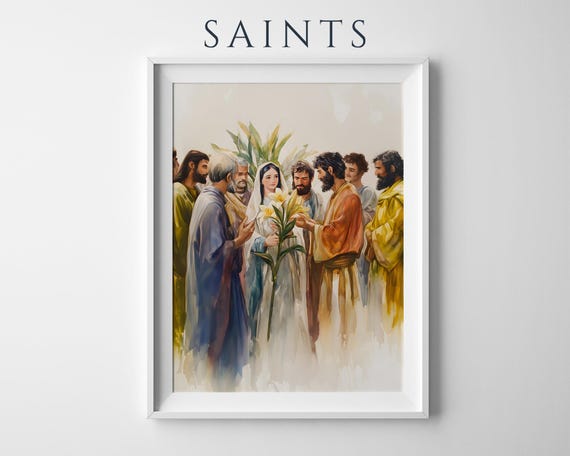
Matthew and Luke tell the story of Mary and Joseph's betrothal from two different angles, and reading them together gives the fuller picture. Luke's Gospel focuses on Mary's side: the angel Gabriel arrives "to a virgin betrothed to a man named Joseph, of the house of David" (NABRE, Luke 1:27) and announces that she will conceive a son through the Holy Spirit, who "will be called Son of the Most High" (Luke 1:32). Mary's response — "How can this be, since I have no relations with a man?" (Luke 1:34) — makes clear that at this stage in the betrothal, she and Joseph had not yet come together as husband and wife in the fuller sense.
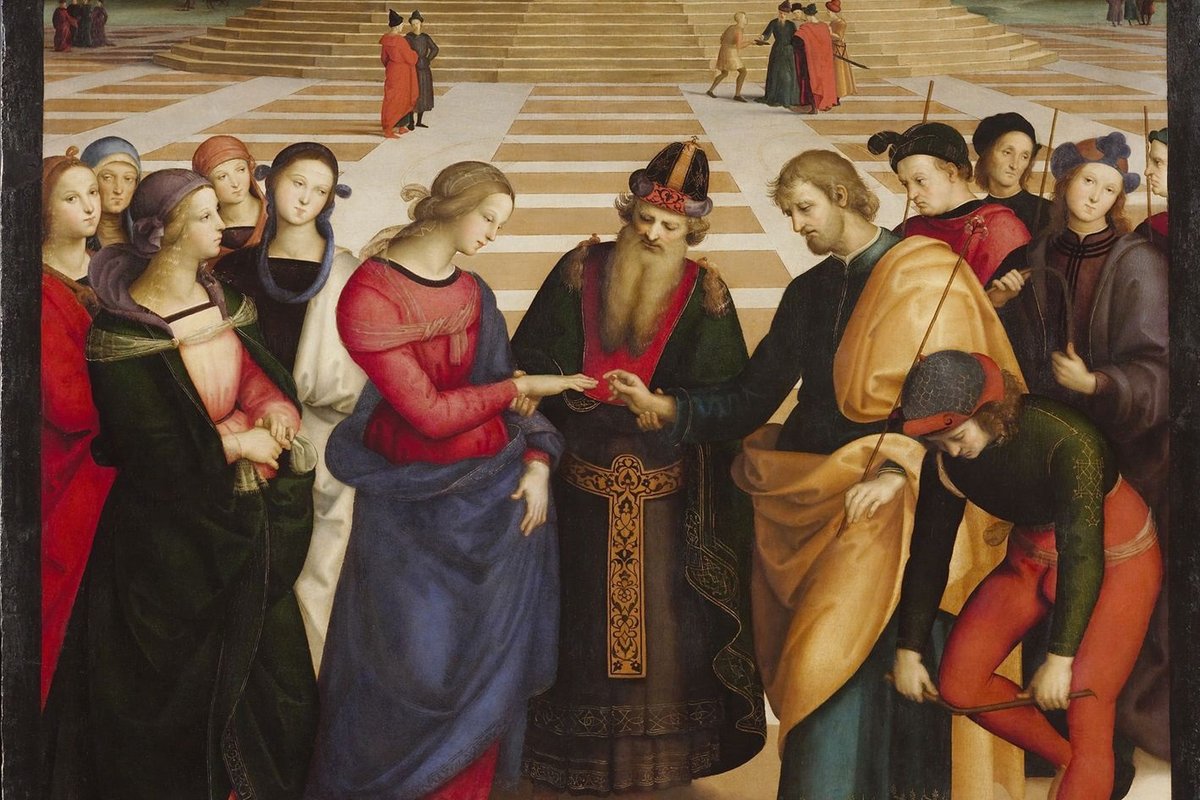
Raphael, "The Marriage of the Virgin," 1504, Pinacoteca di Brera, Milan — public domain.
Matthew's Gospel picks up the story from Joseph's side, and its stakes are sharper than they might first appear to a modern reader. "Now this is how the birth of Jesus Christ came about. When his mother Mary was betrothed to Joseph, but before they lived together, she was found with child through the holy Spirit" (NABRE, Matthew 1:18).
Why betrothal was already marriage
Under first-century Jewish custom, betrothal (known in Hebrew as erusin) wasn't a casual promise to marry later — it was a legally binding contract that made the couple husband and wife in the eyes of the Law, even though the bride typically remained in her father's household for a period, often around a year, before the second stage of the marriage began and she moved into her husband's home. Breaking a betrothal required a formal bill of divorce, and unfaithfulness during this period was treated with the same seriousness as adultery within a completed marriage.
That context makes Joseph's dilemma much starker than "engagement trouble." Mary's pregnancy, unexplained to him, put her in a position where the Law technically allowed for a public accusation with severe consequences. Matthew tells us Joseph, "since he was a righteous man, yet unwilling to expose her to shame, decided to divorce her quietly" (NABRE, Matthew 1:19) — the most merciful path the Law allowed him, chosen before he had any idea what had actually happened. Only after an angel appeared to him in a dream, explaining that the child "has been conceived... through the holy Spirit" (Matthew 1:20), did Joseph take Mary into his home as his wife.
Matthew's careful word choice here matters. Calling Joseph "righteous" (Greek dikaios) while describing his intent to divorce quietly isn't a contradiction — under the Law, ending even a fraudulent-seeming betrothal still required a formal legal process, and Joseph's righteousness is shown precisely in choosing the most discreet, least punitive version of that process available to him, a private document handed over quietly rather than a public accusation that could have exposed Mary to disgrace or worse. Even before the angel's explanation reframed everything, Joseph was already trying to protect Mary within the constraints the Law gave him.
What the two-stage marriage custom protected
The gap between betrothal and full cohabitation wasn't simply bureaucratic delay — it served real social purposes in a small, close-knit society. It gave both families time to finalize financial arrangements like the dowry, gave the groom time to prepare a home, often by adding a room onto his father's house, and gave the whole community a public interval in which the couple's committed status was known and respected even before the marriage was formally completed. Breaking that interval with an unexplained pregnancy wasn't just Mary's private difficulty; it directly implicated the honor of both families in a culture where reputation carried enormous practical weight.
The legend of the flowering staff
Centuries of Christian art depict a very different scene from the betrothal story: Joseph holding a staff that has miraculously burst into bloom, standing before a young Mary as a priest joins their hands. That image comes not from the Gospels but from the Protoevangelium of James, a text written roughly in the mid-to-late second century that was never accepted into the New Testament canon. According to that account, the high priest gathered the widowers of Israel and had each one bring a staff; when Joseph's staff was returned to him, a dove flew from it and landed on his head, marking him as the one chosen to become Mary's guardian. The Protoevangelium portrays Joseph as an elderly widower rather than the young craftsman popular imagination sometimes pictures, and its interest throughout lies in defending Mary's consecrated virginity — a theological concern of the text's author more than a historical record.
It's worth being direct about what this means: the flowering-staff story is pious legend, not Scripture, and carries no doctrinal weight in Catholic teaching. But its influence on Christian art has been enormous — it's the origin of the entire "Marriage of the Virgin" (Sposalizio) artistic tradition, including Raphael's famous 1504 painting of the scene, and it shaped how generations of Christians pictured Joseph long before modern scholarship separated canonical Gospel material from later embellishment.
A quiet foundation
What both Gospel accounts agree on, without embellishment, is something simpler and arguably more remarkable than any staff or dove: two people, already bound to each other under the Law, trusting an explanation that asked everything of their faith before either of them had certainty. Joseph's willingness to take Mary into his home despite what the Law would have permitted him to do, and Mary's own quiet acceptance of what Gabriel told her, together form the foundation the rest of the Holy Family's story is built on — a theme this blog explores further in the Holy Family together.
Trivia
What did it mean for Mary and Joseph to be betrothed?
Why did Joseph plan to divorce Mary quietly?
Is the story of Joseph's flowering staff in the Bible?
Is there a Catholic feast day for the betrothal of Mary and Joseph?
What does the Annunciation have to do with Mary and Joseph's betrothal?
Related Reading