The Presentation of Jesus: An Old Man's Final Wish

An Ordinary Ritual, Faithfully Kept
Forty days after Jesus's birth, Mary and Joseph travel to Jerusalem to fulfill two distinct requirements of Jewish law: the mother's ritual purification after childbirth, and the consecration of a firstborn son to the Lord, rooted in Exodus's command that "every male that opens the womb shall be consecrated to the Lord" (NABRE, Luke 2:23). They bring the offering prescribed for families who could not afford a lamb — "a pair of turtledoves or two young pigeons" (NABRE, Luke 2:24) — a small, easily overlooked detail that quietly signals the family's modest means. This is not, on its surface, an extraordinary scene. It is a young couple doing what devout Jewish families of their time and place were expected to do.
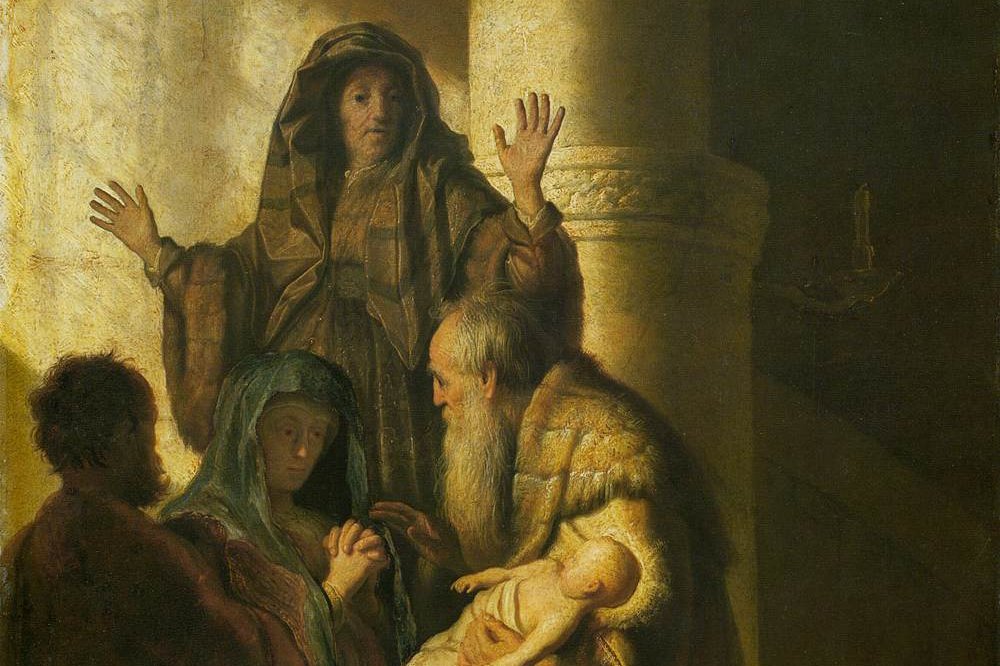
Rembrandt, "Simeon and Anna Recognize the Lord in Jesus," 1627, Hamburger Kunsthalle — public domain.
A Man Who Had Been Waiting His Whole Life
What makes the day extraordinary is who is waiting for them inside. "There was a man in Jerusalem whose name was Simeon. This man was righteous and devout, awaiting the consolation of Israel, and the holy Spirit was upon him" (NABRE, Luke 2:25). Luke tells us it had been revealed to Simeon "that he should not see death before he had seen the Messiah of the Lord" (NABRE, Luke 2:26) — a promise that had presumably shaped years, perhaps decades, of Simeon's life, an old man's entire sense of purpose narrowed down to a single unfulfilled expectation.
"He came in the Spirit into the temple," Luke writes (NABRE, Luke 2:27), and when Mary and Joseph arrive with their infant son to carry out the customary rite, Simeon is somehow there at precisely the right moment. He takes the child into his arms — a poor stranger's baby, to any outside observer — and speaks words that have echoed through Christian worship ever since: "Now, Master, you may let your servant go in peace, according to your word, for my eyes have seen your salvation, which you prepared in sight of all the peoples, a light for revelation to the Gentiles, and glory for your people Israel" (NABRE, Luke 2:29-32). This prayer, known from its Latin opening as the Nunc Dimittis ("now you dismiss"), has been prayed by the Church at Night Prayer for centuries — the words of a man ready to die now that his life's waiting is over.
A Prophecy of Both Glory and Sorrow
Simeon's words to Mary and Joseph don't stop at celebration. After blessing them, he turns to Mary specifically with something heavier: "Behold, this child is destined for the fall and rise of many in Israel, and to be a sign that will be contradicted (and you yourself a sword will pierce) so that the thoughts of many hearts may be revealed" (NABRE, Luke 2:34-35). It is one of the earliest hints in the Gospel of Luke that Jesus's mission will be divisive rather than universally welcomed, and the first direct suggestion that Mary's own life will include profound grief — a foreshadowing Christian tradition has long connected to her presence at the foot of the cross decades later.
Anna, Who Never Stopped Watching
A second figure appears in the same moment, easy to overlook beside Simeon's dramatic prophecy but treated by Luke as no less significant. "There was also a prophetess, Anna, the daughter of Phanuel, of the tribe of Asher. She was advanced in years, having lived seven years with her husband after her marriage, and then as a widow until she was eighty-four. She never left the temple, but worshiped night and day with fasting and prayer" (NABRE, Luke 2:36-37). Anna's entire adult life, by this account, had been spent in sustained devotion within the Temple precincts, decades of quiet fidelity that most of Jerusalem likely never noticed.
"Coming forward at that very time, she gave thanks to God and spoke about the child to all who were awaiting the redemption of Jerusalem" (NABRE, Luke 2:38). Where Simeon's witness is preserved as a formal prayer, Anna's is described more simply as public testimony — she becomes, in effect, one of the Gospel's first evangelists, telling others what she has recognized in this particular infant. Luke pairs a man and a woman, both elderly, both marked by long patient faithfulness, as the first two people outside Jesus's own family to publicly identify who he is.
A Feast That Endures
The Church continues to mark this episode each year on February 2, the Feast of the Presentation of the Lord, sometimes called Candlemas because of the tradition of blessing candles that developed around Simeon's description of Jesus as "a light for revelation to the Gentiles." The feast falls exactly forty days after Christmas, closing the Christmas season with a scene that is deliberately unspectacular in its setting — a poor family completing a routine legal obligation — and yet, through the eyes of two elderly, faithful witnesses, becomes one of the Gospel's clearest early declarations of who the infant Jesus is.
Trivia
What is the Presentation of Jesus at the Temple?
Who was Simeon in the Bible?
What is the Nunc Dimittis?
What did Simeon prophesy to Mary?
Who was Anna the prophetess?
Related Reading