The Healing of the Blind Man

A beggar with a name
Most people healed by Jesus in the Gospels go unnamed — a woman with a hemorrhage, a man born blind, a paralytic lowered through a roof. Mark breaks that pattern here, and does it with unusual specificity: "Bartimaeus, a blind man, the son of Timaeus, sat by the roadside begging" (Mark 10:46, NABRE). Scholars have long noted that "Bartimaeus" already means "son of Timaeus" in Aramaic, so Mark is essentially naming him twice, in two languages, as if making sure no one could miss or forget who this was. By the time Mark's Gospel was circulating among early Christian communities, Bartimaeus may well have been a known figure among them — someone whose healing wasn't just a story about Jesus' power, but a story about a real person whose life had visibly, permanently changed.
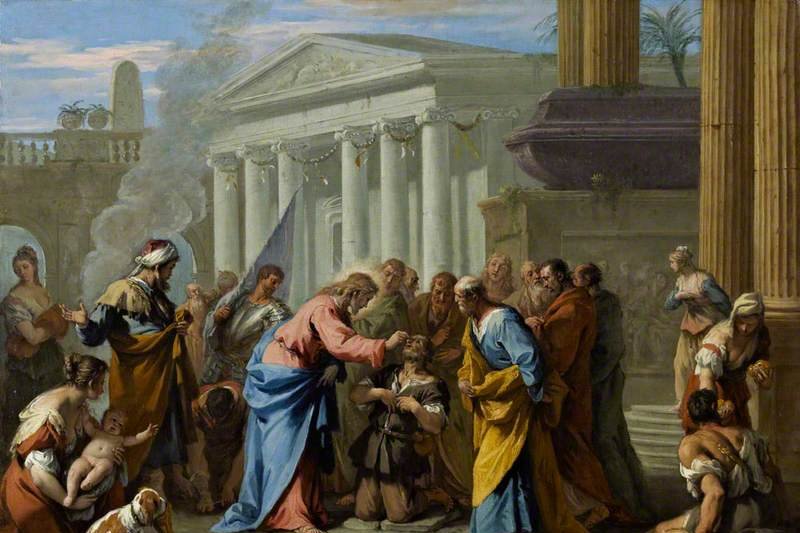
Sebastiano Ricci, "Christ Healing the Blind Man," c. 1712-1716, National Galleries of Scotland. Public domain.
Outside Jericho, on the way to Jerusalem
The setting matters. Jesus is "leaving Jericho with his disciples and a sizable crowd" (Mark 10:46, NABRE), which places this healing at a pivotal moment in Mark's Gospel — the last stop before the road climbs up toward Jerusalem, where Jesus is heading directly into his passion. Mark has structured his Gospel so that this is the final healing miracle before the Jerusalem narrative begins, and it comes right after a section where Jesus has been repeatedly telling his disciples, who keep failing to understand, exactly what awaits him there. A blind man about to receive his sight, positioned at the literal threshold of the road to the cross, carries an obvious symbolic weight that Mark's original audience would not have missed.
Shouted down, and shouting louder
When Bartimaeus hears that it's Jesus of Nazareth passing by, he doesn't hesitate: "he began to cry out and say, 'Jesus, son of David, have pity on me'" (Mark 10:47, NABRE). The crowd's response is immediate and harsh — "many rebuked him, telling him to be silent" (Mark 10:48, NABRE). It's worth pausing on how ordinary this reaction is. A blind beggar shouting from the roadside was, to most people in that crowd, an interruption, an embarrassment, someone who should know his place and not make a scene in front of the visiting rabbi. Bartimaeus's response to being silenced is the moment the whole story turns on: "he kept calling out all the more" (Mark 10:48, NABRE). He doesn't quiet down to match what's expected of him. He gets louder.
A title that names who Jesus really is
The words Bartimaeus shouts aren't a generic plea for help — "son of David" is a specific, loaded title, tied to the ancient promise that a descendant of King David would one day restore Israel and reign as the promised Messiah. Throughout Mark's Gospel, the identity of Jesus is treated as something gradually, carefully revealed, often to the confusion of the very people closest to him. Here, a blind beggar on the side of the road — someone with no formal standing, no education in the Law, nothing but persistence and need — is the one who names Jesus correctly, publicly, twice, while the crowd tries to shut him up. Mark seems to be making a pointed contrast: physical blindness and spiritual sight are not the same thing, and in this story it's the blind man who sees clearly what everyone else in the crowd is missing.
The question Jesus had just asked someone else
"Jesus stopped and said, 'Call him'" (Mark 10:49, NABRE). Bartimaeus responds by throwing off his cloak — likely his only real possession, spread on the ground to collect coins from passersby, and something a beggar would ordinarily guard carefully — and springs up to come to Jesus (Mark 10:50, NABRE). Jesus then asks him a question: "What do you want me to do for you?" (Mark 10:51, NABRE). Careful readers of Mark will recognize that exact question from just a few verses earlier, where James and John, two of Jesus' own inner circle, approach him wanting to be seated at his right and left hand in glory (Mark 10:35-37, NABRE). The same question, asked of the ambitious insider and the desperate outsider, produces two radically different requests — one for status, one simply to see.
"Your faith has saved you"
Bartimaeus's answer is direct: "Master, I want to see" (Mark 10:51, NABRE). Jesus doesn't perform an elaborate ritual or touch his eyes, as he does in some other healing accounts — he simply says, "Go your way; your faith has saved you" (Mark 10:52, NABRE), and Bartimaeus receives his sight immediately. Luke's parallel account renders the same moment slightly differently — "Have sight; your faith has saved you" (Luke 18:42, NABRE) — but both Gospels use the same striking word for "saved," the Greek term also used throughout the New Testament for spiritual salvation. The healing of Bartimaeus's eyes and the deeper healing of faith are presented as inseparable, one and the same act.
Following on the way
What happens next is easy to read past, but it's the detail that gives the whole story its lasting shape: Bartimaeus, now able to see, doesn't go home, doesn't return to begging in a new location, doesn't simply thank Jesus and walk off into his restored life. He "followed him on the way" (Mark 10:52, NABRE). "The Way" would become one of the earliest names used for the followers of Jesus in the Acts of the Apostles, and Mark's choice of words here is almost certainly deliberate — Bartimaeus doesn't just receive a miracle, he becomes a disciple, joining the very crowd heading with Jesus up to Jerusalem and, though he couldn't have known it yet, toward the cross. Luke's account adds that he went "giving glory to God," and that the crowd who witnessed it did the same (Luke 18:43, NABRE) — the healing rippling outward from one man's persistence into public praise.
A model for prayer that refuses to be quiet
The Church has long held up Bartimaeus's cry — "Jesus, son of David, have pity on me" — as a model for prayer, not least because of its close resemblance to the Jesus Prayer used in Eastern Christian spirituality, and because it captures something essential about persistence in faith: the willingness to keep asking, keep calling out, even when the people around you, or your own doubts, tell you to be silent. Readers who want more of the pattern Jesus establishes throughout his healing ministry, and how each miracle points toward a larger truth about who he is, will find further examples in our guide to gospel stories and parables of Jesus. Bartimaeus's story ends not with him healed and left behind, but healed and walking forward — proof that what he asked for was never really just his sight.
Trivia
Who is the blind man Jesus heals outside Jericho?
What did the crowd do when the blind man called out to Jesus?
What title did the blind man use to address Jesus, and why does it matter?
What question does Jesus ask the blind man, and why does it matter that he asks it?
What did the blind man do immediately after receiving his sight?
What does Jesus mean by telling him, "your faith has saved you"?
Related Reading