The Widow's Mite

A scene Jesus watches rather than stages
Unlike many of Jesus's most famous teachings, this one isn't delivered as a parable or a planned lesson — it's an observation made in real time. Mark places it near the end of Jesus's public teaching in the Temple, immediately after he warns the crowd about scribes who "like to go around in long robes," accept honor in public, and yet "devour the houses of widows" while making a show of "lengthy prayers" (Mark 12:38-40, NABRE). Then, almost as if to illustrate the warning with a concrete example, Mark writes: "He sat down opposite the treasury and observed how the crowd put money into the treasury. Many rich people put in large sums" (Mark 12:41, NABRE). Jesus isn't teaching yet. He's watching.
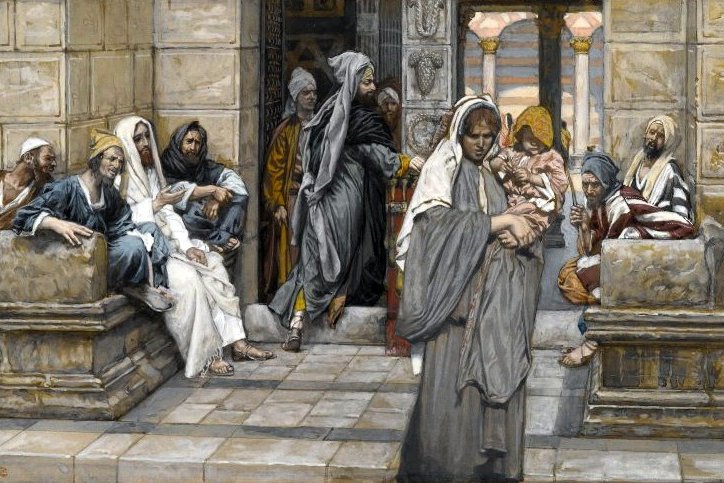
James Tissot, "The Widow's Mite," c. 1886-1894, Brooklyn Museum — public domain.
Two coins, named precisely
Into that stream of large, visible contributions comes someone the text identifies with deliberate specificity: "A poor widow also came and put in two small coins worth a few cents" (Mark 12:42, NABRE). The translation "worth a few cents" is doing real work here — these were among the smallest-denomination coins in circulation in first-century Judea, together worth a fraction of a single day's wage. The famous English phrase "the widow's mite" comes from the King James Version's older word for a similarly tiny coin, not from anything in the original Greek text itself, but the image it has left in popular memory — a poor woman quietly giving almost nothing of measurable value — captures the scene accurately enough.
A widow, specifically
It matters that Mark identifies her as a widow and not simply as a poor woman. In first-century Jewish society, widows without adult sons to support them were among the most economically vulnerable people in the community, frequently dependent on charity, family generosity, or the Temple's own limited provisions for the destitute. That vulnerability is precisely what makes Jesus's warning about scribes "devouring the houses of widows," delivered only two verses earlier, land with such weight — and it's part of why many readers of this passage have long read the two scenes together rather than as unrelated observations. A system capable of leaving a widow with only two small coins to her name, and a class of religious leaders capable of exploiting exactly that vulnerability for their own comfort, sit uncomfortably close together in Mark's account.
What Jesus actually measures
Jesus's comment to his disciples doesn't dispute the arithmetic — obviously, in raw terms, the wealthy donors gave more money than the widow did. What he redefines is the standard of measurement entirely. "Calling his disciples to himself, he said to them, 'Amen, I say to you, this poor widow put in more than all the other contributors to the treasury. For they have all contributed from their surplus wealth, but she, from her poverty, has contributed all she had, her whole livelihood'" (Mark 12:43-44, NABRE). The Greek word behind "livelihood" can also be translated "life" — she gave, in some real sense, not spare change but her means of continuing to live. The rich donors' gifts cost them nothing they would miss. Hers cost her everything she had left to lose.
A story Luke preserves almost word for word
Luke's Gospel records the same episode with only minor differences in wording, placing it in a similarly weighty position — right before Jesus's extended teaching about the destruction of the Temple and the end times (Luke 21:1-4, followed immediately by Luke 21:5 onward). That positioning in both Gospels, immediately before major turning points in each narrative, suggests the early Church regarded this small, quiet scene as more than an isolated anecdote about charitable giving. It functions almost as a hinge — a last, human-scaled image of true devotion offered right before the Gospel narrative turns toward much larger and more dramatic events.
An image many painters have chosen to render quietly
James Tissot, whose watercolor is reproduced above, painted the scene as part of an extensive series illustrating the life of Christ, based on research trips he made to the Holy Land specifically to render Gospel settings with historical and architectural accuracy rather than generic biblical imagery. His widow is a small, almost anonymous figure against the scale of the Temple architecture around her — a choice that mirrors the Gospel's own point exactly: the moment that matters most in the scene is easy to miss unless you're watching closely, the way Jesus was.
Why the story still unsettles easy assumptions about giving
The widow's mite resists being reduced to a simple lesson about donating money, precisely because the Gospel text refuses to draw that lesson explicitly. Jesus doesn't tell his disciples to imitate her, nor does he instruct the crowd to give away everything they have; he simply names what he sees and lets the observation stand. What the passage does insist on, without qualification, is that generosity isn't measured by the size of the gift but by what remains for the giver afterward — a standard that quietly indicts comfortable giving as much as it praises sacrificial giving. Read alongside the cleansing of the temple, which takes place in the same courts only days earlier in the Gospel narrative, the widow's two small coins offer a striking contrast: where Jesus overturns tables in anger at commerce corrupting sacred space, he watches this quieter transaction with something closer to reverence.
Trivia
Where in the Bible is the story of the widow's mite found?
What exactly did the widow put into the treasury?
Why did Jesus say the widow gave more than the rich donors, when her gift was smaller in actual value?
Does this story mean Jesus wanted the widow to give away her last money?
What was the Temple treasury Jesus is described as sitting near?
Related Reading