Morning and Evening Prayer: A Simple Routine for Beginners

Why morning and evening, specifically
The idea of bookending the day with prayer is old — older than Christianity itself, rooted in the Jewish practice of set daily prayer times that the earliest Church carried forward. The Catechism doesn't treat prayer as an occasional favor Catholics do for God on good days; it describes it as a "vital and personal relationship with the living and true God" (CCC 2558), the kind of relationship that, like any other, withers without regular contact. Morning and evening aren't magic hours. They're the two moments in an ordinary day when most people can realistically pause: before the day's demands take over, and after they've finally let go.
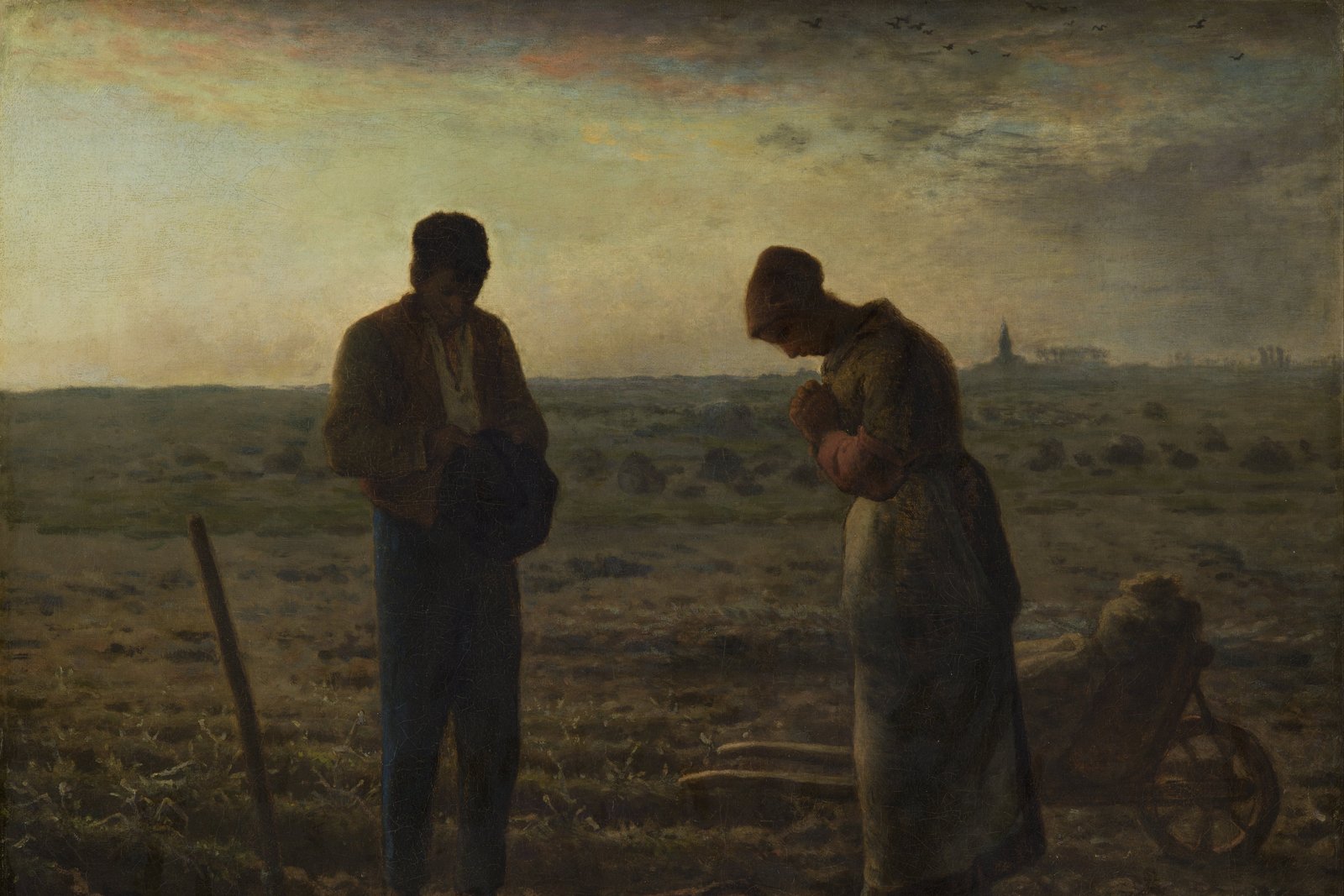
Jean-François Millet, The Angelus, 1857–1859, Musée d'Orsay — public domain.
The Church doesn't mandate a specific personal prayer schedule for lay Catholics — that kind of fixed structure belongs to the Liturgy of the Hours, prayed formally by clergy and religious and optionally by laypeople who choose it. What follows here is simpler: a beginner's routine built from prayers every Catholic already half-knows, arranged so that showing up matters more than getting it perfect.
A five-minute morning routine
Start with the Sign of the Cross — tracing the cross while naming the Trinity is itself a miniature statement of faith, not just a bookend gesture. From there, a traditional and genuinely simple next step is a Morning Offering: a short prayer handing the whole day, its work and its interruptions, over to God before any of it has happened yet. A commonly used version runs: "O Jesus, through the Immaculate Heart of Mary, I offer you my prayers, works, joys, and sufferings of this day." It isn't the only wording — Catholics have used various forms of the Morning Offering for centuries — but the shape is the same: everything that's about to happen, offered in advance.
After that, the Our Father is enough. It's the prayer Christ himself taught his disciples when they asked him how to pray (Matthew 6:9-13), and reciting it slowly, actually attending to the words rather than racing through them, does more than adding three more prayers on autopilot. Someone with an extra minute might add a Hail Mary, asking Mary's intercession for the day ahead, or glance at the day's Mass readings — freely available at usccb.org — even without attending Mass that day. None of these additions are required. The whole routine, done attentively, takes about five minutes.
A ten-minute evening routine
Evening prayer has a different job: not looking forward, but looking back. Saint Ignatius of Loyola built an entire method around this, commonly called the Examen, and a simplified version works well for beginners. Sit somewhere quiet for a few minutes and walk through five short steps: thank God for something specific from the day, ask for the grace to see the day honestly, review the day hour by hour or moment by moment, acknowledge where you fell short or turned away from love, and resolve something concrete for tomorrow. This is a devotional custom, not a Church-mandated formula — the Ignatian Examen is one well-tested way of doing this kind of reflection, not the only one.
Close with the Our Father again, and many Catholics add a Hail Mary and the Glory Be. A traditional favorite for the very last moment before sleep is the Angel of God prayer, asking one's guardian angel for protection through the night — a short, old prayer many people learned as children and never entirely let go of. The whole evening routine, unhurried, runs five to ten minutes.
Building the habit, not just the words
The single biggest reason beginner prayer routines fail isn't the prayers — it's the absence of a fixed trigger. "I'll pray sometime in the morning" rarely survives contact with an actual morning. Attaching the routine to something already automatic works far better: praying immediately after the alarm goes off, before checking a phone, or during the first cup of coffee; praying in bed right before turning off the evening light, before sleep has a chance to arrive first. The trigger does the remembering so the will doesn't have to.
It's also worth expecting the routine to feel mechanical at first, even boring some days. That's normal, not a sign of failure or of insincerity. The Catechism describes distraction and dryness in prayer as common difficulties nearly everyone faces (CCC 2729-2733), not evidence that the prayer "isn't working." The discipline itself — showing up at the same two moments, day after day — is what slowly turns a recited formula into an actual relationship, the same way any two people grow close less through occasional intense conversations than through the accumulated weight of many ordinary ones.
A missed day, or a night when evening prayer collapses into three words before sleep takes over, isn't a broken streak worth agonizing over. Catholic spiritual writers across the centuries return to the same advice: begin again tomorrow, without drama. A five-minute routine kept for a decade will shape a life far more than an ambitious hour-long plan kept for a week and then abandoned in discouragement. The goal was never perfection. It was contact — brief, repeated, faithful contact — kept up at the two hinges of an ordinary day.
For Catholics wanting to go deeper once this basic rhythm feels natural, the most important Catholic prayers are a natural next stop, along with a simple approach to praying the Rosary as a longer evening or weekend practice.
Trivia
How long should a beginner's morning and evening prayer routine take?
What prayers should I say in the morning?
Is an Examen the same thing as an examination of conscience for Confession?
Does the Catechism require Catholics to pray at fixed times of day?
What if I miss a day or fall asleep during evening prayer?
Related Reading