What Is a Plenary Council in the Catholic Church?

Not just another meeting of bishops
The word "council" gets applied loosely to a lot of different Catholic gatherings, which is part of why a plenary council is easy to confuse with something else entirely. In canon law, however, it's a precisely defined term: a plenary council is a formal legislative assembly of every bishop within a single ecclesiastical territory — most often an entire country — convened specifically to establish binding rules, called decrees, for how the Church operates within that territory. It isn't a conference for discussion, and it isn't a purely advisory body. Its decisions, once approved by Rome, carry the force of law.
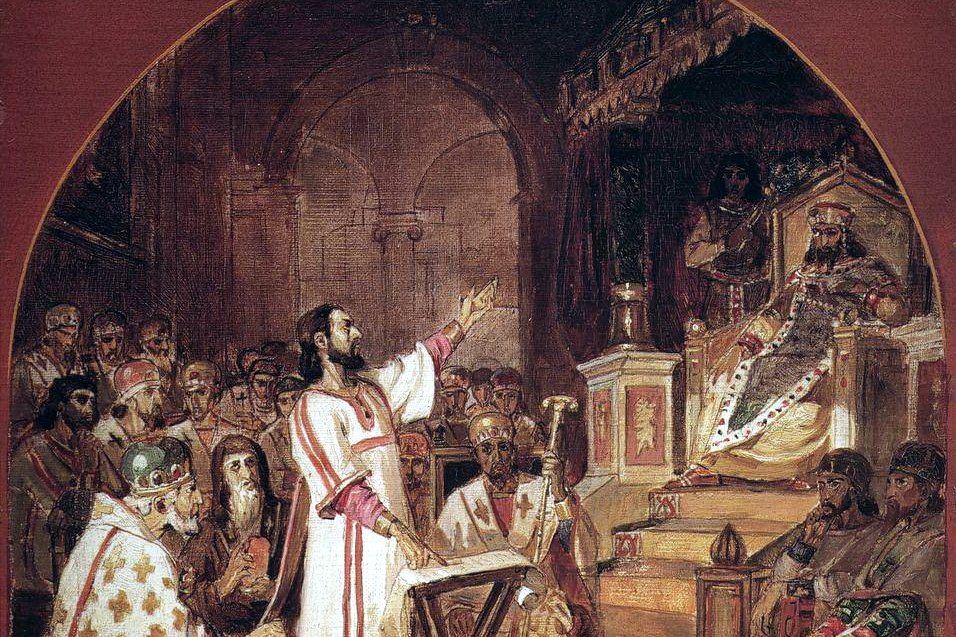
Vasily Surikov, The First Council of Nicaea, 1876 — public domain.
That last detail is what sets a plenary council apart from most other kinds of Church meetings people are likely to have heard of. A synod of bishops, in its most common modern usage — the periodic Synod of Bishops convened in Rome — functions primarily as a consultative body, gathering input and recommendations that the pope then weighs and acts on as he sees fit. A plenary council operates differently: its bishops don't just advise, they legislate, producing decrees that become genuinely binding Church law for their territory once the Holy See has reviewed and formally confirmed them.
Where "plenary" fits among Church councils
Canon law recognizes different levels of councils depending on scope, and understanding where a plenary council sits among them clarifies a lot:
- An ecumenical council — such as the Council of Trent, the First Vatican Council, or the Second Vatican Council — gathers bishops from across the entire worldwide Church and addresses matters of universal Catholic doctrine and discipline. These are rare; the Church has held only twenty-one in its entire history.
- A plenary council gathers all the bishops of one nation or a comparably large, clearly defined territory, and addresses matters specific to the Church within that region — questions of discipline, pastoral practice, and organization that don't require a decision from the universal Church, but do need consistent, binding direction across an entire country's dioceses.
- A provincial council is narrower still, gathering the bishops of a single ecclesiastical province (typically one archdiocese and its suffragan dioceses) rather than an entire nation.
The word "plenary" itself comes from the Latin plenus, meaning full or complete — a plenary council is, in principle, a complete gathering of every bishop with a see within the relevant territory, as opposed to a partial or regional subset.
The Baltimore councils: plenary councils in American practice
The clearest real-world example, and the one most directly relevant to Catholic life in the United States, is the sequence of three plenary councils held in Baltimore during the 19th century, at a time when Baltimore held a position of historic seniority among American dioceses. The First Plenary Council of Baltimore (1852) worked to establish consistent discipline across a rapidly growing and geographically scattered American Catholic Church. The Second Plenary Council (1866), held just after the Civil War, addressed the pastoral needs of a changing nation, including outreach to newly freed African Americans.
The Third Plenary Council of Baltimore (1884) proved by far the most consequential. Its decrees mandated that Catholic parishes establish parochial schools wherever possible, a decision that reshaped American Catholic life for generations and produced the vast network of Catholic elementary and secondary schools that still exists today. The same council also commissioned the Baltimore Catechism, the standardized question-and-answer text used to teach Catholic doctrine to American schoolchildren for much of the 20th century. No American plenary council has been held since 1884, though individual provincial councils and, more commonly today, the ordinary work of the United States Conference of Catholic Bishops (USCCB) — itself a standing conference rather than a legislative council in the canon law sense — now handle much of what a plenary council once addressed.
Why the distinction still matters
Understanding what a plenary council actually is helps clarify something often misunderstood about how the Catholic Church makes decisions: authority isn't simply concentrated in Rome issuing directives downward with nothing happening locally in between. Canon law builds in real structures — plenary and provincial councils among them — that let bishops of a given nation or region address matters specific to their own pastoral situation with genuine legislative authority, always subject to final confirmation by the Holy See, but not merely advisory in the meantime.
That's a meaningfully different kind of authority from a synod's consultative role, and recognizing the difference explains why a single 19th-century gathering of American bishops in Baltimore could produce decrees — on parochial schools, on catechesis, on diocesan discipline — with a lasting, binding, practical impact on Catholic life that outlasted the century it was written in.
It also explains why plenary councils remain, in principle, available to national bishops' conferences today, even though they've become rare in practice. Some countries have held plenary councils in recent decades to address contemporary pastoral challenges — Australia convened its Fifth Plenary Council between 2018 and 2022, covering everything from the Church's response to the clergy sexual abuse crisis to questions of governance and lay participation, with its decrees subsequently reviewed and confirmed, in modified form, by the Holy See. The tool the American bishops used in Baltimore to reshape a young, fast-growing national Church in the 19th century remains, technically, on the shelf for any national conference of bishops willing to take up the considerable work of using it.
Trivia
What is a plenary council in the Catholic Church?
How is a plenary council different from an ecumenical council?
How is a plenary council different from a synod of bishops?
How many plenary councils has the Catholic Church in the United States held?
Who has the authority to call a plenary council?
Related Reading