What Is a Relic, and Why Catholics Venerate Them

Remains, in the literal sense
The English word "relic" comes from the Latin reliquiae — remains, or things left behind — and that root captures the concept precisely. A relic is a physical object connected to a saint or to Christ himself: most directly, part of the saint's actual body, but also, more broadly, anything the saint owned, wore, or touched during life. The underlying conviction, present in Christianity from a very early period, is that a life lived in extraordinary holiness leaves something behind worth honoring in physical, tangible form — not just in memory or writing.
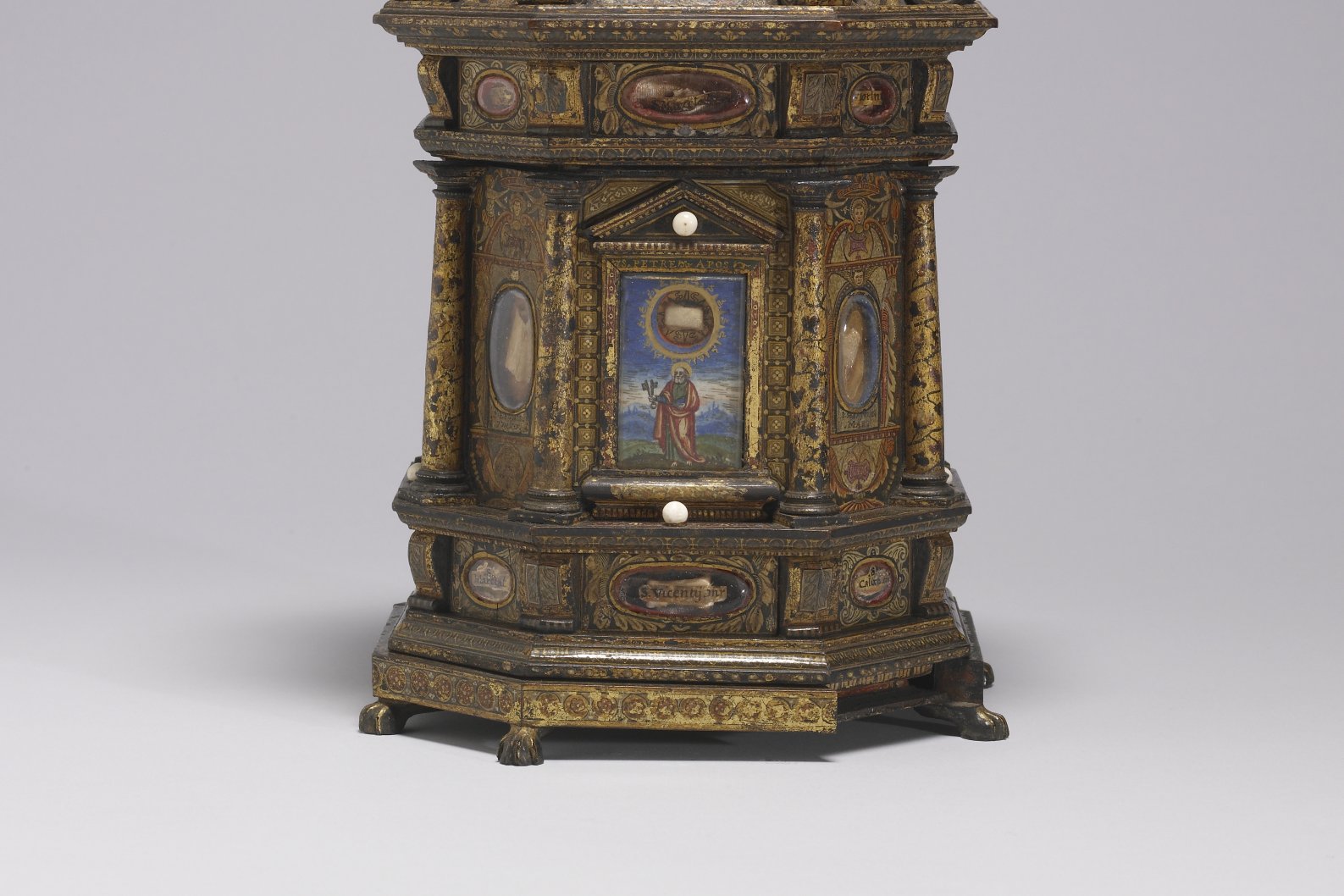
Anonymous Spanish artist, Reliquary with Relics of Christ's Shroud and of Various Martyrs, 1598, The Walters Art Museum — public domain.
Three classes, formally defined
Catholic practice organizes relics into three recognized classes:
- First-class relics are physical parts of the saint's own body — bone fragments, hair, or similar remains. These carry the highest degree of significance within the tradition.
- Second-class relics are objects the saint personally owned or used during life — a piece of clothing, a rosary, a book that belonged to them.
- Third-class relics are objects that have been touched to a first-class relic, typically a small piece of cloth pressed briefly against the saint's remains. These are by far the most common and most widely distributed, since a single first-class relic can generate an enormous number of third-class relics without being diminished.
This tiered system has no single moment of official invention; it developed over centuries of Church practice and is now the standard framework used by dioceses, religious orders, and the Vatican's own relic-authentication offices when cataloguing and distributing relics today.
Veneration, not worship
The single most important theological distinction the Church draws around relics is between veneration and adoration. Adoration (latria in traditional theological Latin) is worship owed to God alone. Veneration (dulia) is the honor given to saints and, by extension, to their relics and images — a real form of respect, but categorically different from worship, and never directed at the relic as though it were divine in itself.
This distinction was formally settled at the Second Council of Nicaea in 787, called specifically to address the Byzantine Iconoclast controversy, a period during which religious images and relics had been actively destroyed by imperial decree over concerns that their veneration amounted to idolatry. The council's decree affirmed that honoring images and relics of Christ and the saints was legitimate and did not constitute worship of the object itself — "the honor paid to the image passes to the prototype," as the council's reasoning is often summarized, meaning that honor directed at a relic or icon is understood to pass through to the person it represents, not to terminate in the physical object.
Biblical precedent Catholic tradition points to
Catholic teaching doesn't claim relics are directly commanded in Scripture, but it does point to several episodes as meaningful precedent. In the Second Book of Kings, a dead man's body, hastily thrown into the prophet Elisha's tomb, "came in contact with the bones of Elisha, he came back to life and got to his feet" (2 Kings 13:21, NABRE). In the Acts of the Apostles, Luke records that when face cloths or aprons that touched Paul's skin were applied to the sick, "their diseases left them" (Acts 19:11-12, NABRE). Catholic tradition reads both passages as showing that physical contact with holiness, even at a remove, has scriptural grounding as a channel of God's power — a foundation later theology built on when developing formal teaching about relics.
From catacombs to cathedrals
The practice of venerating relics traces back to the earliest centuries of Christianity, when believers gathered at the tombs of martyrs in the Roman catacombs to celebrate the Eucharist, a custom that eventually shaped the requirement — still followed today — that a Catholic altar contain a relic of a saint, usually sealed into or beneath the altar stone itself. As Christianity spread, relics of major saints became centers of pilgrimage, and elaborate reliquaries — often gold, jeweled containers built specifically to house and display a relic — became major works of medieval art in their own right, none more famous than the Shrine of the Three Kings in Cologne Cathedral, believed to house relics associated with the Magi who visited the infant Christ.
Rules that still apply today
Because relics have historically been vulnerable to fraud and exploitation, canon law strictly forbids their sale — the same concern that led the Church to abolish the sale of indulgences after the Reformation. Authentic first-class relics are formally documented with a certificate of authenticity from the diocese or religious order that issued them, and their transfer between churches or individuals is governed by specific Church procedures rather than open commerce. That formality reflects how seriously the Church still treats what, to an outsider, might look like nothing more than an old bone or a scrap of cloth.
Trivia
What is a relic in the Catholic Church?
What are the three classes of Catholic relics?
Do Catholics worship relics?
Is the veneration of relics found in the Bible?
Can anyone buy or sell relics?
You May Also Like
Related Reading