Gethsemane and the Church of All Nations

A garden of oil presses
Just across the Kidron Valley from Jerusalem's old city walls, at the foot of the Mount of Olives, a small grove of ancient olive trees marks the traditional site of Gethsemane. The name itself is practical rather than poetic — it derives from a Hebrew or Aramaic phrase meaning "oil press," describing what was, in the first century, a working agricultural site where olives grown on the surrounding slopes would have been pressed for their oil. It was an ordinary place, in other words, before it became the setting for one of the most emotionally raw scenes in the Gospels.
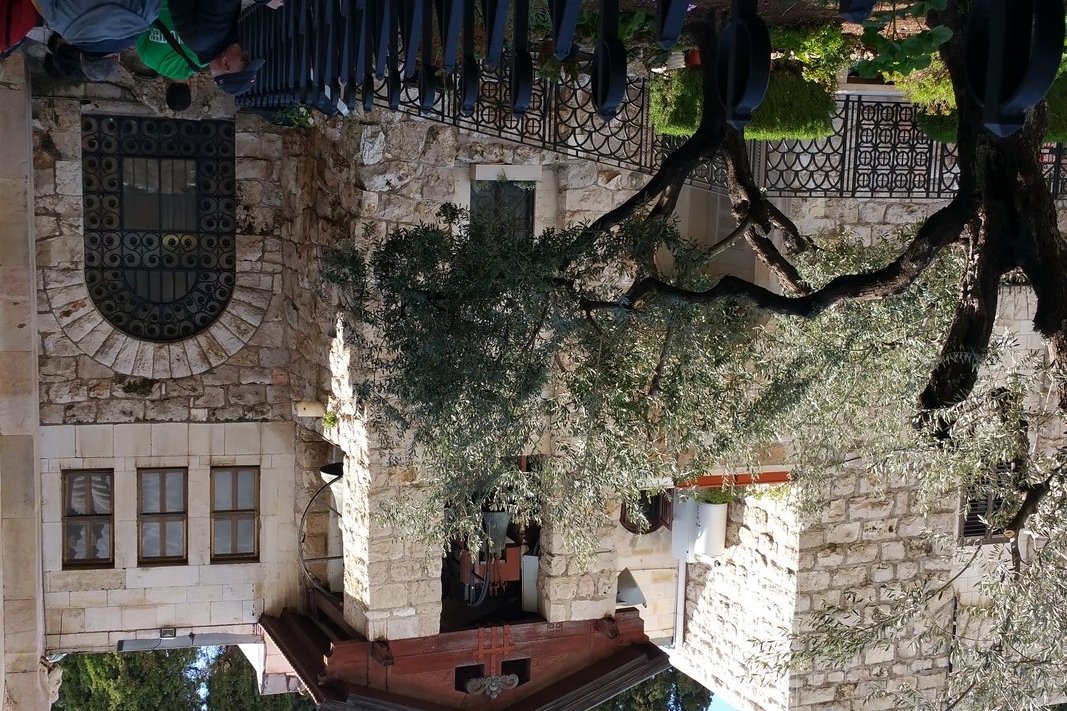
Photograph by Konrad Summers, Church of All Nations, Gethsemane, 2016 — CC BY-SA 2.0, Wikimedia Commons.
According to Matthew, Mark, and Luke, Jesus went to Gethsemane with his disciples on the night before his crucifixion, following the Last Supper, to pray before what he knew was coming. He brought Peter, James, and John further into the garden with him, asking them to keep watch, while he went a short distance further to pray alone.
The Agony in the Garden
What follows is one of the most theologically significant and emotionally direct passages in the Gospels. Luke records Jesus's prayer and its intensity in stark terms: he went out, "as was his custom, to the Mount of Olives... After withdrawing about a stone's throw from them and kneeling, he prayed, saying, 'Father, if you are willing, take this cup away from me; still, not my will but yours be done'" (RSV-CE, Luke 22:39-42). Luke's account continues with a detail unique among the Gospel writers: "He was in such agony and he prayed so fervently that his sweat became like drops of blood falling on the ground" (Luke 22:44).
This episode, traditionally known as the Agony in the Garden, has held a distinct place in Christian devotion for centuries, precisely because of how directly it depicts Jesus's full human experience of fear and suffering, held together with his ultimate submission to God's will. Meanwhile, the Gospels note, the disciples he had asked to stay awake and keep watch instead fell asleep, unable to stay alert even for this one night — a detail read by many commentators as an early, poignant sign of the isolation Jesus would experience through his arrest and Passion. It was here, shortly after, that Judas arrived with an armed crowd to identify and arrest Jesus with a kiss, setting in motion the events leading directly to the crucifixion.
Christian memory of the site since antiquity
Gethsemane has been venerated as a specific, identifiable location since the earliest centuries of Christian pilgrimage. The pilgrim nun Egeria, writing an account of her travels to the Holy Land in the late fourth century, describes visiting a church already established at the site, and Byzantine Christians built a basilica there that later fell into ruin, likely destroyed during the Persian invasion of the early seventh century. A subsequent Crusader-era church was built on part of the same site in the twelfth century before it, too, was eventually lost.
Some of the olive trees still growing in the garden today are genuinely ancient — scientific testing, including radiocarbon dating and genetic analysis conducted in the early twenty-first century, has confirmed that at least several of them are many centuries old. Whether any specific tree visible today could have been standing during Jesus's own lifetime cannot be established with certainty, since olive trees are capable of regenerating from old root systems even after the visible trunk has been damaged or replaced — but their sheer age still lends the site a tangible sense of continuity that few other Gospel locations can offer so directly.
The Church of All Nations
The church that stands at Gethsemane today, formally known as the Basilica of the Agony but more commonly called the Church of All Nations, was built between 1919 and 1924, designed by the same prolific architect, Antonio Barluzzi, responsible for several of the Holy Land's most significant twentieth-century churches, including the Basilica of the Transfiguration on Mount Tabor. Its name reflects how it was funded: contributions came from Catholic communities in numerous countries around the world, an international collaboration commemorated in the national emblems worked into the decoration of its ceiling domes.
Barluzzi's design deliberately evokes the emotional weight of the Gospel scene. The interior is kept deliberately dim, lit largely through violet-tinted alabaster windows meant to suggest the darkness and anguish of the night the church commemorates, and the sanctuary encloses a section of exposed natural bedrock, traditionally venerated as the rock where Jesus knelt in prayer. The church's western facade features a large, striking mosaic depicting Christ as mediator between God and humanity, visible from a considerable distance across the Kidron Valley.
A place still set apart for prayer
Gethsemane remains one of the most visited sites in Jerusalem's immediate surroundings, drawing pilgrims who come specifically to walk among its ancient olive trees and to pray inside the Church of All Nations, particularly during Holy Week, when many parishes around the world commemorate the Agony in the Garden as part of their Holy Thursday observances. Unlike some Gospel sites where identification rests on a slender historical thread, Gethsemane benefits from an unusually continuous chain of Christian memory — pilgrim accounts, successive churches built on the same ground across nearly two thousand years, and, standing quietly among it all, olive trees old enough to have witnessed a meaningful share of that long history themselves.
Trivia
What does the name Gethsemane mean?
What happened at Gethsemane according to the Gospels?
What is the Agony in the Garden?
What is the Church of All Nations?
Are the olive trees at Gethsemane actually from the time of Jesus?
Related Reading