Palma de Mallorca Cathedral (La Seu)

A cathedral vowed in a storm
Tradition holds that Palma Cathedral owes its existence to a vow made under duress: King James I of Aragon, caught in a violent storm at sea while sailing toward Mallorca in 1229 to conquer the island from its Muslim rulers, is said to have promised to build a great cathedral to the Virgin Mary if he survived the voyage. He did survive, and his forces went on to take Mallorca later that year, ending centuries of Muslim rule over the island. Construction of the new cathedral began soon afterward on the site of the island's principal mosque, which was demolished to make way for the new Christian structure — a pattern repeated at several other sites of the Reconquista, including the cathedrals later built at Seville and Córdoba.
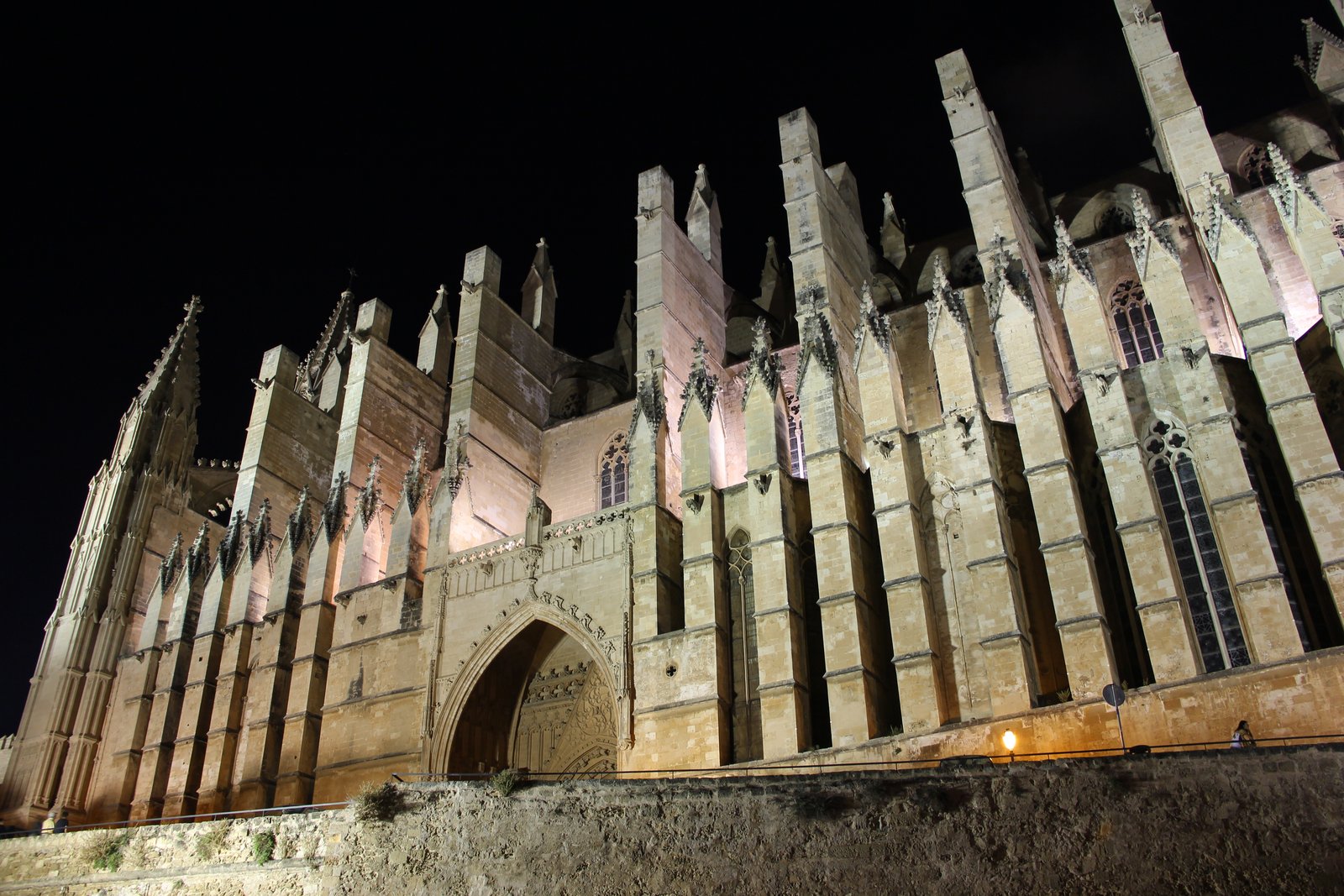
Photograph by Pablo Cuello Martinez, Catedral de Mallorca, Palma, Spain — CC BY-SA 3.0, Wikimedia Commons.
Building proceeded across roughly three centuries, from the 13th century through the early 16th, in the Catalan Gothic style — a regional variant of Gothic architecture developed along the Mediterranean coast of Spain and southern France, characterized by exceptionally wide, open interior spans achieved with fewer interior columns than northern European Gothic cathedrals typically required, giving Catalan Gothic churches a distinctively vast, unbroken sense of interior space. Palma's cathedral pushed this approach to a genuine extreme: its central nave reaches a height of nearly 144 feet, among the tallest of any Gothic cathedral in Europe, supported by unusually slender columns spaced far apart, an engineering achievement that has drawn admiration from architects and engineers for centuries.
Rising straight from the sea
Few cathedrals anywhere occupy a site as visually dramatic as Palma's: built directly against the old city walls overlooking the Mediterranean, La Seu appears from the water to rise almost straight out of the harbor, its honey-colored stone facade and flying buttresses reflected in the sea below at sunset, a view that has made the cathedral one of the most photographed landmarks in the Balearic Islands. The cathedral's main facade holds a Gothic rose window of exceptional scale — nearly 40 feet across and assembled from more than 1,200 individual pieces of stained glass — which, under the right conditions, projects a striking rainbow of colored light across the cathedral's interior stonework, an effect local guides sometimes call the "spectacular eight," after the figure-eight pattern the projected light can form on certain dates of the year.
Gaudí's decade in the cathedral
In 1904, the Bishop of Mallorca invited the Catalan architect Antoni Gaudí — already at work on his famous unfinished Sagrada Família in Barcelona — to lead a restoration and reorganization of the cathedral's interior. Gaudí worked on the project for roughly a decade, until 1914, making changes that reflected his particular architectural philosophy: he relocated the cathedral's choir enclosure out of its traditional position blocking the center of the nave, a common medieval arrangement that Gaudí felt obstructed the open sightlines and processional clarity he believed the original Gothic builders had intended, and he redesigned the canopy suspended above the high altar along with much of the cathedral's lighting. Gaudí's tenure ended amid disagreements with the cathedral chapter over the direction and pace of the work, and some of his more ambitious proposed changes were never completed, but his surviving interventions — particularly the redesigned high altar canopy — remain a distinctive and still-debated part of the cathedral's interior today, a rare instance of one of Europe's most celebrated architects reworking a centuries-old Gothic interior rather than designing an original building.
An active cathedral above the harbor
Palma Cathedral remains the seat of the Diocese of Mallorca and continues to hold regular services and major religious celebrations, even as it draws large numbers of visitors each year specifically for its architecture, scale, and dramatic seaside setting. Restoration and conservation work has continued into the 21st century, addressing the ongoing challenges of maintaining a nearly 700-year-old stone structure exposed to sea air and Mediterranean weather. Together with its rose window, its Gaudí-era interior, and its unmistakable silhouette above Palma's harbor, the cathedral remains one of the defining landmarks of the Balearic Islands and one of the great achievements of Catalan Gothic architecture anywhere in the Mediterranean world.
More recently, the contemporary artist Miquel Barceló, himself a Mallorcan, was commissioned to create a large ceramic mural for one of the cathedral's side chapels, completed in 2007 and depicting the miracle of the loaves and fishes across a swirling, sculptural surface unlike anything else in the building — a striking modern addition that, much like Gaudí's intervention a century earlier, shows how willingly this particular cathedral has continued inviting major contemporary artists to leave their own mark on a structure that has already been under construction and revision, in one form or another, for the better part of eight hundred years.
Trivia
Why is Palma Cathedral called La Seu?
How large is the cathedral's rose window?
What did Antoni Gaudí do to Palma Cathedral?
How long did it take to build the cathedral?
Did the cathedral replace an earlier mosque?
Related Reading