Glastonbury Abbey: Ruins Wrapped in England's Oldest Legends

The abbey that claimed to be first
Walk through the broken arches of Glastonbury Abbey today and it takes real effort to picture what medieval pilgrims once saw: not ruins, but one of the wealthiest, most politically connected monasteries in all of England, its monks holding to a claim almost no other English religious house dared make — that this was the very first place Christianity had ever taken root on British soil, founded not by any missionary of record but by a disciple who had known Jesus personally.
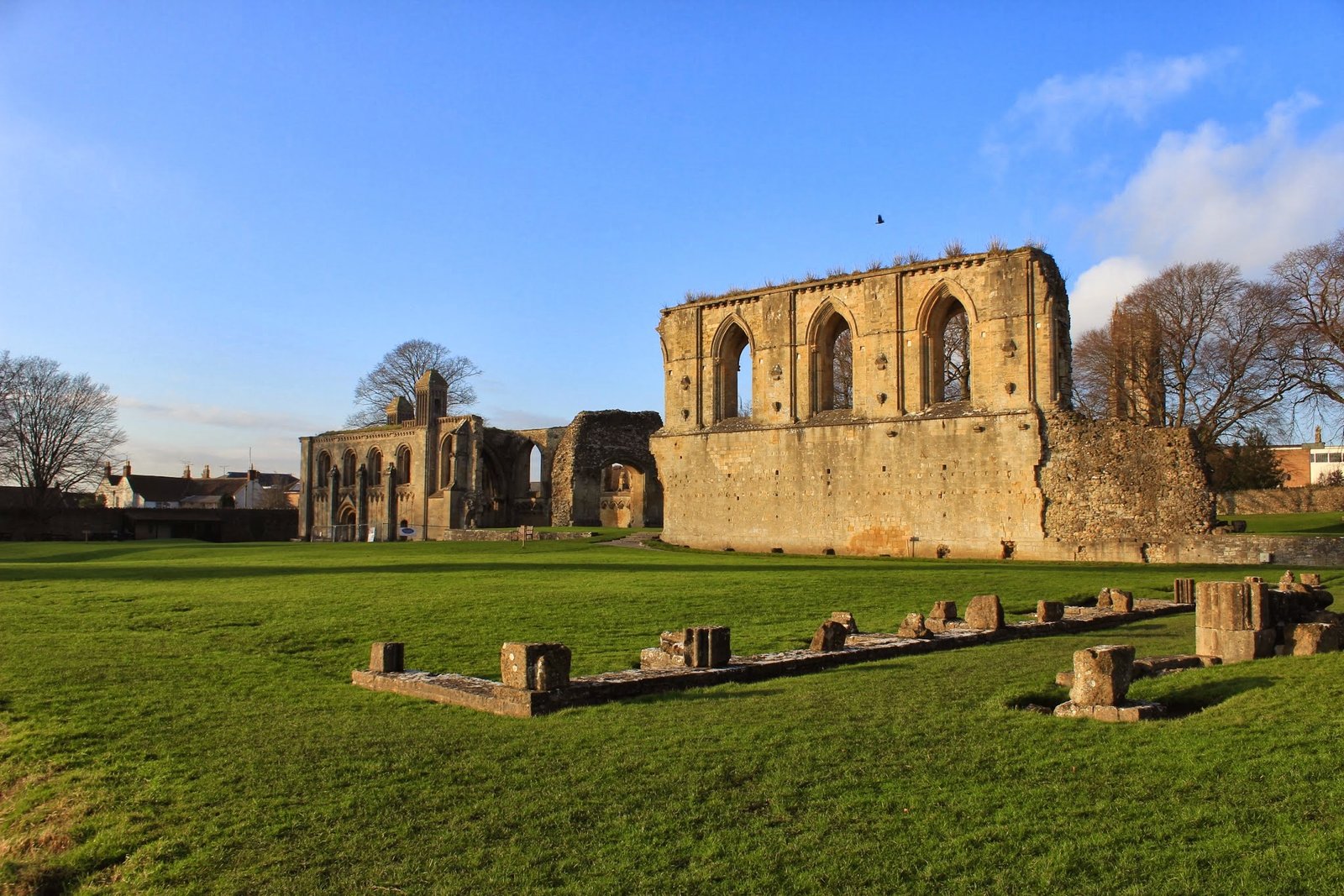
Photograph by Mimihitam, ruins of Glastonbury Abbey, 2014 — CC BY-SA 3.0, Wikimedia Commons.
Archaeology offers a more modest, though still remarkable, picture. Excavations have confirmed a Christian community existed at Glastonbury by at least the seventh century, built on what was then a low, marshy island rising out of the Somerset wetlands — a landscape that likely contributed to the site's mystical reputation long before the medieval legends attached themselves to it. By the time of the Norman Conquest, Glastonbury had already grown into one of the richest abbeys in the kingdom, its wealth built on extensive landholdings across Somerset and a reputation for sanctity that pilgrims traveled considerable distances to visit.
Joseph of Arimathea and the thorn that still blooms
The abbey's most famous legend holds that Joseph of Arimathea — the biblical figure who provided his own tomb for Jesus's burial (Matthew 27:57-60) — traveled to Britain in the years after the Resurrection and founded a small wattle-and-daub church at Glastonbury, making it, by this account, the first Christian church anywhere in the world built after Jesus's death. According to the legend, when Joseph thrust his walking staff into the ground on nearby Wearyall Hill, it took root and grew into a hawthorn tree that flowered twice a year, at Christmas and at Easter.
This tradition has no corroboration in any historical source contemporary with Joseph, and scholars generally trace its earliest written form to the twelfth or thirteenth century, well over a thousand years after the events it describes — making it, in the Church's own careful language, pious legend rather than documented history. Even so, a hawthorn tree descended by cutting from the original — the original itself was cut down by a Puritan zealot during the English Civil War — still grows near the abbey ruins today, and cuttings from it are sent each Christmas to decorate the table of the reigning British monarch, a tradition that continues regardless of the legend's uncertain historical footing.
A grave between two pillars
In 1191, seven years after a devastating fire had destroyed much of the earlier abbey church, monks at Glastonbury announced a discovery that would draw pilgrims — and their donations — from across Europe: a grave, found deep between two ancient stone pillars in the monks' cemetery, containing the bones of a large man and a woman, along with, according to the chronicler Gerald of Wales who claimed to have examined it, a lead cross bearing a Latin inscription identifying the remains as those of King Arthur.
Modern historians treat the discovery with considerable skepticism, noting both its convenient timing — the abbey badly needed funds for reconstruction after the 1184 fire — and the twelfth century's broader appetite for Arthurian legend, which was flourishing in literature across Europe at exactly this period. Whether genuine archaeological discovery, deliberate fabrication, or honest misidentification of older remains, the "Arthur's grave" story succeeded spectacularly at its practical purpose: pilgrim traffic and royal patronage, including from Edward I and Eleanor of Castile who visited the reburied remains in 1278, helped fund Glastonbury's continued rebuilding into one of the grandest Gothic abbeys in England.
Rising from the fire, then falling to the axe
The Gothic ruins that survive today are almost entirely the product of that post-1184 rebuilding, carried out over the following century and a half in the elegant, pointed Gothic style that had by then become standard across English ecclesiastical architecture — a stark contrast to the earlier Saxon and Norman structures the fire had destroyed. By the early sixteenth century, Glastonbury stood among the two or three wealthiest abbeys in England, a status that made it a particularly attractive target when Henry VIII began dissolving the country's monasteries in the 1530s.
The end came brutally. In 1539, the abbey's last abbot, Richard Whiting — an elderly man by then, widely respected even by some of the king's own officials — was tried on almost certainly fabricated charges of concealing abbey treasure from the Crown, and executed by hanging, drawing, and quartering on Glastonbury Tor, the hill overlooking the abbey, in view of the community he had led. The abbey buildings were stripped of lead roofing and anything of monetary value, and the structure was left to the slow decay of weather and local scavenging for building stone over the following centuries.
What remains
What stands today is a landscape of grass, broken arches, and the outline of a church whose full scale can still be traced in the foundations, even with its roof and most of its walls long gone. Glastonbury draws visitors now for reasons ranging from historical interest to religious pilgrimage to the more eclectic spiritual tourism the town has become known for in recent decades — but for anyone tracing the actual documented history beneath the layered legend, it remains one of the clearest physical records in England of how a medieval abbey rose, prospered, and fell within the span of a single dramatic century.
Trivia
What makes Glastonbury Abbey historically significant?
What is the legend connecting Glastonbury to Joseph of Arimathea?
Why is Glastonbury associated with King Arthur?
When was the current abbey structure built?
What happened to Glastonbury Abbey during the English Reformation?
Related Reading