Bellini's Sacred Allegory: A Puzzle Nobody Has Fully Solved

A painting that resists a single reading
Most religious paintings from Renaissance Venice announce their subject clearly — an Annunciation looks like an Annunciation, a Crucifixion looks like a Crucifixion. Giovanni Bellini's Sacred Allegory does something else entirely. On a raised marble terrace overlooking a still lake, the Virgin Mary sits enthroned at the center, flanked by figures generally identified as Saint Paul and Saint Peter or Job, while other figures — a young woman, a bearded hermit, several children, one offering fruit to a robed man outside the terrace's low wall — occupy the space around her without acting out any recognizable scene from Scripture. Behind them, the landscape opens into a distant, carefully rendered vista of hills, a walled town, even a centaur glimpsed on a distant path — details that only deepen the puzzle rather than resolve it.
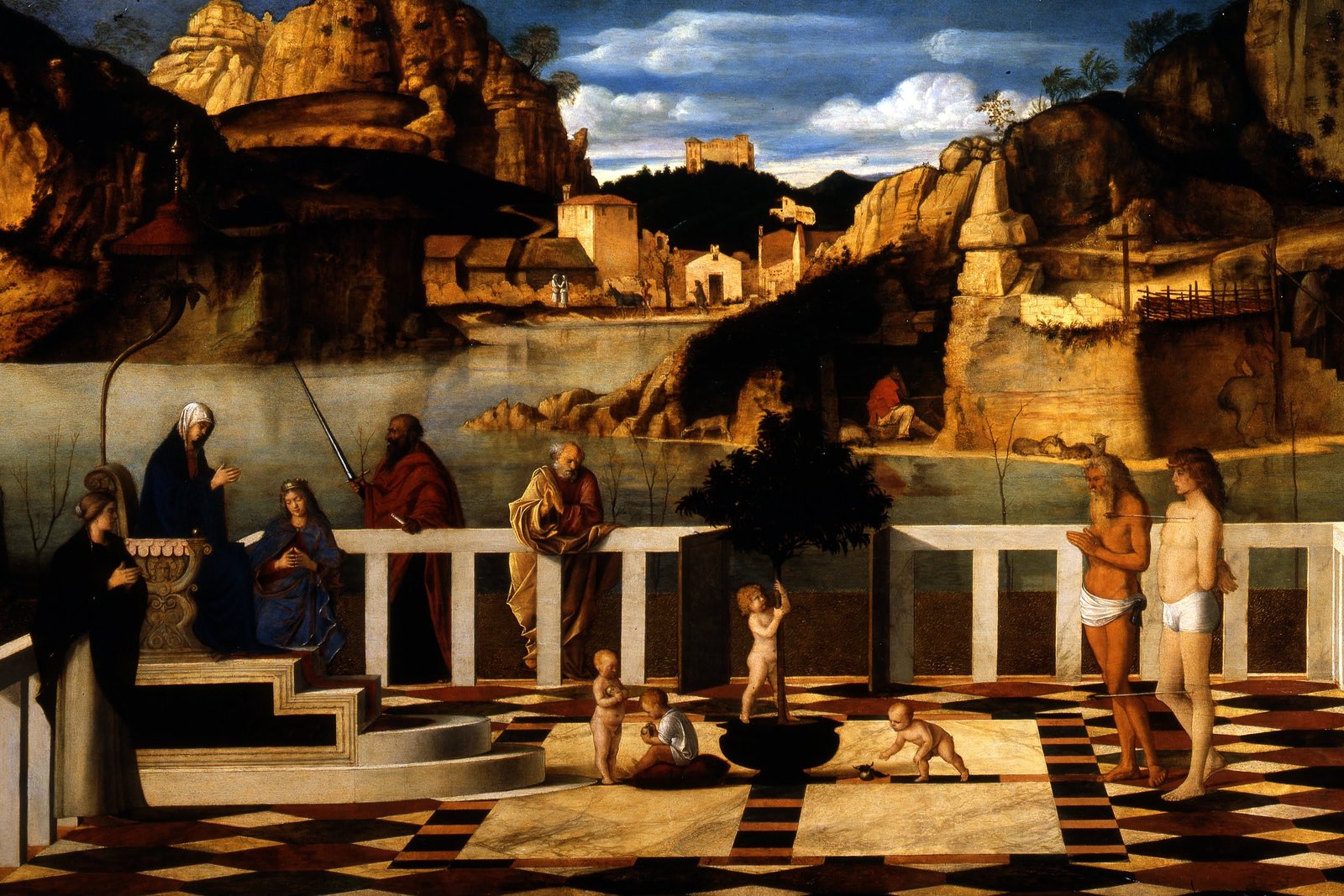
Giovanni Bellini, "Sacred Allegory," c. 1490-1500, Uffizi Gallery, Florence — public domain.
A century of scholarly guesswork
Since the painting entered serious art-historical study in the nineteenth century, proposed interpretations have piled up without ever converging on an agreed answer. Some scholars have read it as a meditation on the Immaculate Conception, others as an allegory of souls awaiting entry into paradise, others still as an image connected to specific theological debates active in Bellini's Venice around 1500. Part of the difficulty is that the painting appears to have been made for a private patron rather than a public church commission, meaning it likely carried a specific, personal meaning understood by its original owner that was never recorded anywhere surviving today. What's left, five centuries later, is a beautifully rendered scene whose individual pieces are legible — real saints, real symbolic objects, a real landscape — while the overall message they're meant to add up to remains genuinely open.
Why that ambiguity doesn't diminish the painting
Rather than reading as a failure of clarity, the painting's puzzle has long been part of its appeal. Venetian humanist culture around 1500 prized exactly this kind of layered, allusive imagery, designed to be studied and discussed rather than grasped instantly — a taste that shaped painting alongside contemporary literature and philosophy in the city's intellectual circles. Bellini was working at a moment when Venetian painting was absorbing new ideas about landscape, atmosphere, and quiet, self-contained compositions, a shift visible across the evolution of Renaissance Madonnas more broadly, and the Sacred Allegory pushes that shift about as far as it can go — toward a devotional scene built more from mood and symbol than from narrative.
Bellini's place at the center of Venetian painting
Giovanni Bellini worked as the leading painter in Venice for roughly half a century, running a large and influential workshop that trained, among others, Giorgione and Titian, the two artists who would go on to define the next generation of Venetian color and atmosphere. Bellini is widely credited with mastering the relatively new technique of oil painting in a way that allowed Venetian artists to achieve a softness of light and subtlety of color that distinguished their work from the more linear, drawing-based tradition of Florentine painting. His long career bridges an earlier, more Byzantine-influenced Venetian style — visible in his family's workshop under his father Jacopo Bellini — and the fully mature Venetian Renaissance that Titian would later carry to its height.
Related devotional works and Bellini's Madonnas
Bellini painted dozens of Madonna and Child compositions throughout his career, many far more conventional in subject than the Sacred Allegory but sharing its same interest in quiet, contemplative atmosphere and carefully observed natural light. These works, more straightforwardly devotional and widely reproduced as altarpieces across churches in the Veneto region, give a useful point of comparison: the Sacred Allegory isn't an outlier in Bellini's technical approach, only in how resistant its subject matter remains to a single settled explanation.
Technique: light, oil, and a Venetian terrace
Part of what makes the Sacred Allegory so hard to dismiss even without a settled meaning is the sheer technical control on display. Bellini renders the marble terrace's checkered pavement receding in careful perspective, the still water of the lake catching pale reflected light, and the distant hills softening into atmospheric blue haze the farther they sit from the viewer — an early, confident use of aerial perspective, the technique of graying and cooling colors with distance to suggest depth, that would become a signature of later Venetian landscape painting. The figures themselves are lit with the same soft, diffused daylight throughout the scene, avoiding the harsh, sculptural shadows more common in contemporary Florentine painting, so that the whole terrace feels bathed in one continuous, believable outdoor light. That unified handling of light across such a crowded, symbolically dense composition is itself part of why the painting still rewards close looking even when its precise program remains unresolved.
How it's studied and viewed today
The painting remains a favorite subject of ongoing academic study precisely because its puzzle has never closed. Visitors to the Uffizi encounter it today much as scholars still do — as an invitation to look closely, identify what can be identified, and accept that some of Bellini's original meaning may simply be lost to time. That openness, unusual for a religious painting from this period, is part of what keeps the Sacred Allegory actively discussed in art history classrooms and museum galleries more than five hundred years after it was painted.
Trivia
What is Giovanni Bellini's Sacred Allegory actually a picture of?
Where can you see Bellini's Sacred Allegory?
Why is the painting called an 'allegory' rather than a biblical scene?
Who was Giovanni Bellini, and why is he significant to Venetian art?
Are there other paintings by Bellini with similarly puzzling or symbolic content?
Related Reading