The Evolution of Renaissance Madonnas

The same subject, painted for seven hundred years
Few subjects in Western art have been painted as often, by as many different hands, as Mary holding her infant son. The Madonna and Child appears on altarpieces, in private devotional panels, on the walls of monastery cells, and eventually in some of the most famous single paintings in the world. Because the subject stayed essentially fixed — a mother, a child, sometimes a throne or a landscape — the changes across the thirteenth, fourteenth, and fifteenth centuries show, with unusual clarity, exactly how Italian painting itself was changing: how artists learned to render weight, depth, gesture, and above all, feeling.
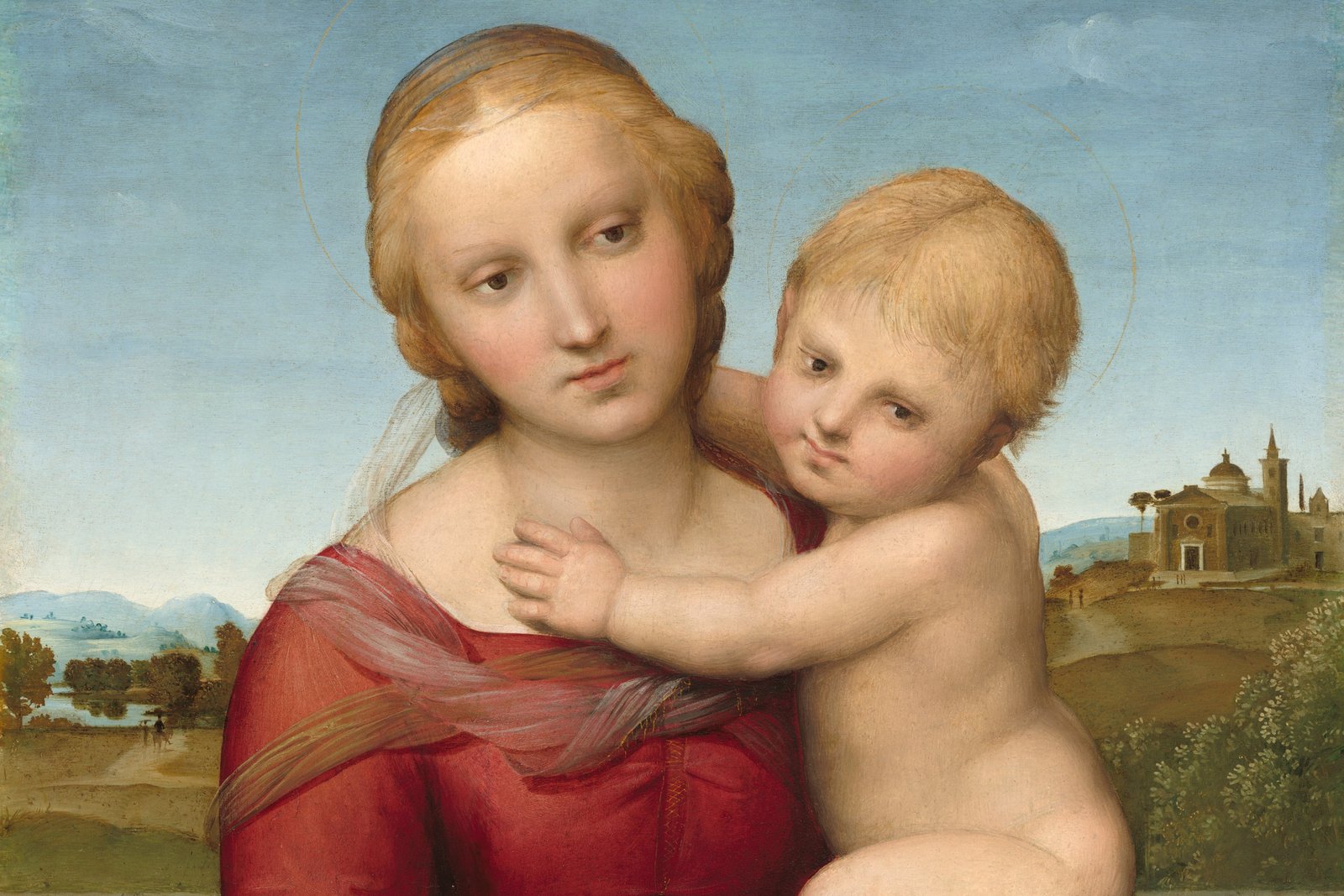
Raphael, "The Small Cowper Madonna," c. 1505, National Gallery of Art, Washington, D.C. — public domain.
Cimabue: majesty without intimacy
Cenni di Pepo, known as Cimabue, working in Florence in the final decades of the thirteenth century, painted Madonnas still deeply rooted in the Byzantine icon tradition that had dominated Italian religious art for centuries. In his Santa Trinita Maestà, Mary sits enthroned in strict frontal symmetry, her proportions elongated, her expression composed and distant. The infant Christ on her lap is rendered less like a baby and more like a miniature adult — a convention common across medieval art, reflecting the theological point that Christ possessed full divine wisdom even in infancy, rather than an attempt at anatomical realism. Gold leaf fills the background, flattening space entirely, and neither figure's gaze meets the other's; both look outward, toward the viewer, in the manner inherited directly from Byzantine icon painting, which prized symbolic presence over naturalistic tenderness.
Giotto: weight enters the picture
Giotto di Bondone, traditionally described as Cimabue's pupil, is the figure art historians most consistently credit with breaking from this inherited flatness. Working in the early fourteenth century, Giotto gave his figures a sense of physical mass that Byzantine-influenced painting had largely avoided — drapery that falls according to a body's actual form underneath it, faces turned at believable angles, hands that grip and hold rather than merely display. In his Madonna and Child compositions, Mary's body occupies real, if still limited, pictorial space, and the interaction between mother and son, while still formal by later standards, begins to carry a hint of genuine physical relationship rather than pure iconic display. Giotto didn't invent tenderness in the Madonna image, but he gave later painters the technical vocabulary — weight, gesture, believable anatomy — that tenderness would eventually be built from.
The fifteenth century: a domestic Mary
Across the 1400s, as Florentine and broader Italian painting absorbed the rapid development of linear perspective, anatomical study, and oil-based technique arriving partly through contact with Northern European painters, the Madonna and Child subject shifted decisively toward intimacy. Painters increasingly set Mary in believable, human-scaled interiors — a chair, a cushion, a window opening onto a landscape — rather than an abstracted golden throne suspended outside ordinary space. The infant Christ began to look genuinely like an infant: soft-bodied, sometimes reaching for his mother, sometimes asleep, sometimes playfully grasping at an object such as a goldfinch, a bird traditionally read as a symbol of the Passion because of a folk legend about its red feathers.
This period also saw the rise of the private devotional Madonna — smaller panels commissioned by individual patrons for a home chapel or bedroom rather than a large public altarpiece. That shift in audience mattered: a painting meant to be looked at daily, alone, in a private room called for a different emotional register than a monumental altarpiece meant to command a congregation's attention from across a nave. Painters responded with softer light, closer framing, and a warmer, more confiding relationship between mother and child.
Raphael and the fully humanized Madonna
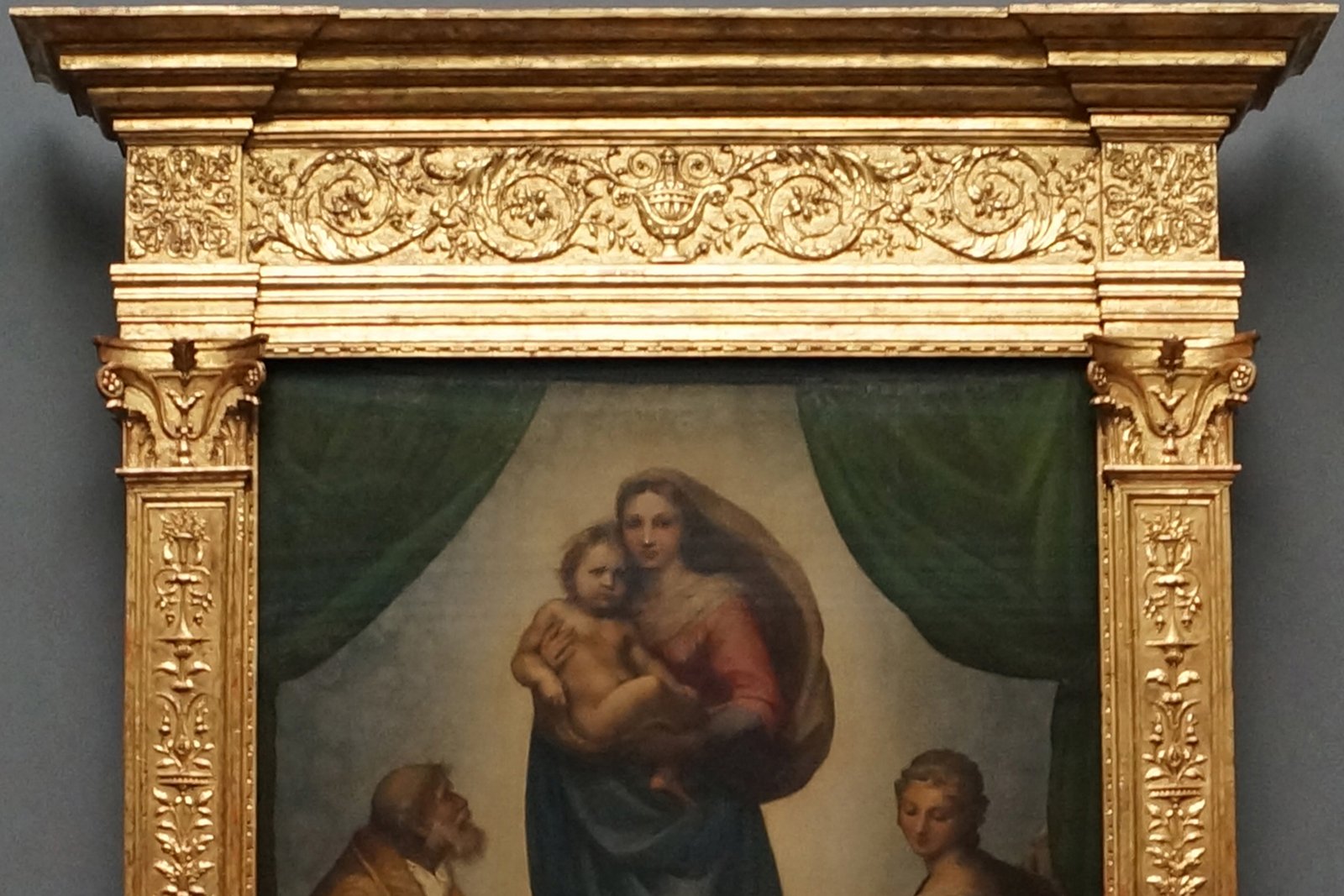
By the time Raphael was painting in Florence and then Rome in the early 1500s, virtually every technical tool later Renaissance painting would rely on — linear perspective, sophisticated modeling of light and shadow, confident anatomical drawing — was fully available. What Raphael added was compositional and emotional refinement. His Madonnas, including The Small Cowper Madonna, the painting used as this article's hero image, typically arrange Mary and Christ into a stable, pyramidal composition, Mary's head at the apex, her body and the infant's forming a solid, balanced base — a structure borrowed partly from Leonardo da Vinci's innovations in the previous decades.
Within that stable geometry, Raphael achieved an unusually natural physical and emotional closeness: Mary's cheek pressed near her son's, her hands wrapped gently around his body, both figures often turned toward each other rather than out toward the viewer. The formality of Cimabue's enthroned, symmetrical Madonna has essentially disappeared, replaced by something closer to an ordinary, deeply loving mother and child — even as the halos, the careful symbolism, and the underlying theological seriousness of the subject remain fully intact.
What the shift actually represents
It would be a mistake to read this two-century arc simply as painters "getting better" at realism in some neutral, technical sense. The change also reflects a broader theological and devotional shift in how the late medieval and Renaissance Church encouraged believers to relate to Christ's humanity — an emphasis, especially strong in Franciscan spirituality, on Christ's full participation in ordinary human experience, infancy included. A tender, physically believable infant Christ wasn't only an artistic achievement; it was also, for many viewers of the period, a more emotionally accessible way to meditate on the doctrine of the Incarnation itself.
The Madonna and Child subject continued evolving well past Raphael — through the heightened drama of the Baroque period and beyond — but the arc from Cimabue's remote, enthroned Mary to Raphael's cheek-to-cheek intimacy remains one of the clearest, most compressed illustrations available of how Renaissance painting transformed not just technique, but the emotional relationship between sacred art and the people looking at it.
Trivia
Why do early Madonna and Child paintings look so stiff compared to later Renaissance ones?
What changed with Giotto's Madonna paintings?
Why did Renaissance Madonnas start showing Mary in ordinary domestic settings?
What makes Raphael's Madonnas different from earlier Renaissance versions?
Did the way Mary was painted change for theological reasons or artistic ones?
You May Also Like
Related Reading