The Sistine Madonna's Two Cherubs: How They Escaped the Painting

A tiny detail with an outsized afterlife
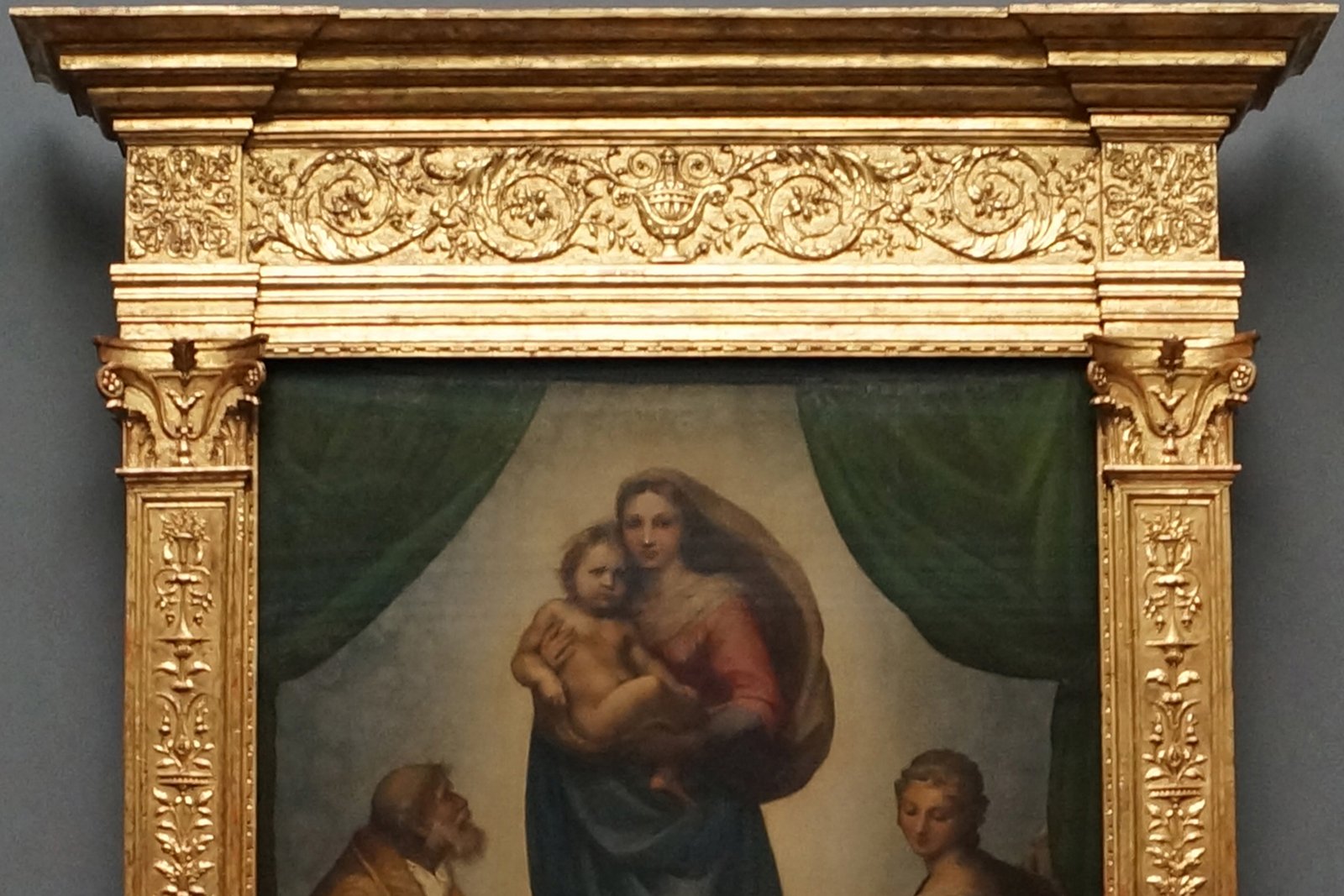
Raphael painted the Sistine Madonna as a full devotional scene: the Virgin Mary stepping forward through parted curtains, cradling the Christ Child, flanked by Saint Sixtus and Saint Barbara in postures of reverence, the whole composition alive with movement and gathered light. At the very bottom, almost as an afterthought, he added two small winged children leaning on a ledge, gazing up and outward with expressions somewhere between curiosity and mild boredom. For centuries they were simply part of the painting. Then, starting in the nineteenth century, printers and publishers began isolating just that bottom strip for postcards and prints, and the cherubs slowly detached themselves from the religious scene above them entirely, becoming one of the most reproduced images in Western visual culture — recognizable to millions who have never seen, or heard of, the painting they came from. Readers can find the full story of Raphael's Sistine Madonna covered elsewhere on this site.
Raphael, "Sistine Madonna" (detail), 1512, Gemäldegalerie Alte Meister, Dresden — public domain.
What "cherub" actually means, and what these figures actually are
In everyday usage, "cherub" has come to mean almost any chubby-cheeked, winged child figure in religious art, and that's the sense in which Raphael's two figures are popularly known. Theologically, though, cherubim are a specific and much more formidable order of angelic being — described in the Old Testament as guardians of sacred space, positioned at the entrance to Eden and depicted atop the Ark of the Covenant, not as playful infants. The small winged children common in Renaissance and Baroque art, including Raphael's pair, are more precisely called putti, a decorative and symbolic figure type borrowed from classical antiquity and adapted into Christian art as an attendant presence in sacred scenes. The popular label "cherub" stuck to them anyway, and by now the two uses of the word have become effectively inseparable in ordinary speech.
Their place within the composition
Positioned at the base of the canvas, resting their arms on what reads as a ledge or the lower edge of the frame itself, the two putti occupy a transitional space between the viewer's world and the vision unfolding above them — the Madonna appearing to step forward through parted curtains as though the painting itself were a window opening onto a heavenly apparition. Their outward, faintly distracted gaze breaks from the upward, adoring attention of Saint Sixtus and Saint Barbara elsewhere in the scene, creating a quiet pause at the bottom of an otherwise intensely focused composition. Exactly what Raphael intended by that contrast was never recorded in his own words, but many art historians read it as a deliberate softening touch, humanizing an otherwise solemn vision with two figures who seem, briefly, unimpressed by the miracle happening just above their heads.
Technique: how Raphael painted them
Even at this small scale, the cherubs show the qualities that made Raphael's brushwork so admired by his contemporaries and by generations of painters after him. The transition from the soft flesh of their cheeks to the wispy, barely-there texture of their hair is handled with the same smooth, almost invisible blending — sfumato, a technique for softening edges so tones melt into one another rather than meeting at a hard line — that Raphael absorbed from studying Leonardo da Vinci's work during his years in Florence. The wings, by contrast, are built with quicker, more textured strokes that catch the light differently from the smooth skin beside them, a small but deliberate contrast in handling that keeps the figures from reading as flat or doll-like despite their compact size. Compared with the sharper, more linear putti common in earlier Quattrocento painting, Raphael's pair feel weighted and three-dimensional, propped believably on an actual ledge rather than simply pasted decoratively along the bottom edge of the canvas.
Raphael's late style and the painting's original purpose
The Sistine Madonna was painted around 1512 as an altarpiece for the church of San Sisto in Piacenza, commissioned by Pope Julius II, and it reflects Raphael working at the height of his powers — balanced composition, warm color, and a naturalism that had moved well past the stiffer, more formal Madonnas of the earlier Renaissance. It remained in Piacenza for over two centuries before Augustus III, Elector of Saxony, purchased it in 1754 for his court in Dresden, where it has remained ever since, apart from a period of wartime relocation to the Soviet Union and its return in 1955.
How the cherubs are used devotionally and culturally today
Today the two figures appear far more often divorced from their religious context than within it — printed on everything from wrapping paper to phone cases — but they retain a smaller, quieter life as a devotional image in their own right, appearing on prayer cards and in Marian devotional contexts precisely because their upward gaze can be read as directed toward the Madonna and Child above them, even when cropped out of the full scene. That dual life, as both a piece of mass commercial imagery and a fragment of genuine Renaissance devotional art, makes them an unusually clear example of how a religious image can travel far beyond the church it was painted for, without ever fully losing the sacred context it came from.
Trivia
What are the two figures at the bottom of the Sistine Madonna usually called?
Were the two cherubs part of Raphael's original plan for the Sistine Madonna, or added later?
Why do the cherubs look bored or distracted rather than adoring the Christ Child?
Where is the original Sistine Madonna, and can the cherub detail be seen there?
Why did the cherub detail become so much more famous than the painting as a whole?
Related Reading