Titian's Assumption of the Virgin: A Church-Sized Miracle

A painting built for one specific wall
Titian didn't paint the Assumption as a self-contained image meant to travel between collections. He designed it for one exact spot: the high altar of Santa Maria Gloriosa dei Frari, a vast Gothic church in Venice, where it would be seen from the far end of a long nave, past the choir screen, lit by the shifting daylight coming through the church's windows. That constraint shaped everything about the painting. Its composition reads clearly even from a hundred feet away — three tiers stacked vertically, each with its own color and energy, so that a worshiper entering the church could take in the entire drama of the scene almost at a glance before walking closer to study the details.
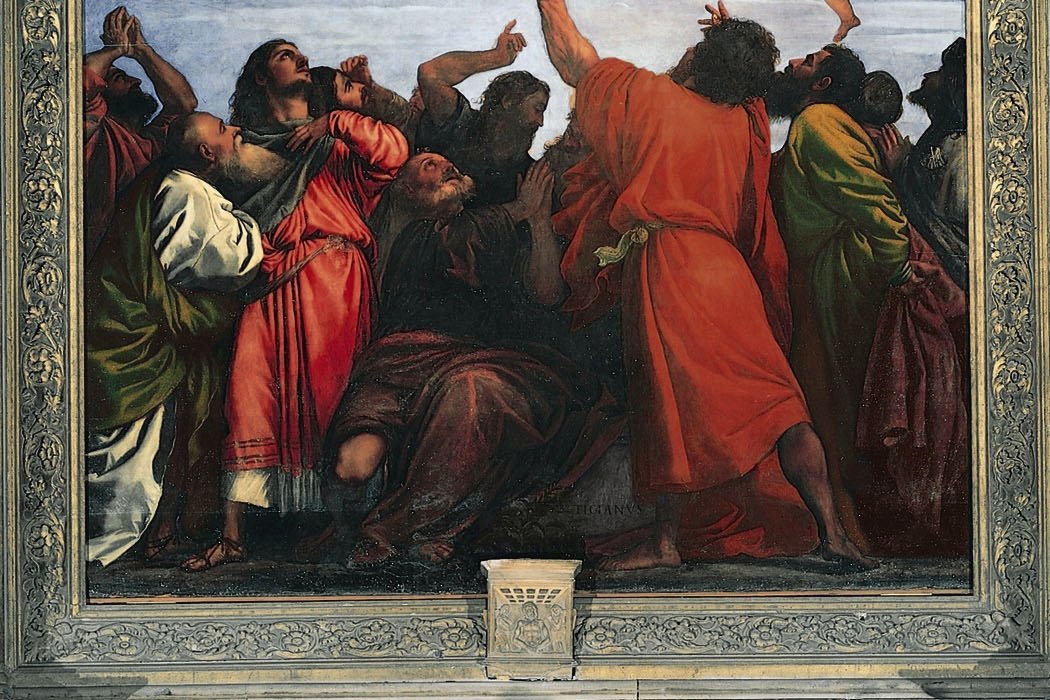
Titian, "Assumption of the Virgin," 1516-1518, Basilica di Santa Maria Gloriosa dei Frari, Venice — public domain.
The composition, tier by tier
At the bottom, the twelve apostles crowd around Mary's empty tomb, their bodies twisting upward in astonishment, arms flung out, robes caught mid- motion — a level of physical energy almost unheard of in Venetian altarpieces up to that point. In the middle tier, Mary herself rises on a cloud crowded with cherubs, dressed in red and blue, her face turned upward, her posture calm against the apostles' turbulence below her. At the top, God the Father descends to meet her from a blaze of golden light, attended by two more angels bearing a crown. The whole composition pulls the eye upward in a single continuous motion, tier to tier, in a way that mirrors the subject itself: Mary's body and soul being drawn bodily into heaven.
Why Titian's approach was such a departure
Venetian altarpieces in the decades before Titian tended toward stately, symmetrical compositions — saints arranged calmly around an enthroned Madonna, gold backgrounds signaling sacred space rather than depicting real sky. Titian instead painted an actual sky, streaked with warm color, and filled it with figures caught in motion rather than static poses. He also scaled the figures unusually large relative to the painting's height, so that even from the back of the nave, the apostles' gestures and Mary's upward gaze remain legible. That combination of dramatic color, physical motion, and a moment captured mid-action rather than posed — sometimes described as the beginning of Venetian High Renaissance color and dynamism — marks a clear turning point away from the more restrained style typical of the evolution of Renaissance Madonnas that preceded him.
The theology behind the image
The Assumption of Mary — the belief that she was taken body and soul into heaven at the end of her earthly life — was a long-held devotional tradition in the Church centuries before Titian painted it, though it wasn't formally defined as dogma until Pope Pius XII's 1950 proclamation Munificentissimus Deus. Readers can find a fuller account of the biblical and doctrinal background of the Assumption elsewhere on this site. What matters for Titian's painting is that by the early sixteenth century, the feast was already central to Venetian religious life, and a Franciscan church dedicating its high altar to this exact moment reflects how deeply the tradition had settled into ordinary devotional practice well before Rome made it official teaching.
Titian's rise and the painting's aftermath
Titian was still a relatively young painter — probably in his late twenties — when the Frari commissioned this altarpiece, and its reception, once early skepticism gave way to acclaim, effectively launched him as the leading painter in Venice for the rest of his long career. He went on to paint a second major work for the same church, the Pesaro Madonna, using an asymmetrical composition that built directly on lessons learned here. The Assumption's influence rippled outward across Venetian painting for generations, shaping how later artists including Tintoretto and Veronese approached large-scale devotional commissions, always working to match — or answer — the sheer ambition Titian had set at the Frari.
Restoration and a near-loss during wartime
The painting's survival in near-original condition owes something to deliberate protection during moments of real danger. During the First and Second World Wars, major Venetian artworks including the Assumption were removed from their churches and hidden in secure locations away from the city to protect them from bombing and looting, only returning to their original settings once the immediate danger had passed. A significant cleaning and restoration campaign in the twentieth century also removed layers of darkened varnish that had dulled Titian's original color relationships over the centuries, work that helped restore the sharp contrast between the warm golds of the upper register and the cooler reds and blues surrounding the apostles below — a contrast central to how the whole composition pulls the eye upward. Conservators have returned to the altarpiece periodically since, monitoring the effects of Venice's humid climate on a canvas that has hung in the same church, largely undisturbed, for over five hundred years.
Still on its altar, five centuries later
Unlike many Renaissance altarpieces scattered by later sales, wars, or museum acquisitions, Titian's Assumption has remained on the same altar almost continuously since 1518, apart from brief periods of restoration and wartime protective storage during the twentieth century. Visitors to the Frari today see it exactly as the Franciscan friars first did — rising above the high altar, dominating the far end of the nave, still doing the job it was built for: drawing the eye, and the visitor's whole body, upward toward the light at its top.
Trivia
Where can you see Titian's Assumption of the Virgin today?
How large is Titian's Assumption of the Virgin?
What Bible passage or Church teaching does the Assumption of the Virgin depict?
Why was Titian's Assumption considered controversial when it was unveiled?
How did the Assumption change Titian's career?
You May Also Like

Related Reading