Bernini's Ecstasy of Saint Teresa: Sculpture as Divine Theater

A saint's own words, carved in stone
What makes Bernini's sculpture unusual among depictions of mystical experience is how closely it follows a written first-person source. Teresa of Ávila, the sixteenth-century Spanish Carmelite reformer and mystic, described the episode herself in her spiritual autobiography: an angel appeared to her carrying a long golden spear tipped with fire, and plunged it into her heart repeatedly, leaving her, in her words, "completely afire with a great love of God." She described the pain as so intense that she moaned aloud, yet so sweet that she had no desire for it to stop — an experience she understood as a profound, embodied encounter with divine love rather than a purely intellectual or abstract one. Bernini did not soften or abstract that account. He carved Teresa mid-swoon, eyes closed, lips parted, robes thrown into deep, turbulent folds, with a smiling angel poised above her holding the golden arrow just before its final thrust.
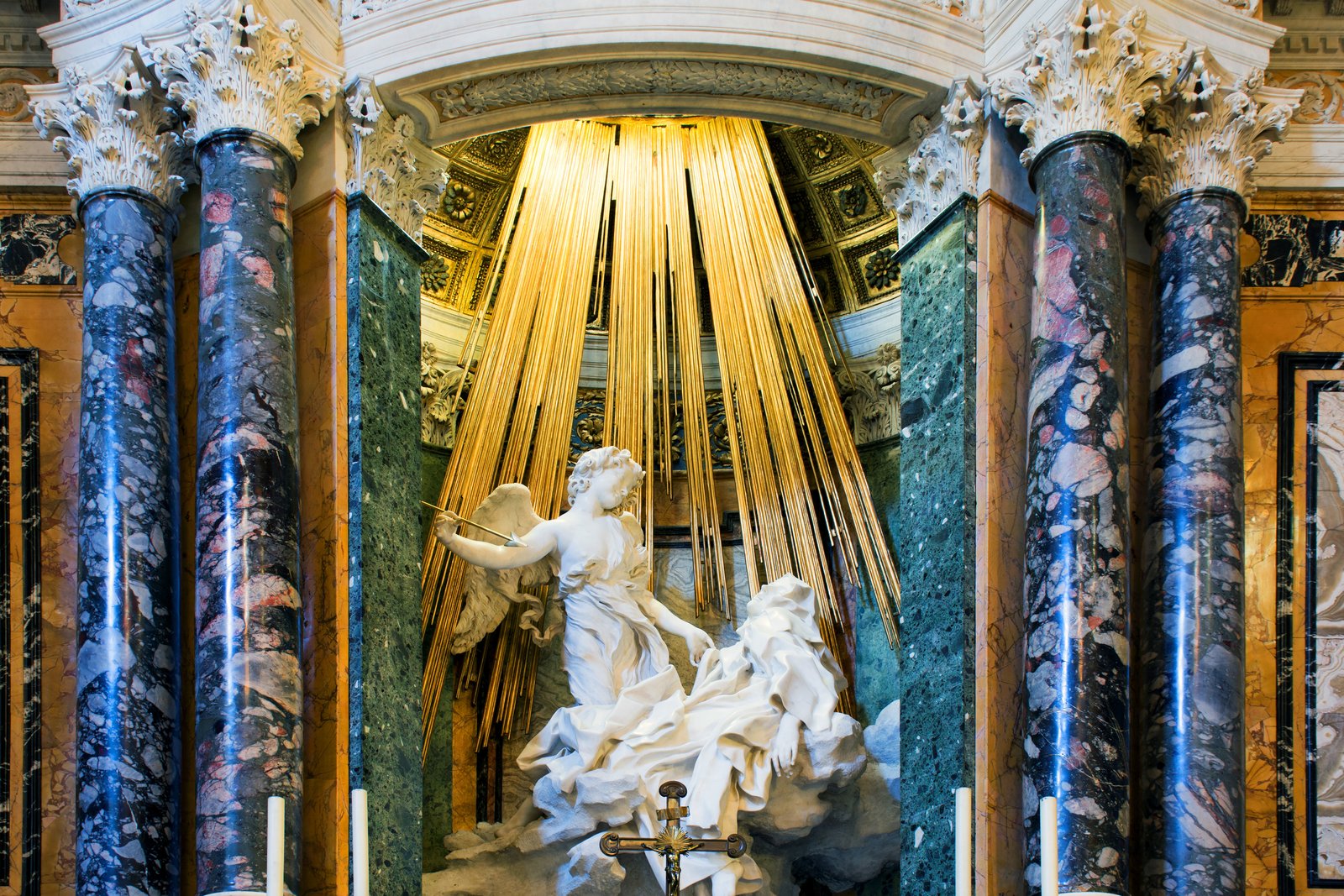
Gian Lorenzo Bernini, "Ecstasy of Saint Teresa," 1647-1652, Cornaro Chapel, Santa Maria della Vittoria, Rome. Photo by Livioandronico2013, CC BY-SA 4.0 (Wikimedia Commons).
Building a theater around a miracle
Bernini's ambition extended well beyond the central figures. He designed the entire Cornaro Chapel as an integrated architectural and sculptural environment, treating the space the way a set designer might treat a stage. The central group of Teresa and the angel sits in a niche framed by colored marble columns, lit from a concealed window positioned to catch natural daylight and channel it down onto the figures, creating an effect of divine light that seems to originate from nowhere visible within the chapel itself. On the side walls, Bernini carved relief portraits of members of the Cornaro family, posed in what resemble theater boxes, watching the central miracle unfold — an unusual and striking device that positions the patrons themselves as witnesses to sanctity, blurring the line between devotional art and dramatic performance. For readers interested in how Baroque artists more broadly used drama and emotional intensity in religious commissions, our overview of Baroque religious painting's dramatic turn explores related developments in painting from the same period.
Bernini's total command of materials
Part of what makes the sculpture so persuasive is Bernini's virtuosic handling of marble to suggest qualities marble should not naturally possess — weightlessness, softness, motion. The cloud beneath Teresa and the angel appears to billow and shift rather than sit as solid stone, achieved through deeply undercut, irregular carving that catches light unpredictably across its surface. Teresa's robes fall in cascading, almost liquid folds that seem caught mid-movement rather than frozen in a single static pose. This technical mastery, combined with Bernini's parallel career as an architect and stage designer for the papal court, allowed him to treat sculpture not as an isolated object but as one element within a total sensory environment involving light, architecture, and implied movement — an approach that became one of the defining characteristics of Roman Baroque art.
Teresa of Ávila's place in the Church
Teresa of Ávila (1515-1582) was canonized in 1622, and in 1970 she was declared a Doctor of the Church, one of the relatively small number of saints given that formal title in recognition of the significant theological and spiritual value of their writings. Her autobiography and her other major works on prayer and contemplative life remain foundational texts within the Carmelite tradition and Catholic spirituality more broadly, describing in unusually candid, direct language her own experience of mystical prayer, including states of rapture, visions, and what she described as a direct, felt union with God. The Catholic tradition distinguishes between such extraordinary mystical graces, understood as freely given divine gifts not required for holiness, and the ordinary path of prayer and virtue expected of all the faithful — a distinction worth keeping in mind when approaching a work as visually intense as Bernini's sculpture.
Controversy and reinterpretation over time
The sculpture's frank physicality has drawn commentary, and at times skepticism, since not long after its completion. The eighteenth-century French writer Charles de Brosses famously remarked, after viewing the work, that if this was divine love, he was familiar with it too — a comment reflecting a more secular, skeptical eighteenth-century sensibility toward mystical experience rather than any flaw in Bernini's theological intent. Modern art historians generally read the work differently: as a faithful, if theatrically heightened, visualization of language Teresa herself used, situated within a Counter-Reformation context that actively encouraged emotionally immersive religious art capable of moving worshippers toward deeper devotion, in direct response to the plainer aesthetic favored by Protestant reformers of the period.
A landmark of Roman Baroque art
More than three and a half centuries after its installation, the Ecstasy of Saint Teresa remains one of the most visited and most discussed works within Rome's vast concentration of Baroque art. It represents Bernini at the height of his powers, working across sculpture, architecture, and light design simultaneously to construct not merely an image of a mystical event but something closer to an immersive re-enactment of it, still capable of startling visitors who step into the Cornaro Chapel today.
Trivia
What does Bernini's Ecstasy of Saint Teresa actually depict?
Where is the Ecstasy of Saint Teresa located?
Who commissioned the work and why?
Why is the lighting in the chapel considered so important to the work?
Has the sculpture's intensely physical depiction of religious ecstasy ever been controversial?
Related Reading