Donatello's David: The First Free-Standing Nude Since Antiquity

A statue that broke a thousand-year silence
For roughly a millennium after the collapse of the Western Roman Empire, European sculptors had essentially stopped casting free-standing nude figures in bronze. The technical skill required to pour and finish such a work was formidable, and the cultural appetite for unclothed heroic figures had faded along with the classical world that produced them. Donatello's bronze David changed that in a single, quiet gesture: a slender young man, weight shifted onto one hip in the classical contrapposto pose, standing with almost languid confidence over the severed head of a defeated giant. The choice to revive an ancient sculptural form for a biblical subject was itself a statement — a deliberate bridge between pagan antiquity and Christian narrative that would become one of the defining moves of the Italian Renaissance.
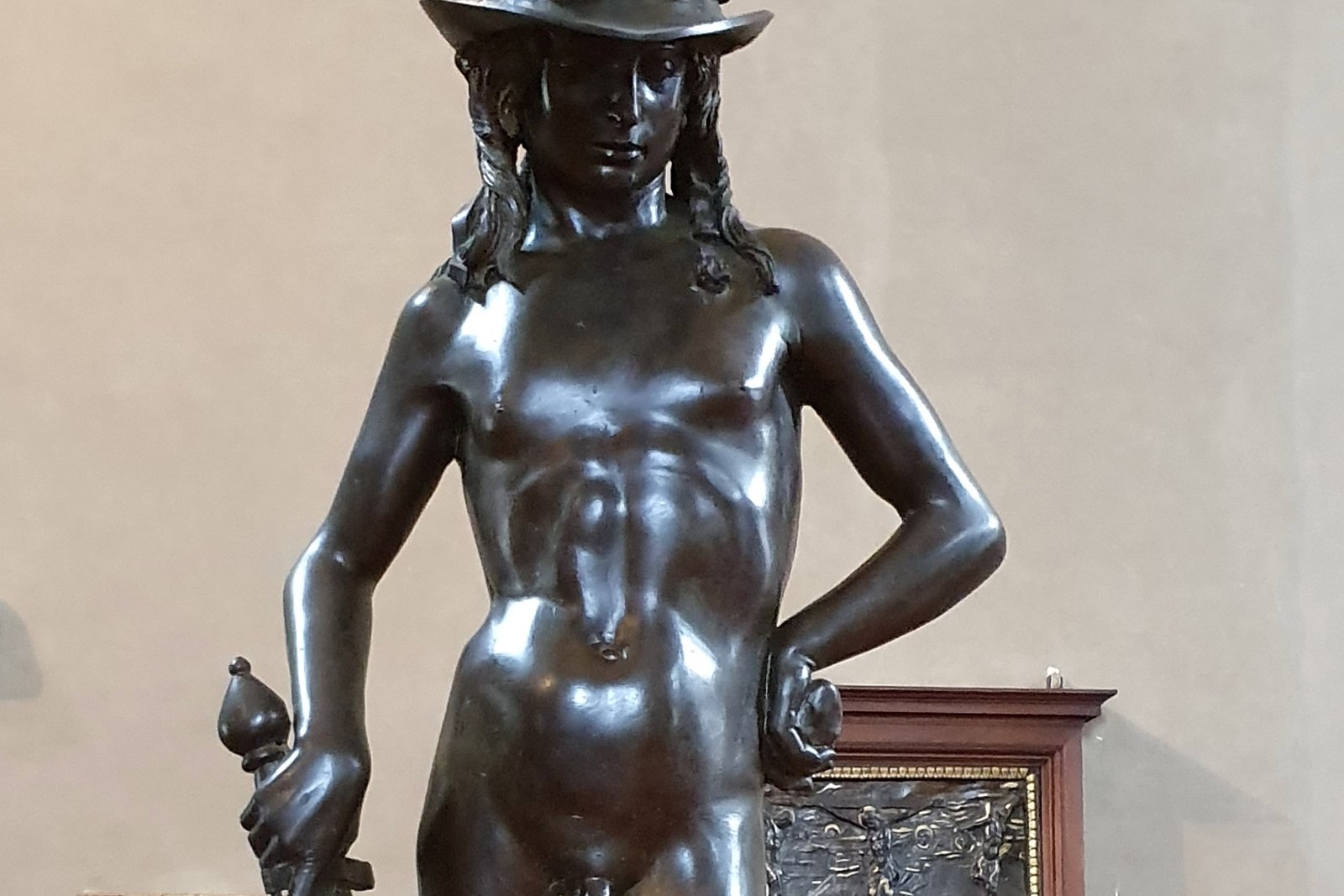
Photo of Donatello's bronze David, c. 1440s, Bargello Museum, Florence, by Yair Haklai, CC BY-SA 4.0 (Wikimedia Commons).
The Medici and a political message in bronze
Most art historians connect the statue's commission to the Medici family, almost certainly Cosimo de' Medici, the banker and de facto ruler of Florence, though the exact date remains disputed, with proposals ranging from the 1430s to as late as the 1460s. It stood in the courtyard of the Palazzo Medici, a space visitors would pass through on their way to meetings with the family, where its message was hard to miss: a small, apparently unarmed youth had defeated a heavily armored giant through faith and cunning rather than brute strength. For a wealthy Florentine banking family navigating precarious politics among larger, more militarily powerful rivals, the image of the underdog triumphant carried an obvious appeal, and David himself had long served as an unofficial civic symbol of Florence's own self-image as a small republic capable of outmaneuvering larger powers.
The puzzle of the nudity
What draws the most sustained scholarly attention, and debate, is Donatello's decision to depict David essentially nude, wearing only a laurel-crowned helmet and a pair of boots. Earlier and contemporary depictions of David in Florentine art typically showed him clothed, so the choice was a deliberate departure rather than a default. Proposed explanations range widely: an allusion to classical heroic nudity as a marker of virtue and victory, a reference to David's youth and vulnerable humanity in contrast to Goliath's armored bulk, or more specific readings tied to Medici patronage and Florentine humanist culture. No single explanation has achieved full scholarly consensus, and the ambiguity is, if anything, part of what has kept the statue a subject of ongoing art-historical conversation for centuries. Readers interested in how artists across eras have handled the human form within religious subjects may also find our guide to Catholic sacred art a useful starting point for exploring related themes.
Casting a nude in bronze: a technical feat
Beyond its iconography, the statue represents a genuine technical achievement. Casting a free-standing, life-sized nude figure in bronze using the lost-wax method demanded precise control over metal flow, cooling, and structural support — the slender ankles and single-point contact with the base leave little margin for error, and a failed pour could mean losing months of work and expensive material. Donatello, already established as one of the leading sculptors of early fifteenth-century Florence through works like his marble Saint George and his relief panels for Florence Cathedral, brought that accumulated technical mastery to bear on a work that had no direct living precedent to draw from. Later Renaissance sculptors, including Verrocchio, who produced his own bronze David a generation later, and eventually Michelangelo with his colossal marble version, would all work in Donatello's shadow when tackling the same biblical subject.
From Medici courtyard to public museum
The statue's own history after its creation was almost as eventful as the biblical episode it depicts. It remained in Medici hands, moved between family properties, until the Medici were briefly expelled from Florence in 1494, at which point the Florentine government seized it along with other Medici property and relocated it to the Palazzo della Signoria, the seat of civic government, reinforcing its status as a symbol of republican defiance against tyranny. It passed through several further relocations over the following centuries before settling at the Bargello, Florence's museum dedicated to sculpture, where it remains on permanent public display today, now viewable by any visitor rather than reserved for guests of a private courtyard.
A hinge point in sculptural history
Donatello's David occupies an unusual place in art history: a work small enough to overlook at a glance, yet consequential enough to mark a genuine turning point in how European sculptors thought about the human body, classical revival, and religious narrative. It demonstrated that a biblical hero could be rendered with the same confident physical presence as an ancient god or athlete, and in doing so it helped open the door for the extraordinary run of Renaissance sculpture that followed over the next century. Standing before the bronze today in the Bargello, it is worth remembering that this quiet, almost understated figure once represented one of the boldest artistic risks of its era.
Trivia
What Bible story does Donatello's David depict?
Why is Donatello's David considered so historically significant?
Who commissioned Donatello's David and why?
What is unusual about how David is dressed, or not dressed, in the statue?
Where can Donatello's David be seen today?
Related Reading