Michelangelo's Moses

A tomb that kept shrinking
In 1505, Pope Julius II commissioned Michelangelo to design and carve what was intended to be one of the most ambitious funerary monuments in the history of Western art — a freestanding, multi-tiered tomb featuring dozens of sculpted figures, meant to stand at the center of a rebuilt Saint Peter's Basilica. Michelangelo spent months in the marble quarries of Carrara selecting stone for the project before it was interrupted, first by funding disputes with the pope and then by Julius's decision to redirect Michelangelo's attention toward painting the Sistine Chapel ceiling instead.
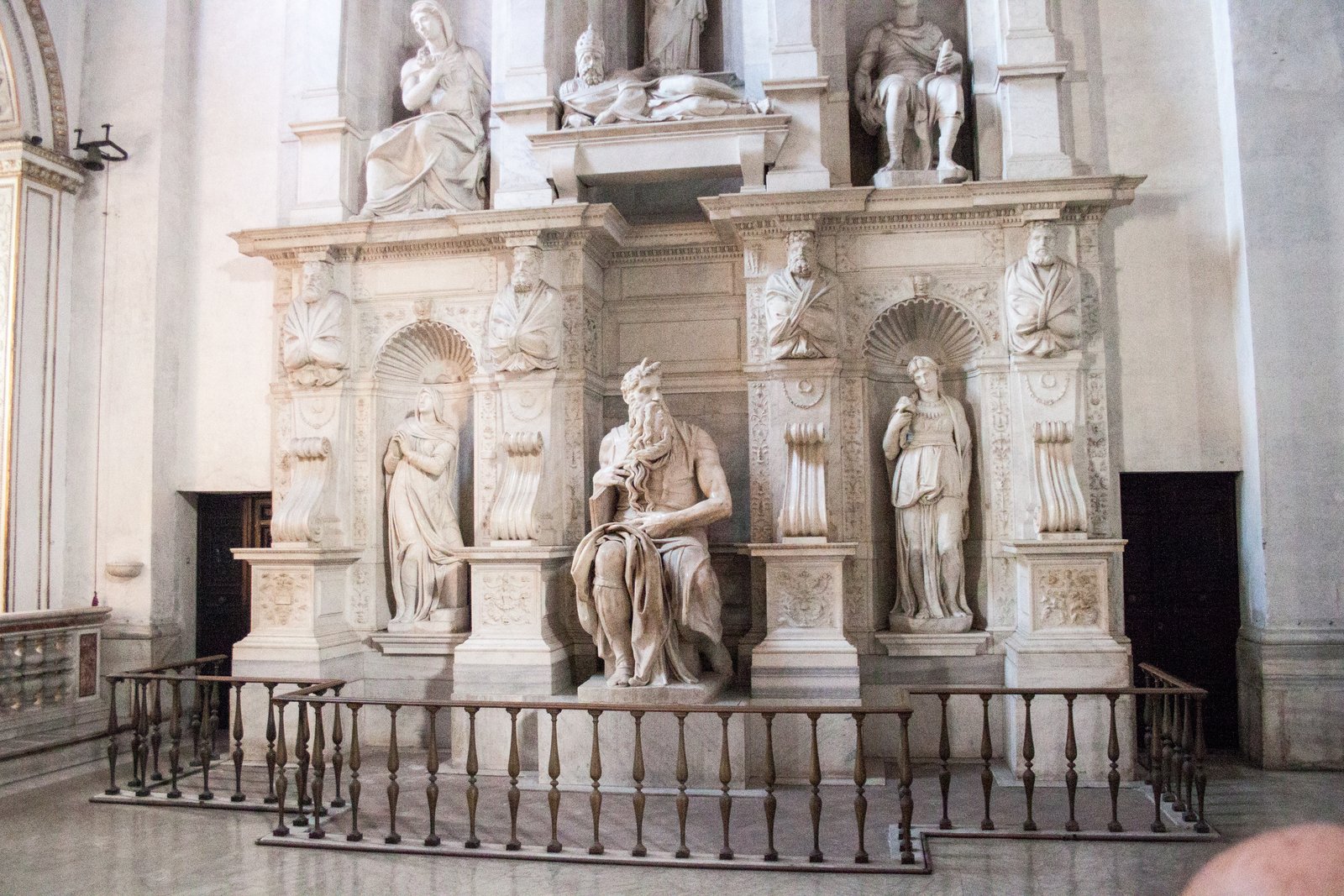
Michelangelo, Moses, c. 1513-1515, San Pietro in Vincoli, Rome. Photograph by Szilas — public domain.
What followed was one of the most protracted and frustrating episodes of Michelangelo's career, a saga later chroniclers would call "the tragedy of the tomb." Julius died in 1513 before the monument was finished, and over the following decades Michelangelo was contractually bound, under pressure from the pope's heirs, to complete an increasingly scaled-back version of the project even as other major commissions — including the Sistine ceiling and, later, the Medici Chapel — pulled his attention elsewhere. The tomb that finally reached completion in 1545, forty years after the original commission, installed not in Saint Peter's but in the far smaller Roman church of San Pietro in Vincoli, bore little resemblance to Julius's original vision. Of its surviving figures, Moses is the only one universally agreed to be entirely Michelangelo's own work from start to finish, and it dominates the finished monument as its unmistakable centerpiece.
A coiled, watchful stillness
Even reduced from its original conception, Michelangelo's Moses remains an imposing presence: over seven feet tall, seated on a throne-like block, one hand resting on the tablets of the Law tucked beneath his arm, the other threading through his long, elaborately carved beard in a gesture of restless tension rather than calm repose. His head is turned sharply to one side, his brow furrowed, his gaze fixed on something beyond the edge of the composition. Nothing about the pose reads as settled; it looks instead like a body caught in the instant just before movement, coiled and ready to rise.
Art historians have generally connected this charged stillness to the biblical narrative surrounding Moses's descent from Mount Sinai bearing the tablets of the Law, and specifically to the moment described in Exodus when he discovered the Israelites worshipping a golden calf in his absence — an interpretation supported by the statue's tense, alert expression, though Michelangelo left the precise narrative moment deliberately ambiguous rather than illustrating a single specific action. What's certain is the sculptural achievement: even confined to a seated pose, Michelangelo built an extraordinary sense of contained physical power and imminent motion into solid marble, a hallmark of his mature style that would recur across his later work.
The horns, explained
The statue's most immediately striking and frequently questioned detail is the pair of small, distinctly visible horns rising from Moses's head — a feature that strikes many modern viewers as unexpected, given that horns carry strongly demonic associations in later popular culture. The explanation, however, has nothing to do with any suggestion of evil. It traces back to a translation choice made over a thousand years before Michelangelo picked up his chisel, in Saint Jerome's Latin Vulgate Bible, the standard biblical text used throughout medieval and Renaissance Western Christianity.
The relevant passage, Exodus 34:29, describes Moses's face after he descended Mount Sinai having spoken with God, using a Hebrew word, karan, that carries the sense of radiating light or sending out rays — his face shone, or was radiant, from the encounter. Jerome rendered this Hebrew term as cornuta, the Latin word for "horned," likely because the Hebrew root shares a spelling with a related word for "horn." Whether Jerome intended this literally or as a kind of visual metaphor for radiant light has been debated by scholars, but the effect on centuries of Western art was direct and lasting: artists working from the Vulgate text depicted Moses with small horns as a standard, unremarkable convention, a visual shorthand for divine radiance rather than any sinister quality, and Michelangelo was working squarely within that established tradition rather than inventing something new or strange.
A legend that outlived its evidence
One of the most frequently repeated stories about this statue holds that Michelangelo, upon completing it, was so struck by how lifelike and commanding it appeared that he struck its knee with his mallet or chisel and shouted "Speak!", frustrated that the figure remained silent despite seeming so nearly alive. It's a vivid image, and it has circulated in guidebooks and popular retellings for generations. It should be treated, however, as legend rather than documented fact — no contemporary source from Michelangelo's own lifetime records the incident, and it appears to belong to the same broader tradition of dramatic artist-anecdotes that has attached itself to numerous celebrated works across art history, valued more for what it says about the statue's uncanny lifelike power than for its accuracy as biography. That power, in any case, needs no embellishment: five centuries after its completion, Michelangelo's Moses remains one of the most visited and studied works of Renaissance sculpture, still commanding the small Roman church built to hold what was originally meant to be a far grander monument entirely.
Trivia
Where is Michelangelo's Moses located?
Why does Moses have horns in Michelangelo's sculpture?
Why was Julius II's tomb never completed as originally planned?
Is the story about Michelangelo striking the statue's knee true?
What biblical moment does the statue depict?
You May Also Like
Related Reading