The Baptistery Doors of Florence: The Gates Michelangelo Called Paradise

A competition that launched an era
Florence's Baptistery of San Giovanni, an octagonal building standing directly across from the city's cathedral, was already centuries old and deeply cherished by Florentines when the wool merchants' guild responsible for its upkeep decided, in 1401, to commission a second set of bronze doors. They staged a competition, inviting leading young sculptors to submit a bronze relief panel depicting the biblical Sacrifice of Isaac, a subject chosen partly for its dramatic tension and partly as a technical challenge, since casting bronze relief with fine figural detail demanded real mastery. Among the entrants was Filippo Brunelleschi, who would later become the architect of the cathedral's famous dome, but the judges selected the panel submitted by a young goldsmith named Lorenzo Ghiberti. Art historians have long treated this competition, and Ghiberti's victory, as a symbolic marker for the opening of the Florentine Renaissance in the visual arts.
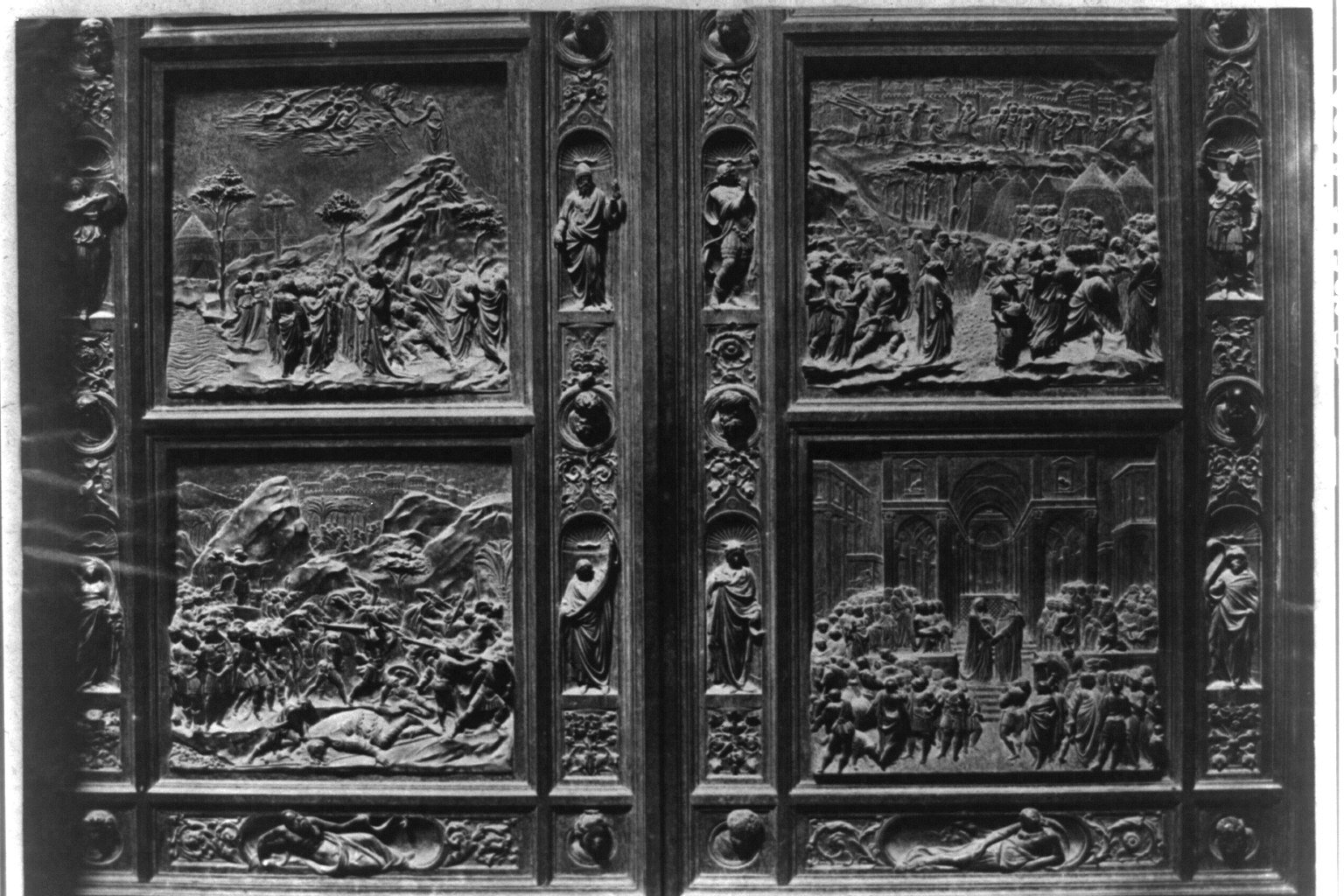
Lorenzo Ghiberti, east doors of the Florence Baptistery ("Gates of Paradise"), 1425-1452. Photograph, 1855 — public domain.
Two sets of doors, decades apart
Ghiberti's relationship with the Baptistery doors did not end with a single commission. His first major project, the north doors, occupied him from 1403 to 1424, depicting twenty-eight scenes from the life of Christ and the four Evangelists and Church Fathers, still working within a visual style closely tied to the lingering Gothic conventions of the period. It was only with his second commission, the east doors — begun in 1425 and not completed until 1452, just before his death in 1455 — that Ghiberti fully embraced the new artistic language of linear perspective, classical architectural framing, and deeply modeled figures that define the mature early Renaissance style. Rather than the twenty-eight smaller quatrefoil panels of the north doors, he reduced the east doors to just ten larger square panels, giving each Old Testament scene considerably more space to develop complex, multi-figure narrative compositions in high and low relief combined.
Old Testament scenes rendered with new depth
Each of the ten panels on the east doors tells a distinct Old Testament story — from the Creation and the story of Adam and Eve, through Noah, Abraham and Isaac, Jacob and Esau, Joseph in Egypt, Moses receiving the Law, Joshua at Jericho, the reign of David, and finally Solomon and the Queen of Sheba. What set these panels apart from earlier relief sculpture was Ghiberti's confident use of the newly developed mathematical system of linear perspective to create convincing illusions of deep pictorial space within a physically shallow bronze relief, combining architectural backdrops, layered figure groups, and varying depths of carving to suggest a receding three-dimensional world. The technique paralleled experiments happening simultaneously in Florentine painting, and readers curious how this same perspectival revolution played out on a flat wall rather than in bronze may enjoy our piece on Masaccio's Holy Trinity fresco, painted during the same decades Ghiberti was still at work on these doors.
Twenty-seven years on one commission
The sheer duration of the east doors project is itself remarkable: nearly three decades of sustained work, involving an extensive workshop of assistants, apprentices, and specialist bronze-casters operating under Ghiberti's direction, since a project of this scale and technical complexity could not have been completed by one person alone. Ghiberti himself later wrote an account of his career emphasizing his personal artistic judgment and craftsmanship, an unusually self-conscious gesture for the period that reflects the rising status of individual artists during the early Renaissance, moving away from the more anonymous guild-craftsman model of earlier medieval art production. Notable figures who trained or worked in Ghiberti's workshop over the decades included, at least briefly, a young Donatello, linking the doors directly to the wider network of sculptors reshaping Florentine art in this period.
Preservation and the move indoors
By the twentieth century, the gilded bronze surface of the doors, exposed to Florence's open-air Piazza del Duomo for over five hundred years, had suffered visible deterioration from pollution, weather, and a serious 1966 flood that struck Florence and damaged several panels. Conservators undertook an extensive, decades-long restoration effort, and starting in the 1990s the original panels were permanently removed from the Baptistery itself and relocated to controlled, indoor display at the Museo dell'Opera del Duomo, with a precise bronze replica installed on the building to preserve the doors' familiar public presence on the piazza. Visitors today can view the meticulously restored originals up close indoors, seeing details of gilding and fine surface modeling that would have been far harder to appreciate on the doors' original exterior location.
A defining monument of Renaissance sculpture
More than six centuries after the 1401 competition that started it all, the Gates of Paradise remain one of the touchstone works used to mark the transition from late Gothic to Renaissance art in Florence. They represent not just extraordinary technical achievement in bronze casting and gilding, but a genuine conceptual leap in how sculpture could organize space, narrative, and figure within a fixed physical frame. Ghiberti spent the better part of his working life on these two sets of doors, and the results have more than justified Michelangelo's famously enthusiastic verdict.
Trivia
What are the Gates of Paradise?
Why are they called the Gates of Paradise?
How did Ghiberti win the commission for the doors?
Did Ghiberti make more than one set of doors for the Baptistery?
Are the original doors still on the Baptistery today?
Related Reading