Bosch's Garden of Earthly Delights: A Triptych Nobody Fully Explains

An artist we barely know
Remarkably little verified biographical information survives about Hieronymus Bosch, despite his standing as one of the most instantly recognizable painters of the late medieval Netherlands. He was active in the town of 's-Hertogenbosch, in the present-day Netherlands, from which his adopted professional name derives, and surviving records place him as a member of a local religious confraternity, but details of his artistic training, his personal beliefs, and much of his working life remain genuinely unknown. This scarcity of documentation has left considerable room for scholarly speculation about his intentions, particularly regarding his most famous and most enigmatic surviving work, the large triptych now known as the Garden of Earthly Delights, painted sometime between roughly 1490 and 1510.
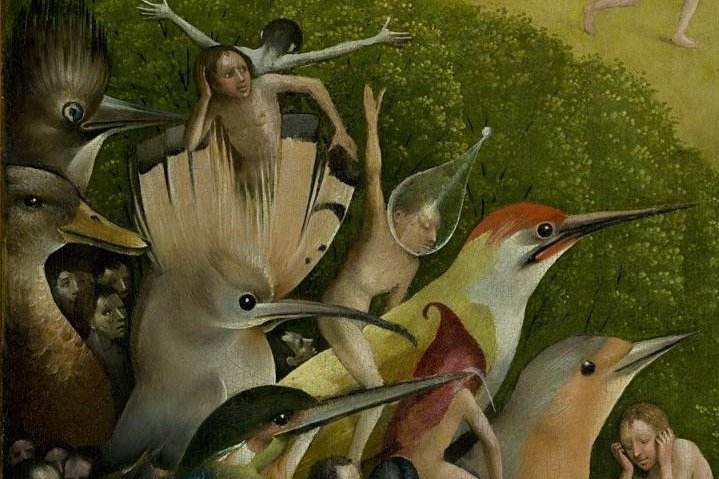
Hieronymus Bosch, "The Garden of Earthly Delights" (central panel, detail), c. 1490-1510, Museo del Prado, Madrid — public domain.
Three panels, one unsettled argument
When closed, the triptych's exterior shutters display a grisaille, or grayscale, image of the earth enclosed within a translucent sphere, representing the third day of Creation according to the biblical account in Genesis. Opened, the interior reveals its three now-famous panels: on the left, a serene depiction of the Garden of Eden showing God presenting Eve to Adam; in the enormous central panel, an astonishingly dense, fantastical landscape crowded with hundreds of nude human figures, oversized fruit, exotic and invented birds, and elaborate architectural and rock formations, arranged in scenes whose precise meaning has never been definitively settled; and on the right, a starkly different nightmarish vision of hell, filled with grotesque tortures, burning structures, and monstrous hybrid creatures.
Warning, or window into paradise?
The traditional and still most widely held scholarly interpretation reads the central panel as a moralizing warning against the fleeting, ultimately damning nature of sensual pleasure and sin, positioned as a consequence flowing directly from the innocence of Eden on the left and leading inexorably toward the punishment depicted on the right. Under this reading, the strange, playful intimacy shown among the central panel's countless figures represents humanity's descent into sensual indulgence, doomed to end in the torments awaiting on the opposing panel. A minority of scholars have proposed more unconventional readings, including interpretations connecting the imagery to specific heterodox religious movements of the period, or suggesting the central panel might depict an alternate, innocent vision of pleasure rather than straightforward condemnation. No single interpretation commands full scholarly consensus, and that persistent ambiguity is itself part of what has kept the painting a subject of active art-historical debate for generations.
A visual imagination without clear precedent
What makes Bosch's work so distinctive within the broader tradition of Netherlandish religious painting is the sheer inventiveness of his visual imagination, populating his panels with hybrid creatures, architectural fantasies, and symbolic objects that draw on an eclectic mix of medieval bestiary tradition, alchemical imagery, proverbial expressions, and outright invention, executed with the same meticulous technical precision that Netherlandish painters typically reserved for more conventional devotional subjects. This combination of fantastical content and technically accomplished execution set Bosch apart from contemporaries and has made his work a recurring point of reference for later artists exploring surreal or symbolic imagery, connecting his 16th-century painting to concerns that would resurface centuries later in entirely different artistic movements. Readers interested in how other painters of the period balanced technical precision with dense symbolic content may enjoy our overview of the halo in religious art, exploring another recurring visual device layered with theological meaning.
From private collection to national treasure
The triptych's early ownership history places it in the possession of Netherlandish nobility before it was acquired by King Philip II of Spain in the second half of the 16th century, a monarch known for his serious interest in devotional and moralizing art despite the painting's unusual subject matter. It has remained part of the Spanish royal, and later national, collection ever since, surviving centuries of political upheaval to become one of the centerpiece holdings of the Museo del Prado in Madrid, where it continues to draw enormous crowds of visitors eager to examine its almost inexhaustible density of invented detail firsthand.
Still resisting easy answers
More than five hundred years after its creation, the Garden of Earthly Delights remains one of the rare works of pre-modern art that continues to generate genuinely open scholarly disagreement about its core meaning, rather than settled consensus refined only at the margins. That persistent uncertainty has done nothing to diminish its power. If anything, the painting's refusal to resolve into a single, tidy reading is precisely what keeps drawing new generations of viewers back to Bosch's crowded, strange, and still faintly unsettling vision of paradise, pleasure, and punishment.
Conservation science has added its own layer to that ongoing fascination. Detailed infrared and X-ray examination of the panels in recent decades has revealed extensive underdrawing beneath the visible paint surface, showing how carefully Bosch planned even his most seemingly whimsical inventions before committing them to paint, and confirming that the finished panels closely follow his original design rather than reflecting significant later alteration. That technical evidence has helped settle at least one question even as the deeper question of meaning remains open: whatever the triptych is ultimately about, it was the product of a single, exacting artistic vision, not a composite assembled or substantially reworked by other hands. Few paintings from the period reward such sustained, close looking, and fewer still have kept viewers looking quite this closely for quite this long.
Trivia
What is the Garden of Earthly Delights?
Who was Hieronymus Bosch?
What does the central panel actually represent?
Who commissioned the painting?
Where can the Garden of Earthly Delights be seen today?
Related Reading