Saint John Vianney's Incorrupt Heart: A Relic Apart From His Body

Two relics, two chapels, one village
Saint John Vianney spent more than forty years as parish priest of Ars-sur-Formans, a once-tiny French village he arrived at in 1818 and never willingly left, becoming famous for the extraordinary hours he poured into hearing confessions — read more about his life in our article on Saint John Vianney. When he died in 1859, the village that had grown up around his ministry faced an unusual question: what to do with the body of a man whose reputation for holiness was already drawing thousands of pilgrims a year, even before any formal declaration by Rome.
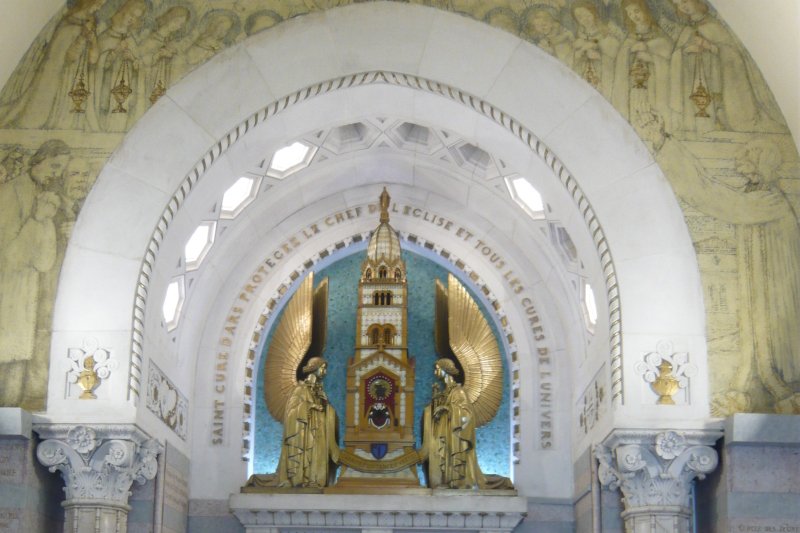
Photograph by Laifen, Chasse Coeur St Cure (2009). CC BY-SA 3.0, via Wikimedia Commons.
The answer, worked out over the following decades, was to divide the relics between two separate structures on the shrine grounds, a layout pilgrims can still walk through today, covered in more detail in our article on the shrine at Ars-sur-Formans. Vianney's body rests in a glass reliquary above the former high altar of his original parish church, now enclosed within the much larger Basilica of Saint Sixtus built up around it. His heart, however, was removed and enshrined separately, in its own dedicated building a short walk from the basilica: the Chapelle du Cœur, the Chapel of the Heart, where it sits inside a gilded, tower-shaped reliquary flanked by two kneeling angel figures, an inscription above declaring the saint protector of parish priests "of the whole world."
A tradition older than one village
Separating a heart from the rest of a body for distinct veneration is not something invented at Ars. French and broader European Catholic practice has a long history of "heart burial" and divided relics — a custom with roots that predate Vianney by centuries, tied partly to practical considerations of embalming and transport in earlier eras, and partly to a devotional sense that the heart, as a traditional symbol of love and interior life, deserved its own dedicated place of honor. What makes Ars distinctive is less the practice itself than the fact that both halves of Vianney's relics — body and heart — remain accessible to pilgrims in active, functioning chapels rather than one being lost to history or quietly absorbed into an ossuary.
What "incorrupt" does and doesn't mean
Both relics at Ars are commonly described using a word that gets used loosely outside Catholic circles: incorrupt. It's worth being precise about what that word is actually claiming, because popular retellings tend to overstate it. "Incorrupt" does not mean a body or organ shows no sign whatsoever of the passage of time, nor does it mean the Church treats every case the same way or with the same level of scrutiny. Historically, investigators evaluating a candidate's remains — working within standards associated with the eighteenth-century canonist Pope Benedict XIV — looked for an unusual degree of preserved form, flexibility, or color well beyond what ordinary decomposition would produce, specifically in bodies that had not been deliberately embalmed to achieve that effect.
In practice, that is a matter of degree, not an absolute binary. Many bodies venerated under the "incorrupt" label, including Vianney's own, were exhumed decades after death, found in a notably preserved state relative to expectations, and then received conservation treatment to protect that condition going forward — in Vianney's case, a wax mask cast over the face and hands, a widely documented and openly acknowledged step taken by shrine custodians, not a detail hidden from visitors. The Church does not require belief in strict, untouched incorruptibility as a condition of sainthood, and has not treated it as a required miracle for canonization for some time; it is one devotional phenomenon among many associated with certain saints' remains, not a doctrinal test every holy person is expected to pass. Readers interested in how the Church frames relic veneration more broadly, regardless of a given relic's physical state, can see the Catechism of the Catholic Church's own treatment of the subject (no. 1674), which places veneration of relics among the Church's encouraged, non-obligatory popular devotions.
A relic that left Ars
For most of its history, Vianney's heart stayed exactly where it had been enshrined, visited by pilgrims willing to make the journey to rural eastern France. That changed in 2018 and 2019, when the Shrine of Ars entrusted the relic to the Knights of Columbus, a Catholic fraternal organization, for an extended tour across the United States, timed to mark the two-hundredth anniversary of Vianney's arrival at Ars in 1818. Over several months the heart relic traveled to dozens of states, drawing public veneration events at cathedrals and parish churches, including a widely covered stop at St. Patrick's Cathedral in New York City in April 2019, before returning to its permanent chapel at Ars that June.
The tour landed in a period when Vianney's name was already unusually prominent in Catholic life internationally, thanks to a decision Pope Benedict XVI had made a decade earlier. In 2009, Benedict opened a worldwide "Year for Priests," deliberately choosing June 19 — the 150th anniversary of Vianney's death — as its opening date, and naming the Curé of Ars explicitly as a model of priestly holiness for the occasion. He devoted a general audience that August specifically to Vianney's life and example, and closed the Year for Priests the following June with a World Meeting of Priests gathered in Rome. That sustained attention from the Vatican kept Ars, and its two separately enshrined relics, in front of a global Catholic audience well beyond the small village's own capacity to draw pilgrims on its own.
Why the Church allows a divided relic at all
It might seem strange, from outside Catholic devotional practice, that a saint's remains can be split between two buildings and still be treated with full reverence in both places. The theology behind this traces back to the Second Council of Nicaea in 787, which addressed the veneration of relics and sacred images directly: the honor shown to a relic, the council taught, ultimately passes to the person it represents, not to the physical object treated as independently holy in itself. Because the object of veneration is the saint, not a specific intact assemblage of tissue, there is no doctrinal obstacle to a heart being honored in one chapel while the rest of a body rests in another a few hundred meters away.
That framework is also why the Church has never needed to resolve, in any binding way, exactly how "incorrupt" a given relic truly is before allowing it to be venerated. Pilgrims standing before either of Vianney's relics at Ars — the body above the old high altar, or the heart inside its gilded tower — aren't being asked to render a verdict on preservation science. They're there, as pilgrims have been since 1859 and long before that at other shrines, to be close to the memory of a man whose life was unusually, exhaustingly devoted to the people who sought him out, and whose two resting places, however the Church came to divide them, keep that devotion within reach for anyone willing to make the trip.
Trivia
Where is Saint John Vianney's heart kept, and is it different from his body?
What does 'incorrupt' actually mean when the Church applies it to a relic?
Did Saint John Vianney's heart travel outside France?
How does the Year for Priests connect to Vianney's heart relic?
Why does the Church allow veneration of a heart separately from the rest of a body?
Related Reading