Our Lady of Mount Carmel

A mountain already marked by fire
Mount Carmel carries weight in Scripture long before any Marian devotion attaches to it. It's the setting of one of the Old Testament's most dramatic confrontations: the prophet Elijah, standing alone against 450 prophets of the pagan god Baal, challenges them to a public test of whose god can send fire to consume a sacrificial offering. The prophets of Baal fail for hours. Elijah's own offering, soaked in water beforehand to remove any doubt, is consumed instantly when he calls on the Lord (1 Kings 18:20-39, NABRE). It's this mountain — already associated in Jewish and Christian tradition with a decisive, visible act of God — that later hermit communities chose as their home.
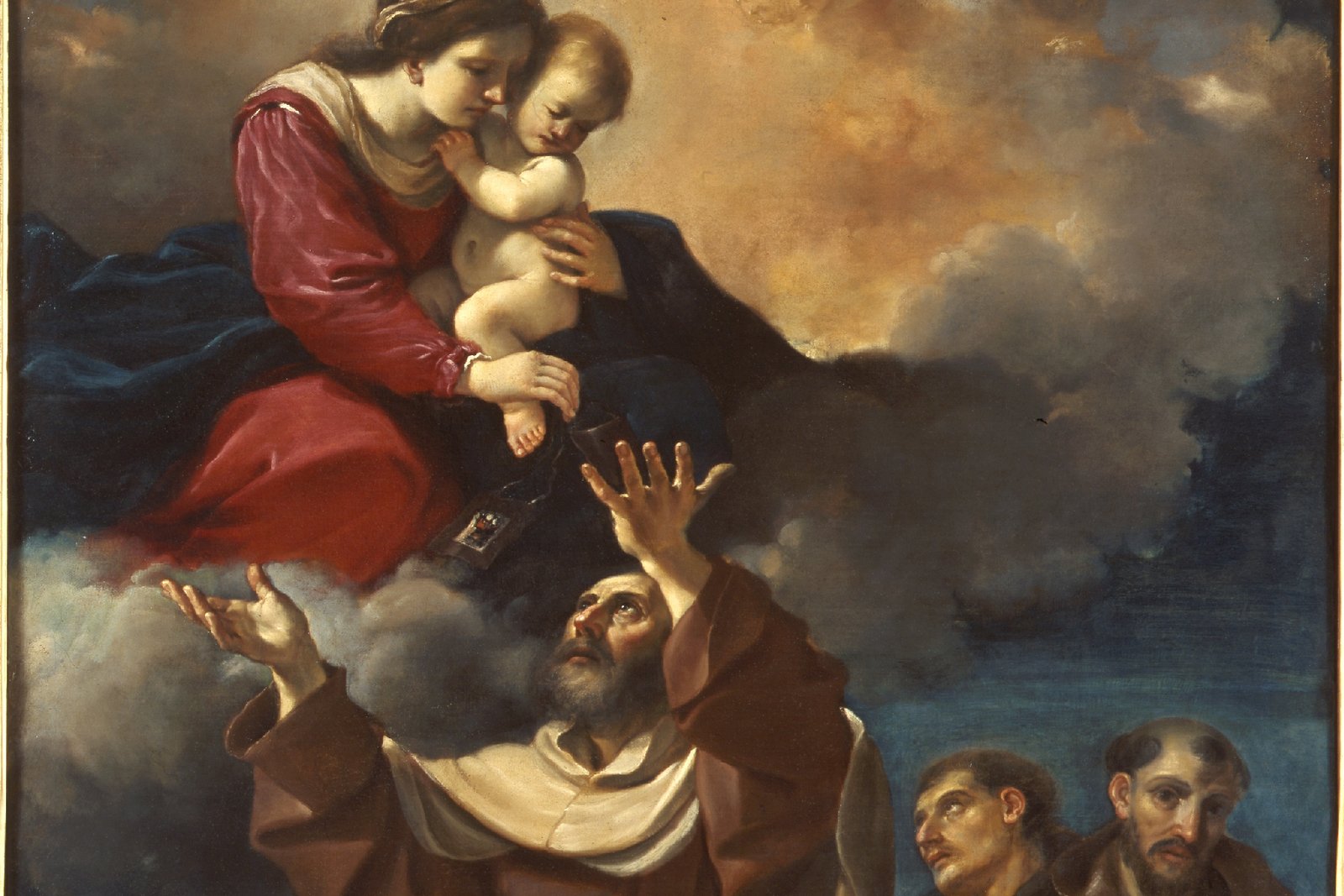
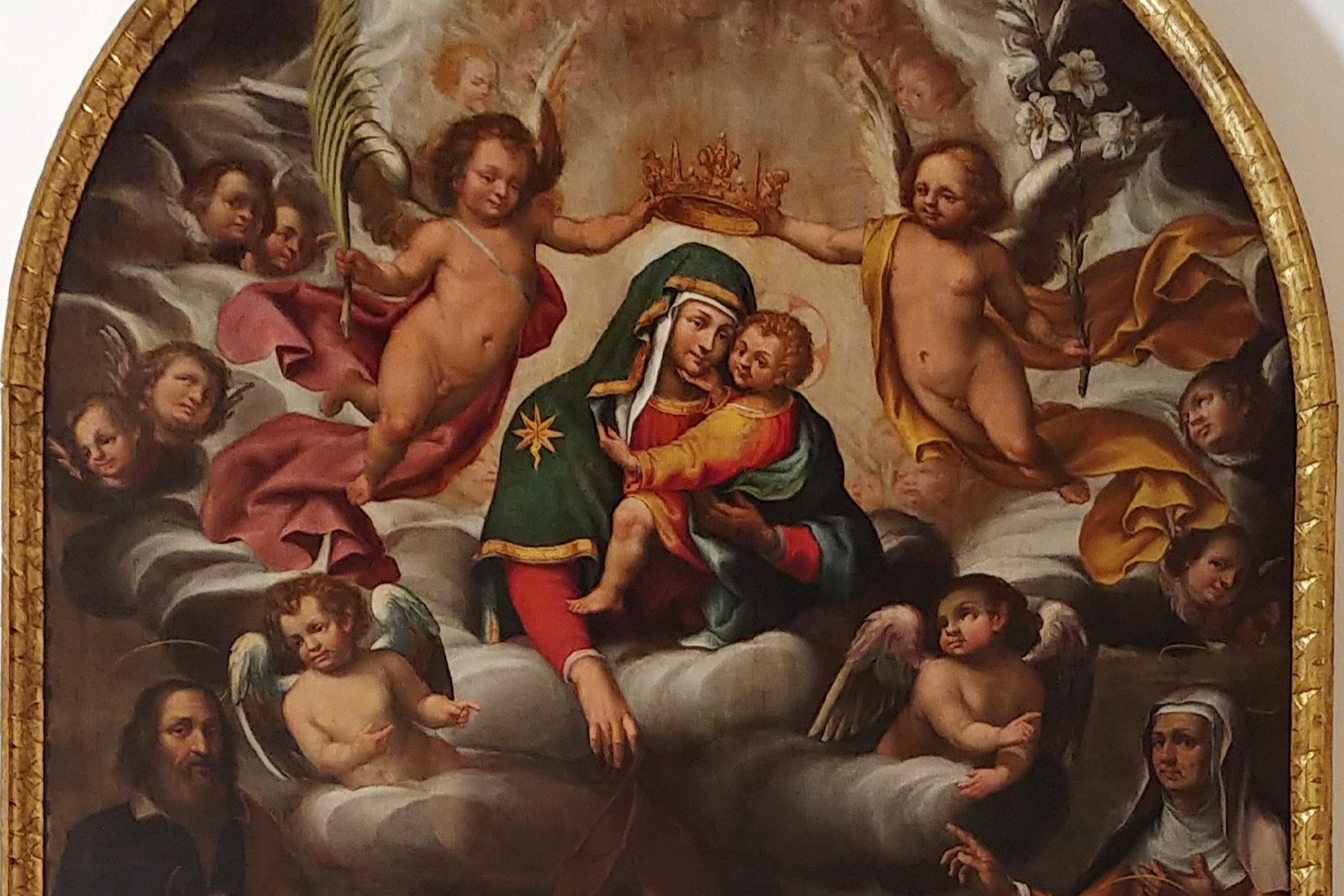
Guercino, "Madonna del Carmine con i Santi Alberto, Francesco e un francescano." Public domain (Wikimedia Commons).
Hermits who took Mary as their patroness
In the 12th century, a community of hermits settled on Mount Carmel, in what is now northern Israel, drawn by the site's biblical associations and its relative remoteness. These hermits organized themselves into what became the Carmelite order, and from early on, they adopted the Virgin Mary as their special patroness — building a chapel dedicated to her on the mountain itself. As the order spread across Europe in the centuries that followed (driven in part by the upheavals of the Crusades, which made the original site increasingly difficult to hold), the devotion to "Our Lady of Mount Carmel" spread with them, eventually becoming a formally recognized feast on the wider Church calendar.
The Brown Scapular and Saint Simon Stock
The devotion most closely associated with Our Lady of Mount Carmel today is the Brown Scapular — two small rectangles of brown cloth connected by cords, worn over the shoulders and hanging front and back, traditionally next to the skin. Carmelite tradition traces its origin to a vision reported by the English Carmelite Saint Simon Stock in the 13th century, in which Mary is said to have presented him with the scapular, promising protection to those who wore it with devotion until death. It's important to distinguish what this represents in Catholic teaching: the apparition and its associated promises rest on centuries of pious tradition passed down through the Carmelite order, not on a formally defined dogma the Church requires the faithful to believe.
A devotion that spread well beyond the Carmelite order
Over time, the scapular moved from a garment worn specifically by Carmelite religious to a sacramental adopted by laypeople across the Catholic world, often received through a formal rite of enrollment performed by a priest. Popes across several centuries encouraged the practice and attached indulgences to it, while the Church has consistently framed it as an aid to devotion and a sign of one's commitment to Mary, not a magical guarantee or a substitute for a genuinely lived faith.
The feast day today
The feast of Our Lady of Mount Carmel is celebrated on July 16 each year, and remains especially significant within the Carmelite order — including its Discalced Carmelite reform, associated with figures like Saint Teresa of Ávila and Saint John of the Cross — as well as in parishes and communities with strong Marian devotional traditions more broadly. The title endures as one of the clearer examples in Catholic history of a devotion growing directly out of a specific place, carried forward by the religious community that first took root there.
From hermits to a formal religious order
The transition from scattered hermits on a mountainside to a structured religious order didn't happen overnight. The Carmelite hermits initially lived a loosely organized eremitical life, each in his own small cell, gathering for common prayer but otherwise pursuing a solitary existence modeled loosely on the prophet Elijah's own time alone in the wilderness. Around 1209, Saint Albert of Jerusalem, the Latin Patriarch of the city, gave the community a formal rule of life, and the order received papal approval later in the century. When Crusader-held territory in the Holy Land grew increasingly unstable through the thirteenth century, the Carmelites relocated their communities to Europe, adapting from strict hermit life toward the more communal structure of a mendicant order — similar in that respect to the Franciscans and Dominicans who were organizing around the same period — while still keeping Mount Carmel's memory, and Mary's patronage, at the center of their identity.
How the title differs from an apparition-based feast
It's worth distinguishing this feast from Marian titles that commemorate a specific reported apparition, such as Our Lady of Lourdes or Our Lady of Fatima. Our Lady of Mount Carmel instead commemorates an order's ongoing patronal relationship with Mary, built up gradually over centuries of communal devotion rather than centered on one dated, witnessed event. The Brown Scapular vision attributed to Saint Simon Stock is the closest this devotion comes to an apparition narrative, but even that story functions more as the origin account of a specific sacramental practice than as the foundation of the wider feast itself, which predates and extends beyond the scapular tradition.
A devotion that reached far beyond Carmel's original mountain
Today, "Our Lady of Mount Carmel" is one of the most widely used Marian titles outside the Carmelite order itself, giving her name to parishes, towns, and popular festivals across Latin America, the Philippines, southern Italy, and immigrant Catholic communities throughout the world. In several of these places, the July 16 feast has grown into major public celebrations involving processions, decorated boats, and street festivals — a long journey from a scriptural mountain associated with a solitary prophet's confrontation with false gods, to a devotion now celebrated by millions of Catholics who may never have set foot near Mount Carmel itself.
Trivia
Why is Mount Carmel already significant in the Old Testament, before any Marian connection?
Who were the Carmelites, and what is their connection to this title?
What is the Brown Scapular, and what tradition is associated with it?
When is the feast of Our Lady of Mount Carmel celebrated?
Is devotion to the Brown Scapular required Catholic belief, or optional piety?
You May Also Like
Related Reading