Saint Adalbert of Magdeburg, the Missionary Who Failed First

A monk called east by a foreign princess
Adalbert was born around 910, likely in the Lorraine region, and entered religious life as a Benedictine monk at the monastery of St. Maximin in Trier, one of the more prominent monastic houses in the East Frankish kingdom of his day. His life took an unexpected turn around 959, when Princess Olga of Kiev — regent of the Kievan Rus' and later venerated in the Eastern Church as a saint herself for her own eventual conversion to Christianity — sent envoys to the German emperor Otto I asking for missionaries to establish Christianity among her people. Otto, seeing both a genuine missionary opportunity and a chance to extend German political and religious influence eastward, agreed, and had Adalbert consecrated as a missionary bishop specifically for this purpose in 961, sending him east with a small group of companions.
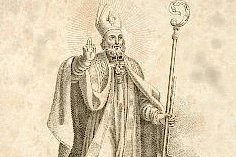
W. Hoffmann, portrait of Adalbert of Magdeburg, 1830 — public domain.
A mission that collapsed almost immediately
What Adalbert and his companions found on arriving in Kiev was very different from what Olga's original request had suggested. By the time the mission reached Kievan territory, the political situation had shifted — some historical accounts point to renewed pagan resistance at court, possibly connected to the rising influence of Olga's son Svyatoslav, who remained committed to the traditional Slavic and Norse religious practices of the Rus' elite rather than his mother's Christian sympathies. The mission met open hostility rather than the welcome it had been promised, and within roughly a year it had effectively collapsed. Several of Adalbert's companions were killed in the unrest, and Adalbert himself, according to the sources, escaped back toward German territory only with considerable difficulty and danger — a genuinely harrowing outcome for what had begun as a diplomatically arranged mission at a foreign ruler's own invitation.
Rebuilding a career around patient, local work
A failed mission of that kind might easily have ended a churchman's career in the medieval world, but Adalbert's did not. He returned to German territory and was made abbot of the monastery of Weissenburg in Alsace, a significant post in its own right, and remained closely connected to the ongoing German missionary effort among the Slavic peoples living east of the Elbe River — an effort Otto I considered a central part of his own imperial and religious policy. Rather than another dramatic foreign mission, Adalbert's later work was steadier and more institutional: helping organize the structures, dioceses, and personnel that would let Christianity actually take root and endure in newly contacted or newly conquered Slavic territory, rather than depending on the kind of single dramatic mission that had nearly gotten him killed at Kiev.
First Archbishop of a brand-new see
That patient, institution-building work culminated in 968, when Otto I created the new Archdiocese of Magdeburg specifically to serve as an ecclesiastical center for the German Church's ongoing mission and administration east of the Elbe, and named Adalbert its first archbishop. The appointment reflected real trust in a man who had already shown he could survive and adapt after failure rather than simply retreating from missionary work altogether. As archbishop, Adalbert spent his final years overseeing the practical work of establishing the diocese's structures and supporting the broader network of new sees Otto's policy created across the Slavic frontier — the same kind of unglamorous, foundational labor that later allowed Christianity to become durably established in territories where a single missionary bishop, arriving alone as Adalbert once had at Kiev, could accomplish little on his own.
A chronicler as well as a bishop
Beyond his practical ecclesiastical work, Adalbert left behind a genuinely significant piece of medieval historical writing: a continuation of the chronicle originally begun by the monk Regino of Prüm, extending its coverage of contemporary events into Adalbert's own lifetime. This continuation is treated by modern historians as a valuable, largely firsthand source for tenth-century German and Central European affairs, written by a man who had himself lived through — and nearly died in — some of the events at the edges of the very world he was recording. He died in 981, having spent roughly two decades as archbishop, and is remembered with a double legacy: as a missionary whose first great effort ended in near-disaster, and as the patient administrator and chronicler whose later, quieter work proved far more lasting. The archdiocese he founded went on to play a central role in the German Church's presence in Central Europe for centuries afterward, a durability that owed far more to the unglamorous administrative groundwork of his later years at Magdeburg than to the single dramatic missionary journey that first brought him to Otto I's attention. His feast is kept on June 20, and he should be carefully distinguished from the younger, better-known Saint Adalbert of Prague, a Czech bishop and martyr of the following generation who shares his name but not his biography.
Trivia
Who was Saint Adalbert of Magdeburg?
Is Saint Adalbert of Magdeburg the same person as Saint Adalbert of Prague?
What happened on Adalbert's mission to the Rus'?
What did Adalbert do after the failed mission to Kiev?
Did Adalbert write anything that survives today?
You May Also Like

Related Reading