Saint Rupert of Salzburg

A bishop with no fixed diocese
Very little about Rupert's early life survives in reliable form. Historians generally place his origins among Frankish nobility, possibly connected to the Merovingian royal family, and most accounts agree he served as bishop of Worms — a Rhineland see with a long Christian history — before he ever set foot in Bavaria. Why he left is less clear. Later legend frames it as a straightforward missionary calling, but it's just as likely that shifting political fortunes in Worms made a fresh start elsewhere the more practical option. What matters for history is what happened next: an invitation arrived from Theodo, the duke ruling over Bavaria, who wanted a bishop capable of organizing Christian life in a territory where the old Roman-era church had largely collapsed.
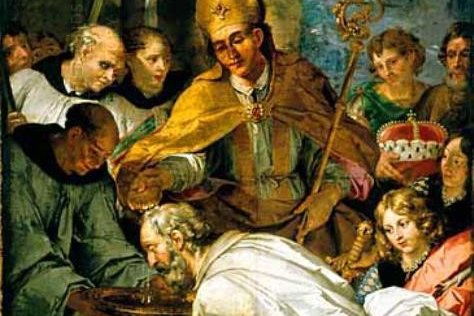
Franciscus de Neve the Younger, Saint Rupert Baptizes the Bavarian Duke Theodo, 1670s — public domain.
Bavaria at the end of the seventh century wasn't purely pagan — pockets of Christianity had survived from the Roman period, and earlier missionaries had passed through — but it lacked the kind of settled, structured church life that Rupert's contemporaries would have expected in Francia or Italy. Duke Theodo needed a bishop who could build something lasting, not simply preach and move on. Rupert appears to have been exactly that kind of administrator-missionary, and Theodo's baptism, along with much of his court, is remembered as an early and consequential success of the mission.
Rebuilding a ruined Roman town
Rupert's most lasting decision was where to settle. He chose Juvavum, a once-important Roman town near the Alps that had fallen into decline after the empire's collapse in the region — overgrown, half-abandoned, but strategically placed along old trade routes and, crucially, sitting on top of some of Europe's richest salt deposits. Rupert rebuilt it as a Christian center, founding the monastery of Saint Peter — still standing today as one of the oldest continuously operating monasteries in the German-speaking world — and a convent for women, traditionally associated with his relative or protégée Erentrudis, who became its first abbess.
The town Rupert refounded took its later name, Salzburg, directly from the salt trade he is credited with reviving. Salt was not a minor detail in the early medieval economy; it was one of the most valuable commodities a region could control, used for food preservation across an enormous trading radius. By reestablishing both the church and the salt works together, Rupert tied Salzburg's spiritual and economic identity together from its very foundation — a combination that shaped the city's importance for the next thousand years, long after the Bavarian duchy that first invited him had been absorbed into larger political structures.
The bishop who became the city's patron
Rupert served as Salzburg's first bishop and is traditionally said to have died on Easter Sunday, though the exact year — anywhere from around 710 to 720 depending on the source — isn't firmly established in the surviving records, a common problem for figures from this period whose lives were only written down generations after their deaths. What's certain is the scale of his lasting influence: Salzburg grew from Rupert's refounded settlement into an archbishopric, a major center of Central European Christianity, and eventually one of the most visited cities in Austria, its skyline still dominated by the cathedral and abbey complex that trace their origins directly back to him.
His feast is kept on September 24, traditionally connected to a later translation of his relics to the cathedral, distinct from the March 27 date sometimes given for his actual death. In Salzburg itself, both dates carry local significance, and Rupert remains paired in local devotion with Saint Virgil, a later bishop of Salzburg who continued and expanded the diocesan structure Rupert had first put in place.
Iconography: the bishop with the salt barrel
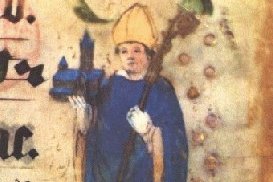
Artists have consistently identified Rupert through one distinctive attribute: a small barrel or vessel of salt, sometimes shown resting at his feet or held in his hand alongside his bishop's crozier and mitre. It's a practical piece of visual shorthand that ties directly back to the salt-trade revival credited to him, and it appears repeatedly across centuries of Bavarian and Austrian religious art — on the Salzburg coat of arms, in cathedral statuary, and in devotional paintings like the one that anchors this article, which shows him baptizing Duke Theodo before an assembled court. The scene captures the two threads of Rupert's legacy at once: a missionary bishop converting a ruling family, and the founder of a city whose wealth would come from the ground beneath it.
A mission continued by later bishops
Rupert's work in Bavaria fits into a broader pattern of early medieval missionary activity that reshaped Christian Europe north of the Alps. He predates the more famous English missionaries who worked in neighboring Germanic territories a generation or two later — figures like Saint Boniface, whose organizational reforms across Hesse, Thuringia, and Bavaria built on groundwork that bishops like Rupert had already begun to lay. Readers interested in this wider missionary movement may also want to read about Saint Willibrord, who carried a similar refounding mission into Frisia around the same period Rupert was establishing Salzburg — two bishops working at opposite corners of the same unsettled frontier, both leaving cities and dioceses that would long outlast them.
Today, Salzburg's cathedral treasury and the abbey of Saint Peter still preserve traditions tracing back to Rupert's founding mission, and his memory persists in a city whose very name announces, in German, what he is remembered for reviving.
Trivia
Who was Saint Rupert of Salzburg?
Why is Saint Rupert called the 'Apostle of Bavaria'?
What is Saint Rupert's connection to Salzburg's salt industry?
When is the feast of Saint Rupert celebrated?
Is Rupert of Salzburg the same as Robert or Rupert of other regions?
You May Also Like
Related Reading