Saint Bernard of Menthon

An archdeacon in the western Alps
Bernard was born around 1020, according to tradition into a noble family connected to the Menthon area near Annecy, in what is now eastern France, though as with several early medieval saints the specific biographical details of his birth and early life come primarily from later sources compiled well after his own lifetime, and should be read with appropriate caution. What is more firmly established is his adult career: Bernard served as archdeacon in the diocese of Aosta, a mountainous region straddling what is now the border of Italy and the wider western Alps, a position that gave him significant pastoral and administrative responsibility across a genuinely difficult and remote territory.
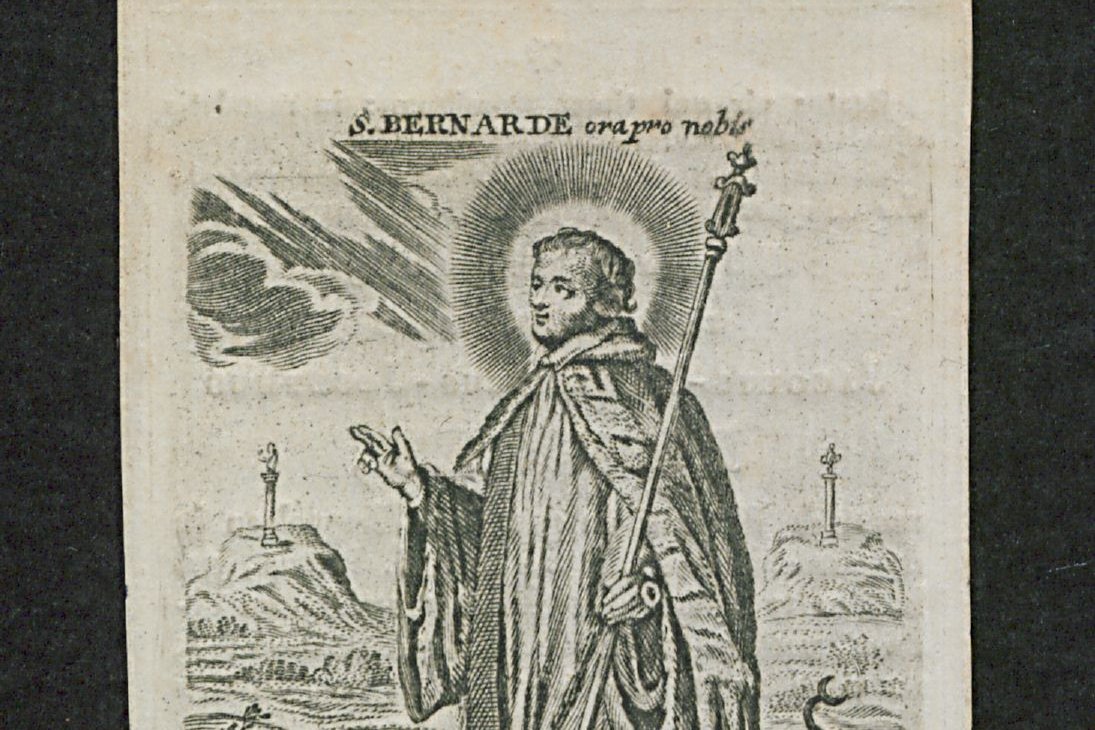
Alexander Goetiers, engraved portrait of Saint Bernard of Menthon, c. 1655 — CC0, public domain dedication.
Part of that responsibility, according to tradition, involved active preaching against lingering pagan practices that persisted in some Alpine communities under his care even centuries after the region's formal Christianization — a reminder that conversion in genuinely remote mountain regions often proceeded more slowly and unevenly than in better-connected lowland areas, with older practices persisting locally well past the point where a region might be considered, in a general sense, Christian.
Building shelter at the deadliest crossings
Bernard's most consequential and lasting work was practical rather than purely pastoral: recognizing the real, ongoing danger faced by travelers crossing the Alpine passes connecting Italy to France and Switzerland — routes used constantly by merchants, pilgrims heading to and from Rome, and other travelers despite genuinely severe risks from weather, altitude, avalanches, and, according to persistent tradition, robbery by bandits who preyed on exposed travelers at some of the more remote crossing points — Bernard founded hospices at two of the most dangerous of these passes.
These hospices, staffed by communities of canons committed to the specific practical work of sheltering, feeding, and actively searching for travelers in danger, represented a genuinely significant humanitarian undertaking for the period, sited at extreme altitude in conditions that made the work itself dangerous for the rescuers as well as those they were helping. The two passes where Bernard's foundations were established came, over the following centuries, to carry his name directly: the Great St Bernard Pass and the Little St Bernard Pass, both still known by those names today, nearly a thousand years after Bernard's original foundations.
A legacy that outgrew its founder
The most widely recognized element of Bernard's legacy today developed centuries after his own lifetime and had nothing directly to do with his own personal actions: the community at the Great St Bernard hospice, continuing the rescue mission Bernard had originally established, began breeding and training dogs specifically suited to locating travelers lost or buried in snow, work that built over generations into the development of a distinct breed that took its name directly from the pass and hospice where the work was done. The St Bernard dog, now recognized worldwide as a symbol of alpine rescue, is in that sense Bernard's indirect legacy — a practical outgrowth of the rescue mission he founded, developed by successors working within an institution he had established, rather than anything Bernard did personally.
This popular association, while historically once-removed from Bernard himself, reflects something genuinely accurate about the continuity of his original foundation's purpose: the hospice communities he established kept functioning, in essentially the same rescue-oriented mission, for many centuries, adapting their specific methods — eventually including specially trained dogs — while preserving the same basic commitment to saving travelers from the mountains' real dangers that had motivated Bernard's original foundations.
A thin biographical record, honestly acknowledged
It's worth being direct about how little independent contemporary documentation actually survives for Bernard's own lifetime — much of what circulates about his specific biography, including precise details of his family background and the exact chronology of his hospice foundations, comes from sources compiled well after his death, in the pattern common to many early medieval founders whose institutions long outlasted any detailed contemporary record of their own personal lives. What can be said with real confidence rests on the institutional evidence itself: the hospices at the passes that still carry his name were functioning, serving exactly the rescue purpose tradition credits to Bernard, within a documented timeframe consistent with his traditional lifetime, even where the finer biographical details remain less firmly established than the institutions he is credited with founding.
Patron of the mountains he served
Bernard died around 1081, having spent much of his adult career establishing and sustaining an institution whose humanitarian mission would long outlast him. His feast is kept on June 15. In 1923, Pope Pius XI formally declared Bernard the patron saint of mountaineers, skiers, and Alpine travelers — a modern papal recognition of a protective role that Bernard's original hospices had, in practical terms, already been serving for the better part of nine centuries by the time it received formal recognition. Among saints associated with specific, sustained humanitarian institutions rather than singular dramatic acts, Bernard's legacy is measured less in any single documented deed than in an institution that kept doing the same essential, dangerous work of rescue for centuries after its founder's own death.
Trivia
Who was Saint Bernard of Menthon?
Why did Bernard build hospices at these specific mountain passes?
How is Bernard connected to the St Bernard dog breed?
What was Bernard's role before founding the hospices?
When is Saint Bernard of Menthon's feast day?
You May Also Like
Related Reading