Saint Catherine of Alexandria, Virgin and Martyr

A legend built on a scant historical foundation
Saint Catherine of Alexandria occupies an unusual place among the saints venerated by the Catholic Church: enormously popular across medieval Christian art, literature, and devotion, yet resting on a historical foundation that modern scholarship regards as genuinely thin. No contemporary source from the early fourth century, the period in which her martyrdom is traditionally placed, mentions her at all, and the earliest surviving accounts of her life and death date from several centuries later, a considerable gap that has led many historians to treat her story as legendary, or as a composite drawn from the memory of other, less individually documented Christian martyrs of the period.
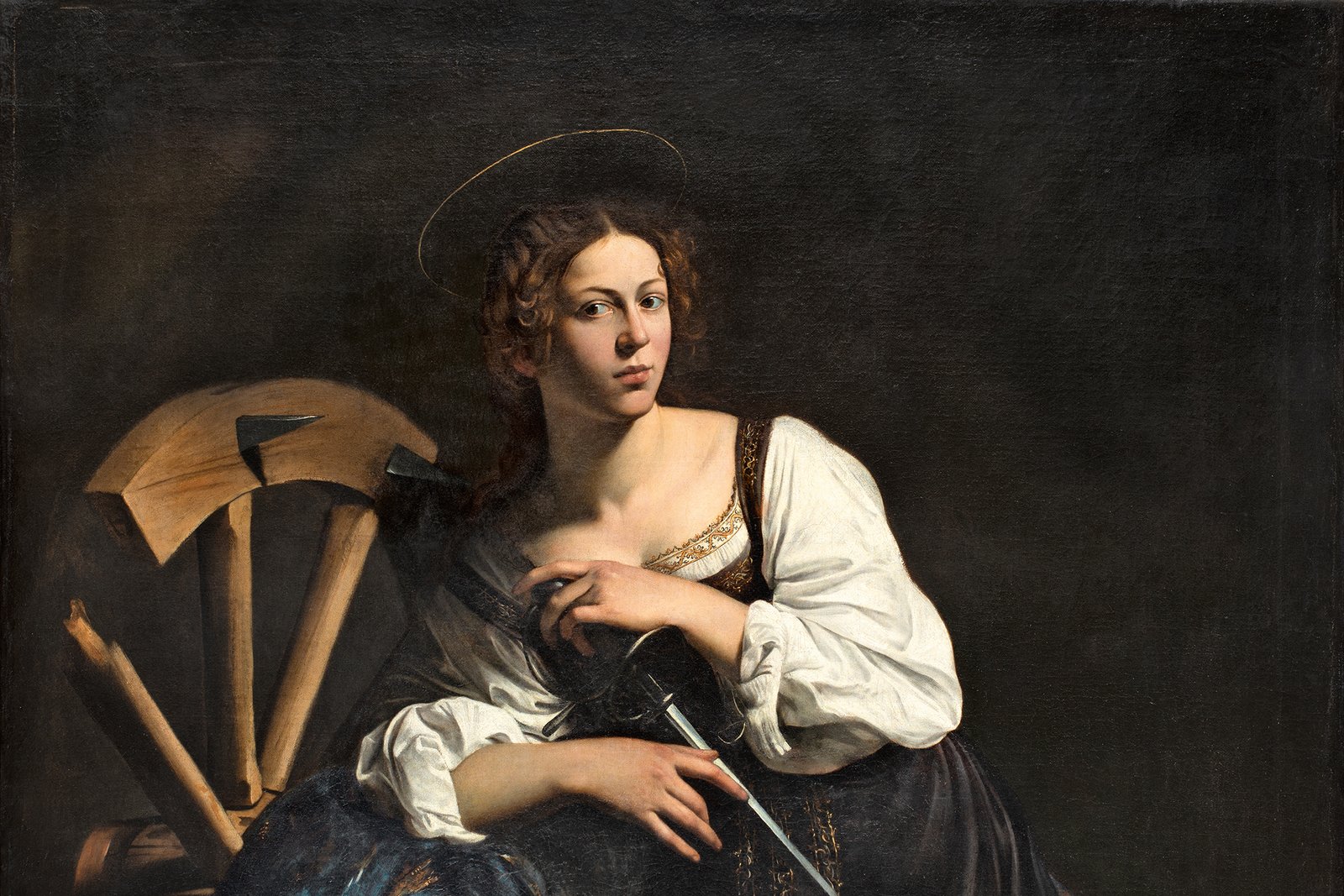
Caravaggio, Saint Catherine of Alexandria, 1598–99, Museo Thyssen-Bornemisza, CC0.
This uncertainty led the Catholic Church to remove her feast from the mandatory universal liturgical calendar during the 1969 calendar reforms that followed the Second Vatican Council, a reform that similarly affected several other saints whose historical basis had come to be regarded as insufficiently documented. Her enduring and widespread popular devotion, however, led to her feast being restored to the calendar as an optional memorial in 2002, a recognition that, whatever the uncertainties surrounding the historical details, her veneration has shaped Christian devotional life for well over a thousand years and continues to hold genuine significance for many believers today.
A noblewoman of exceptional learning
According to the traditional account, Catherine was born to a noble, possibly royal, family in Alexandria, Egypt, then one of the great intellectual centers of the ancient Mediterranean world, home to its famous library and a long tradition of philosophical and scientific learning. The legend describes her as extraordinarily well educated from a young age, versed in philosophy, rhetoric, and the sciences to a degree that would have been unusual for anyone in the ancient world, let alone a young woman, and as having converted to Christianity through a combination of study and, in some versions of the story, mystical vision.
Her renowned learning and firm Christian conviction set the stage for the story's central conflict, which unfolds during the reign of the Roman emperor most versions of the legend identify as Maxentius, who ruled the western portion of the Roman Empire in the early fourth century, a period marked by intermittent but often severe persecution of Christians before Constantine's later edict of toleration reshaped the empire's relationship with the faith entirely.
The debate that converted her would-be judges
The best-known episode of Catherine's legend describes her direct confrontation with imperial authority over the persecution of Alexandria's Christian community. According to the story, Catherine approached the emperor to protest his treatment of Christians, and, in response, he assembled fifty of the empire's most accomplished pagan philosophers and orators, intending to have them publicly refute her faith through superior argument and thereby humiliate and silence her.
The legend describes the reverse outcome: Catherine's answers to the philosophers' arguments proved so compelling that all fifty were converted to Christianity by the end of the debate, a reversal that enraged the emperor, who had earlier promised the philosophers safety regardless of the debate's outcome but nonetheless had them executed for their conversion. The emperor, according to the story, then turned his attention directly to Catherine herself, first attempting to persuade her to abandon Christianity and marry him, an offer she refused, reportedly on the grounds that she considered herself already spiritually wedded to Christ, before resorting to imprisonment and, eventually, execution.
The breaking wheel and its lasting symbolism
The most visually striking element of Catherine's legend, and the detail most responsible for her enduring recognizability in Christian art, concerns the method chosen for her execution. According to the story, the emperor ordered her tortured and killed using a breaking wheel, a device fitted with sharp spikes designed to inflict a prolonged and agonizing death by dismemberment as the victim's body was broken across it. Tradition holds that the wheel miraculously shattered the instant Catherine touched it, sparing her from that particular torment, though the legend concludes with her subsequent beheading by sword shortly afterward.
The broken spiked wheel became Catherine's standard iconographic attribute in medieval and Renaissance Christian art, appearing alongside her in countless paintings, sculptures, and stained glass windows across Europe, and it left its mark on language and culture well beyond religious art: the spinning firework still known today as a "Catherine wheel" takes its name directly from the device associated with her martyrdom.
Mount Sinai and a devotion that spread across Europe
Tradition holds that angels transported Catherine's body after her death to Mount Sinai, the same mountain associated in the Old Testament with Moses receiving the Ten Commandments, and a monastery bearing her name, Saint Catherine's Monastery, still stands at the foot of the mountain today, one of the oldest continuously inhabited Christian monasteries in the world and a significant site of pilgrimage since at least the early medieval period.
From this Sinai connection, devotion to Catherine spread rapidly across medieval Europe, particularly following the Crusades, and she became one of the most widely venerated female saints of the entire medieval period, invoked as a patron of philosophers, scholars, students, and unmarried women, a set of patronages drawn directly from her legendary learning and her steadfast refusal of the emperor's marriage proposal, as well as of wheelwrights and other craftspeople whose trades connected to the wheel of her martyrdom. Her feast day, celebrated on November 25, remains an occasion of genuine devotion in many Catholic and Orthodox communities today, honoring a figure whose historical outlines remain genuinely uncertain but whose symbolic power, as an emblem of intellectual courage joined to unwavering faith, has proven remarkably durable across seventeen centuries of Christian memory.
Trivia
Who was Saint Catherine of Alexandria?
What is the legend of Catherine debating fifty philosophers?
What is the breaking wheel, and what does it have to do with Catherine's martyrdom?
Why is there historical doubt about Saint Catherine's existence?
What is Saint Catherine of Alexandria the patron saint of, and when is her feast day?
You May Also Like
Related Reading