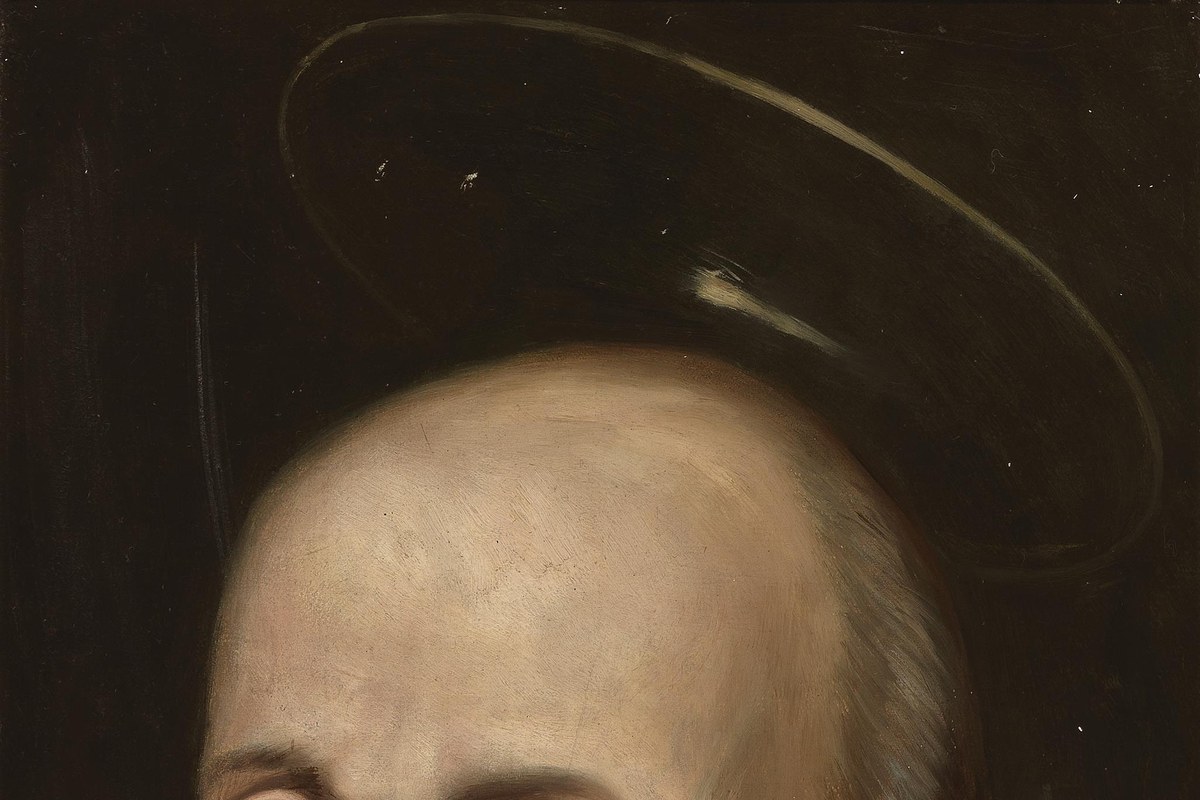
Saint Edmund of Abingdon

An early Oxford Aristotelian
Edmund was born around 1174 in Abingdon, near Oxford, and pursued an academic career that placed him at the genuine leading edge of English intellectual life in his generation. He studied at Oxford and Paris, and is credited as among the first masters to teach Aristotle's logical works — recently recovered and translated into Latin, and only beginning to reshape European university education — as part of the Oxford curriculum, well before Aristotelian logic became the standard, expected foundation of university teaching it would become later in the thirteenth century. This academic distinction gave Edmund a genuine scholarly reputation independent of any Church office, unusual grounding for a man who would later rise to the most senior position in the English Church.

Nuremberg Chronicle, woodcut portrait of Edmund, Archbishop of Canterbury, 1493 — public domain.
He was eventually ordained and moved from purely academic work into ecclesiastical administration, serving as treasurer of Salisbury Cathedral before his election, somewhat unexpectedly, as Archbishop of Canterbury in 1233, confirmed and consecrated in 1234. The appointment followed a difficult vacancy in which earlier candidates had been rejected, and Edmund arrived at Canterbury already known more as a scholar and preacher than as an experienced administrator of a major diocese — a background that would shape both his strengths and the difficulties that followed.
A king determined to control the Church
Edmund's archbishopric coincided with a period of sustained royal pressure on Church appointments under King Henry III, a pattern that had already produced serious conflict for earlier Archbishops of Canterbury — most famously Saint Thomas Becket, whose own conflict with the crown over similar issues had ended in his murder decades before. Henry III consistently favored royal candidates and royal relatives for bishoprics, abbacies, and other Church positions across England, over the objections of cathedral chapters attempting to exercise their canonical right to free election, and Edmund, drawing on both his own principled convictions and the precedent of earlier archbishops' resistance, pushed back against this pattern throughout his time at Canterbury.
The conflict was sustained and genuinely wearing rather than resolving in any single dramatic confrontation. Edmund found himself repeatedly at odds with the king over specific appointments and over the broader question of how much control the crown could legitimately exercise over Church governance — a dispute with deep roots stretching back through English history and one that would continue to resurface for generations after Edmund's own death.
Withdrawal, exile, and death
Worn down by years of this unresolved tension, and increasingly at odds with elements of his own cathedral chapter as well as the crown, Edmund eventually withdrew from active governance of his archdiocese and traveled to France, taking up residence at the Cistercian abbey of Pontigny, in Burgundy — a site that already carried real symbolic weight for exiled Archbishops of Canterbury, having previously sheltered both Thomas Becket and Stephen Langton during their own periods of conflict with the English crown decades earlier. Edmund's own withdrawal there placed him within a specific, recognized pattern of Canterbury archbishops choosing exile at Pontigny over continued confrontation at home.
He died not long after, in 1240, at Soisy near Provins in France, without ever returning to England or to the see he had led for roughly six difficult years. He was buried at Pontigny, and his tomb there became a site of pilgrimage in the years following his death, extending the abbey's already established connection to exiled English archbishops into a third generation of veneration.
A scholar's spiritual writing alongside administration
Beyond his academic and administrative career, Edmund also produced spiritual writing that circulated well beyond his own lifetime, most notably a devotional treatise known as the Speculum Ecclesiae or Mirror of the Church, offering guidance on prayer and the spiritual life intended for a general audience rather than purely academic readers. The work was translated and adapted into several vernacular versions in the centuries after his death, evidence that Edmund's reputation rested on more than his administrative conflicts with Henry III alone — he was remembered by later generations as a genuine spiritual teacher as well as a churchman who had resisted royal overreach, a combination that helps explain the relative speed of his canonization.
A fast canonization and a lasting feast
Edmund was canonized in 1246, just six years after his death — a notably swift process by medieval standards, reflecting both the strength of his personal reputation for scholarship and holiness and the sympathy his sustained conflict with royal overreach had generated within the wider Church. His feast is kept on November 16. Among the several medieval Archbishops of Canterbury whose tenures were defined by conflict with the English crown over the proper limits of royal authority in Church affairs, Edmund's story is a quieter one than Becket's — no dramatic murder, no single decisive confrontation — but it reflects the same underlying and recurring struggle, worn down over years rather than resolved in a single moment, that shaped English Church-state relations across much of the medieval period.
Trivia
Who was Saint Edmund of Abingdon?
What was Edmund's academic career before he became archbishop?
Why did Edmund conflict with King Henry III?
What connection does Edmund have to Pontigny Abbey?
When is Saint Edmund's feast day?
You May Also Like
Related Reading