Saint Gertrude of Nivelles

Born into the family that ran the kingdom
Gertrude was born around 626 into a family that stood near the very top of Frankish political power. Her father, Pepin of Landen, held the office of mayor of the palace under the Merovingian kings — a position that, especially in this period, often carried more real governing authority than the kingship itself, and which would eventually, through Pepin's descendants, evolve into the Carolingian dynasty that produced Charlemagne. Her mother, Itta, came from a comparably prominent noble background. A daughter of this household was, by any conventional expectation of the era, destined for a politically significant marriage.
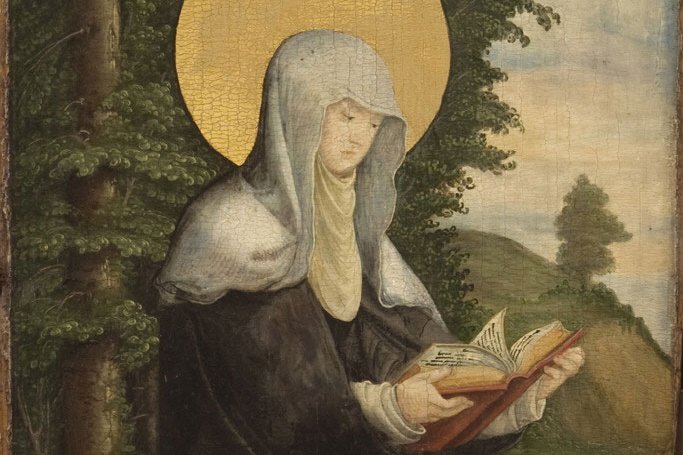
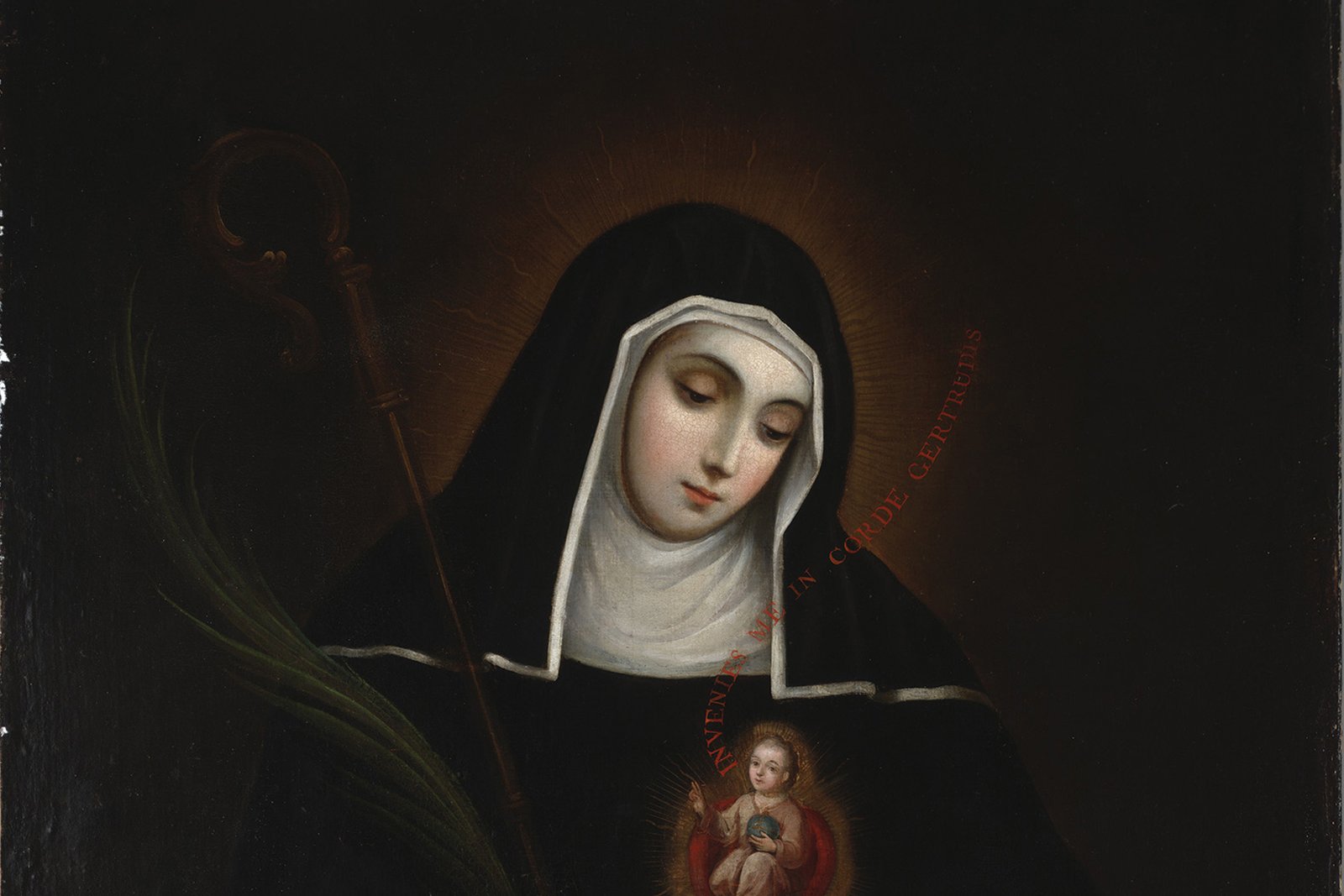
Anonymous Flemish painter, portrait of Saint Gertrude of Nivelles, c. 1530 — public domain.
Gertrude apparently had other plans from a young age. The most frequently repeated episode from her early life describes a suitor's formal marriage proposal, delivered in the presence of King Dagobert I himself — about as public and consequential a setting as a marriage negotiation could take place in. According to the traditional account, Gertrude refused outright, declaring that she would take neither this particular suitor nor any earthly husband, having already resolved to give her life entirely to religious service.
A convent built around a daughter's vocation
Rather than opposing her daughter's decision, Itta supported it directly and practically: after Pepin's death around 640, she founded a monastery at Nivelles, in what is now Belgium, specifically to provide a home for Gertrude's vocation and for other women (and, since Nivelles operated as a double monastery, men as well) drawn to religious life. Gertrude, still only in her early teens, became its first abbess, with her mother Itta continuing to guide and support the young community during its earliest and most vulnerable years.
Nivelles grew under Gertrude's leadership into a significant center of religious life and learning, maintaining close ties with the wider network of Frankish and Irish-influenced monasticism that was spreading rapidly across the region during this period — Nivelles is recorded as having welcomed Irish monks and maintained connections to figures within the broader missionary tradition associated with Saint Columban, whose influence shaped monastic life across Francia in the generation just before Gertrude's own.
Austerity, decline, and early retirement
Gertrude's governance of Nivelles was marked, according to contemporary and near-contemporary accounts, by a personal austerity that went well beyond what was strictly required of her position — extended fasting, minimal food, and a demanding schedule of prayer and study that reportedly undermined her physical health over time. By her mid-twenties, her health had deteriorated enough that she chose to step down from active governance of the monastery, handing leadership to her niece Wulfetrude while she herself withdrew into a more purely contemplative life, dedicating her remaining years to prayer, biblical study, and preparation for death rather than the administrative demands of running a large religious community.
She died in 659, still relatively young, having spent barely two decades as abbess but having established Nivelles firmly enough that it continued to flourish for centuries after her death, eventually becoming one of the notable religious houses of the medieval Low Countries.
The Pippinid family's stake in Nivelles
Gertrude's family background is worth dwelling on a little further, because Nivelles was never simply a private religious retreat — it was, from the start, bound up with the political fortunes of one of the most consequential families in early medieval European history. Pepin of Landen is generally regarded by historians as the founding figure of the Pippinid dynasty, the family line that would, within a century of Gertrude's death, produce Pepin the Short and then Charlemagne himself, transforming the office of mayor of the palace into outright Frankish kingship. A monastery founded and led by members of this family functioned, in practice, as both a genuine spiritual community and a dynastic institution — a place where the family's wealth, influence, and claim to religious legitimacy were reinforced generation after generation. Gertrude's own brother, Grimoald, went on to serve as mayor of the palace in his turn, and her family's continued involvement in governing Francia helped ensure that Nivelles retained royal favor and protection long after her own death.
A traveler's saint
Among Gertrude's most distinctive later associations is her connection to travelers, particularly the custom, recorded in parts of the medieval Low Countries and Rhineland, of asking for "Saint Gertrude's cup" — a final drink or blessing before setting out on a journey, and of offering prayers to her for a safe first night's lodging away from home. This tradition, along with her patronage against rodents, likely grew from the coincidence of her March feast falling near the traditional start of the agricultural and travel season in northern Europe, when roads became passable again after winter and farmers turned their attention to planting — practical seasonal concerns that medieval popular piety often attached to a nearby saint's day regardless of anything in that saint's own biography. The association proved durable: Gertrude remained one of the most widely invoked patrons for travelers and pilgrims across the German-speaking and Low Countries region well into the later Middle Ages.
Feast day and later devotion
Gertrude's feast is kept on March 17. Devotion to her spread widely across the medieval Low Countries, Germany, and beyond in the centuries following her death, and she became associated in popular tradition with protection for travelers and, somewhat later, with protection against mice and rats — an association whose precise origins are debated but which is generally linked to the timing of her feast day near the start of the agricultural planting season in parts of northern Europe, rather than to any specific episode from her own life.
In art, she is typically shown as a young abbess in religious habit, often holding a small model of a church or a crozier as symbols of her founding and governing role at Nivelles, sometimes accompanied by mice — a reference to her later-developed patronage. Readers interested in the broader network of powerful Frankish noblewomen who shaped early medieval monastic life may also want to read about Saint Columban, whose Irish-influenced missionary tradition helped form the wider monastic world Nivelles belonged to, or explore how double monasteries like Gertrude's compared to similar Anglo-Saxon foundations governed by royal abbesses across the Channel during roughly the same period.
Trivia
Who was Saint Gertrude of Nivelles?
Why did Saint Gertrude refuse to marry?
What is a 'double monastery,' and why does it matter for Gertrude's story?
Why is Saint Gertrude associated with cats and mice?
When is the feast of Saint Gertrude of Nivelles?
You May Also Like
Related Reading