Saint Walburga, the Abbess and Her Healing Oil

An English family that evangelized Germany together
Walburga was born around 710 in the Kingdom of Wessex, in what is now southern England, into a family that would produce an unusually concentrated cluster of missionary saints. Her father, Saint Richard the Pilgrim, died on pilgrimage to Rome; her brothers, Saint Willibald and Saint Winibald, both became missionaries and monastic founders in Germany; and her uncle was Saint Boniface, the English-born bishop whose decades of missionary work among the Germanic peoples earned him the title "Apostle of the Germans" and who stands as one of the most consequential figures in the Christianization of early medieval Europe.
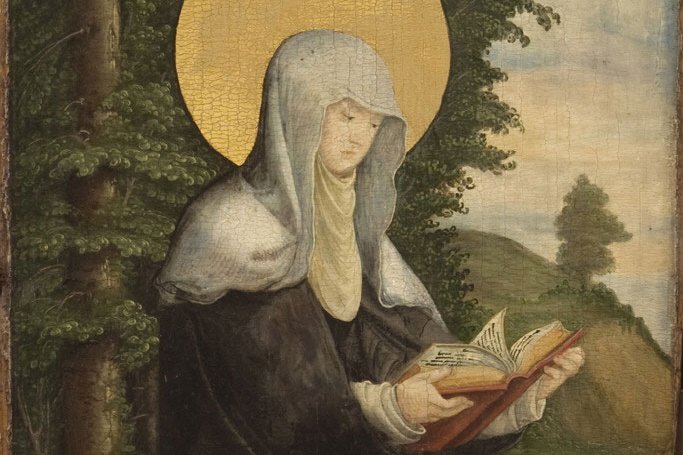
Master of Meßkirch, "Heilige Walburga," c. 1535-40 — public domain (Wikimedia Commons).
Walburga herself was educated at Wimborne Abbey, a double monastery in Dorset known for training women who went on to lead religious communities of their own — a detail worth noting because it shaped what she was equipped to do once she reached the European mainland. Around 748, at Boniface's request, she crossed to what is now Germany to join the wider missionary effort her family had already committed itself to, part of a larger wave of English monks and nuns Boniface actively recruited to help staff and stabilize the new monastic foundations supporting his mission.
Governing monks and nuns together at Heidenheim
Walburga's brother Winibald founded a double monastery — a single institution housing separate communities of monks and nuns under unified leadership — at Heidenheim, in Bavaria, and after his death in 761, Walburga succeeded him as its head. This is a significant and somewhat unusual detail in her story: for roughly the next eighteen years, until her own death in 779, Walburga governed not only the community of nuns at Heidenheim but the monks as well, a degree of formal authority over male religious communities that few women held anywhere in the eighth-century Church.
Double monasteries were not unique to Heidenheim — several existed across Anglo-Saxon England and on the continent during this period, often led by abbesses of considerable standing, following a pattern with roots partly in the earlier English monastic tradition Walburga herself had been trained in at Wimborne. Even so, her role at Heidenheim reflects real trust placed in her by the wider Bonifatian missionary network, and it placed her at the center of a monastery that functioned as both a spiritual and a practical hub for the ongoing Christianization of the surrounding Bavarian countryside — training clergy, copying manuscripts, and anchoring Christian practice in a region where it was still comparatively new.
Death, and a second story that began afterward
Walburga died at Heidenheim on February 25, 779. That date remains her traditional feast day, marking the anniversary of her death in the way the Church has long commemorated most saints. But Walburga's story, unusually, did not end with her burial — it entered a second, quite different chapter roughly ninety years later.
Around 870, her relics were translated (formally moved, with ceremony) to Eichstätt, where a convent had been established in her honor. It was at this new resting place that the detail most associated with her name today began: a rock formation near her relics started to produce a clear liquid, which the faithful gathered and came to venerate as possessing healing properties, attributing the phenomenon to her intercession. This liquid, still referred to as "Walburga's oil," continues to be collected today by the Benedictine sisters of the Abbey of Saint Walburga in Eichstätt, primarily during the months between October 12 and February 25 each year, and it is sent, on request, to the sick around the world who seek it.
It's important to be clear about how the Church treats this phenomenon: it has never been the subject of a formal dogmatic declaration, positive or negative, and it belongs to the category of long-venerated pious tradition rather than defined Catholic teaching. What can be said with more confidence is the historical continuity itself — this practice has been documented at Eichstätt for many centuries, making it one of the longest continuously observed devotional customs connected to any single saint's relics anywhere in the Church.
The strange second life of her feast day
Walburga's other, far more widely recognized association today has nothing to do with anything she did during her lifetime, and it's worth untangling clearly rather than letting the two stories blur together. Walpurgisnacht — "Walpurgis Night," the eve of May 1 — takes its name from Walburga because her canonization, in the ninth century, happened to be formally observed on that date in parts of the Church calendar, a date that in Germany came to be associated with her feast alongside the more traditional February 25 commemoration of her death.
May 1, however, already carried deep significance in pre-Christian Northern European seasonal tradition, marking the arrival of spring and, in later centuries, becoming associated in German folklore with witches' gatherings on the Brocken, the highest peak in the Harz mountains — a body of folklore that developed independently over centuries and simply attached itself, by calendar coincidence, to the same date already linked to Walburga's name. None of this folklore derives from anything in her actual biography as a Benedictine missionary and abbess; it is a case, similar in structure to how Saint Corona's name became linked by pure coincidence to an unrelated modern subject, of a saint's name becoming attached to something that developed for entirely separate historical reasons.
Why her story still holds together
What makes Walburga worth remembering isn't really the oil, striking as that tradition is, or the folklore that borrowed her feast day for unrelated purposes. It's the substance of her actual life: an Englishwoman, trained in one of the more academically serious monastic environments available to women of her century, who crossed the sea at her family's call and ended up responsible for an entire religious community — men and women both — in a country that was still actively becoming Christian around her. Her brothers Willibald and Winibald are remembered as founders and bishops; Walburga is remembered as the one who kept their foundation running for nearly two decades after Winibald's death, with enough evident competence and holiness that the community she led kept her memory — and eventually her relics — at the center of its devotion for the next twelve centuries.
Trivia
Who was Saint Walburga?
Why is Walburga associated with a healing oil?
Was Saint Walburga really an abbess who governed monks?
Is Walpurgisnacht connected to Saint Walburga's actual life?
What is Saint Walburga's feast day?
You May Also Like
Related Reading