Saint Gertrude the Great, Mystic of the Sacred Heart

Raised inside the cloister from childhood
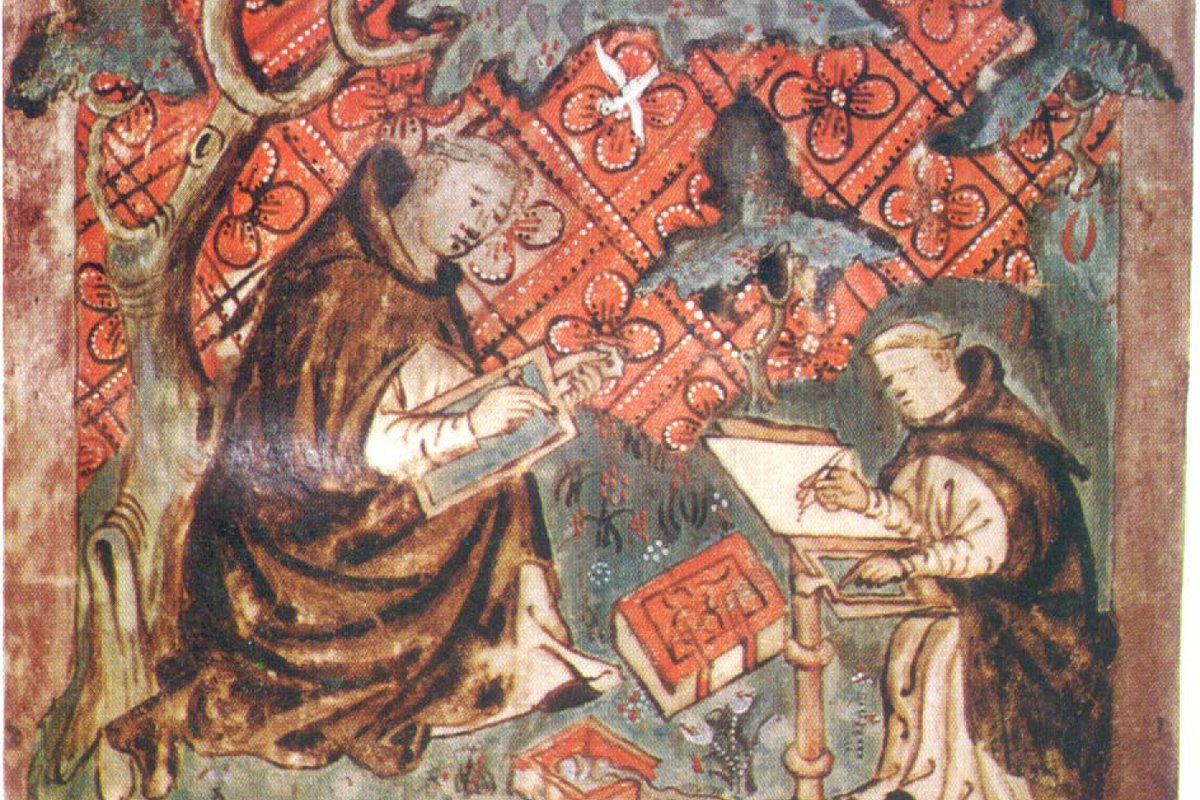
Gertrude's early life is unusually undocumented for a saint of her later stature — almost nothing is recorded about her family, birthplace, or background before she arrived at the Cistercian monastery of Helfta, in what is now Germany, at around five years old in 1261. She wasn't sent there as a novice choosing religious life; she was, by the custom of the period, placed there as a child oblate, to be raised and educated by the nuns.
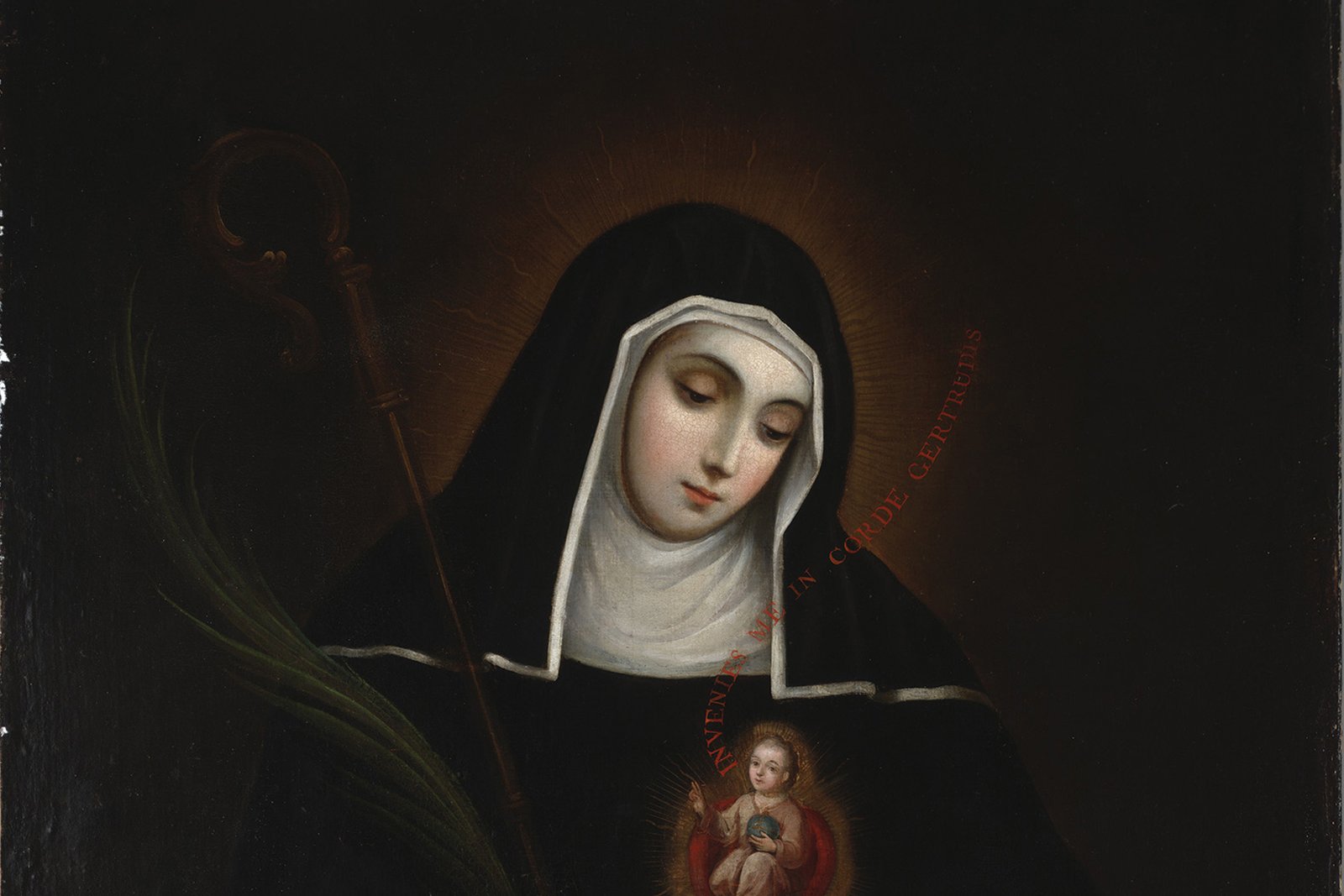
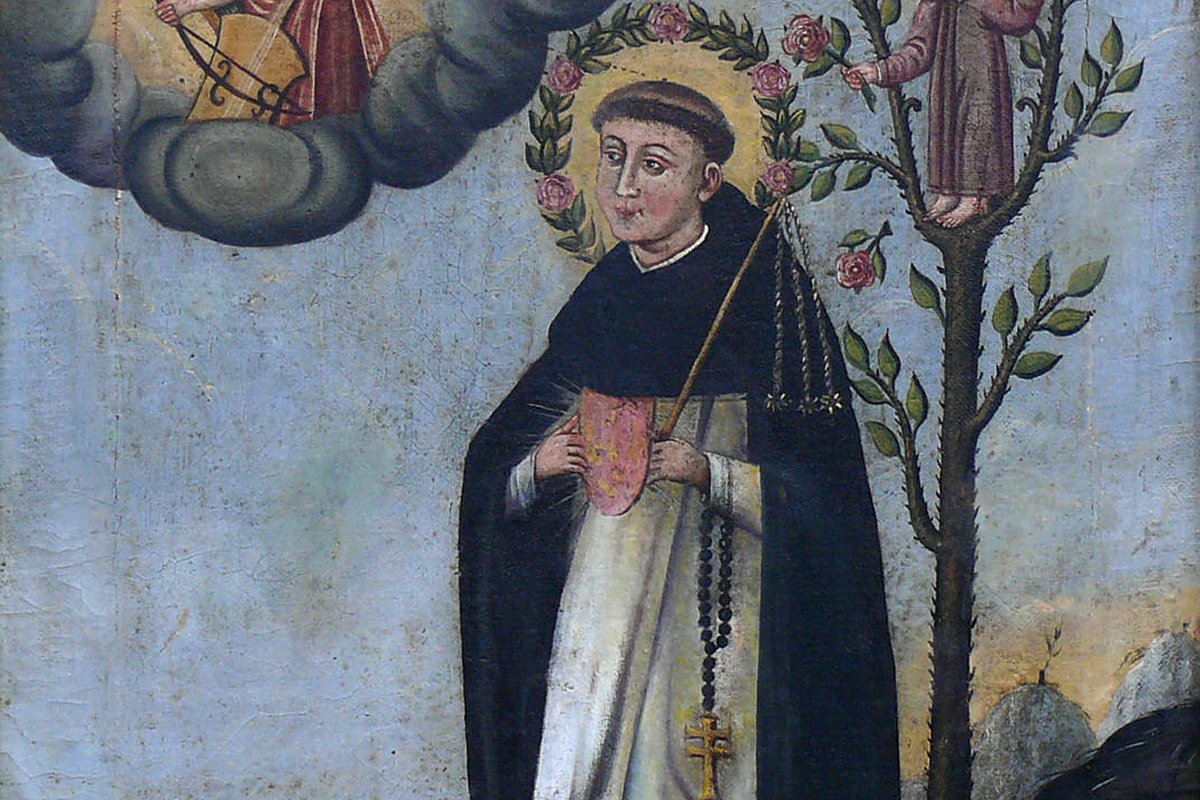
Miguel Cabrera, "Santa Gertrudis," 1763. Public domain (Wikimedia Commons).
Helfta at the time was an unusually rich intellectual and spiritual environment for women religious, home to several other notable mystics of the era, including Mechtild of Hackeborn and Mechtild of Magdeburg. Gertrude excelled there as a student in the classical sense — grammar, rhetoric, philosophy, the liberal arts of medieval education — and by her own later account, spent roughly the first two decades of her life at the monastery immersed primarily in secular learning rather than deep contemplative prayer.
That intellectual formation wasn't wasted time, even by her own later reckoning. The training in careful reading, Latin composition, and theological argument she absorbed as a young scholar gave her, once her spiritual life deepened, the tools to record her visions with a precision and literary sophistication rare among medieval mystics — many of whom depended entirely on scribes to translate an inner experience into readable prose. Gertrude could largely do that work herself, which is part of why her writings read with such distinctive clarity and structure compared to other visionary texts of the period.
A vision that reordered her priorities
That changed, by her own written testimony, in January 1281, when Gertrude was about twenty-five. She describes an encounter with Christ — appearing to her as a young man taking her by the hand — that she experienced as a direct and personal calling away from the academic focus that had defined her life until then. In the account preserved in her writings, she describes her prior scholarly pursuits, once her primary passion, suddenly feeling like "vanity of vanities" against the depth of what she had just experienced.
From that point forward, Gertrude's intellectual gifts didn't disappear — they redirected entirely toward scripture, theology, and the careful, sustained recording of her ongoing mystical experiences. This is a distinction worth being precise about: what follows in Gertrude's life belongs to the realm of private revelation and personal mystical experience, a category the Church treats with real seriousness but distinct from the public revelation contained in scripture and defined dogma. The Church has never required belief in the specific content of any private revelation, including Gertrude's, even while long venerating her as a genuine and holy mystic.
The Herald of Divine Love
Gertrude's visions and theological reflections were eventually compiled into a work known as the Herald of Divine Love (Legatus Divinae Pietatis), a text produced partly in her own hand and partly by other nuns at Helfta working from her accounts and notes — a common way mystical writings were preserved in women's monastic communities of the period, since not every visionary nun had the freedom or resources to compile a finished manuscript entirely alone.
The work is centered heavily on themes of divine love, intimate union with Christ, and — significantly for later Catholic devotional history — vivid imagery involving the heart of Jesus as a symbol of his boundless love for humanity. In one frequently cited passage, Gertrude describes resting her head near Christ's heart and hearing its beat, an image of intimacy that later Sacred Heart devotion would build on extensively, translating a private mystical experience into a devotional practice meant for the whole Church.
Historians of Christian spirituality generally regard Gertrude's writings as among the most important early sources feeding into what would become, several centuries later, the much more widely known and formally promoted devotion to the Sacred Heart of Jesus, associated in its later form especially with the seventeenth-century visions of Saint Margaret Mary Alacoque. The four-century gap between Gertrude's private revelations and the Sacred Heart devotion's full public promotion illustrates something important about how mystical experience moves through Church history: an individual nun's vision, recorded and preserved by her community, can quietly shape theology and popular piety for generations before the wider Church formally embraces and promotes what it points toward.
Why "the Great"
Gertrude is one of only a small number of women in Church history given the honorific "the Great" — a title distinguishing her from the earlier Saint Gertrude of Nivelles, a seventh-century abbess, but also reflecting the outsized influence her writings had on later Catholic spirituality. She was never processed through a formal canonization in the modern juridical sense; instead, her long-standing popular veneration was formally confirmed and extended to the universal Church by Pope Clement XII in 1738, a route to sainthood not uncommon for figures from earlier centuries of Church history.
Her feast day is kept on November 16. She remains a significant figure not just for the content of her visions but for what her life represents more broadly: a woman raised almost entirely within the walls of a single monastery, whose private interior life, carefully written down by herself and her sisters in religion, went on to shape how millions of Catholics centuries later would come to understand and pray toward the heart of Christ.
Trivia
Who was Saint Gertrude the Great?
Why is she called Gertrude 'the Great'?
What happened to Gertrude at age 25 that changed the direction of her life?
What is the Herald of Divine Love?
When is Saint Gertrude the Great's feast day?
You May Also Like
Related Reading